My boyfriend slapped a homeless man on the sidewalk to “teach him a lesson” in front of me… He had no idea the man crossing the street from the restaurant was the billionaire whose signature was on his paycheck.
Everyone on the sidewalk thought they were watching my boyfriend humiliate a homeless man. None of them knew who was crossing the street toward him.
I’d been dating Brad for eight months. Long enough to know which side of him he brought out in public.
He worked at a private equity firm in midtown — one of those places where every associate under thirty-five drove a car their base salary shouldn’t have afforded. His uncle was a managing partner. Brad liked to remind me of that.
I only mention it because it mattered later.
We were walking back to his car from Vincenzo’s, the Italian place on Fifty-Second. He’d picked it because his firm’s biggest client ate there every Thursday. Brad liked to be seen. He hadn’t been seen that night. He was frustrated. I’d said the wrong thing about the wine, and he’d been picking at me for ten minutes.
“You ever notice you get smug when you drink?” he said.
“You ever notice you only call me smug when I’m right?” I said.
He laughed. The laugh had no sound in it.
That was when he saw the man sitting on the curb.
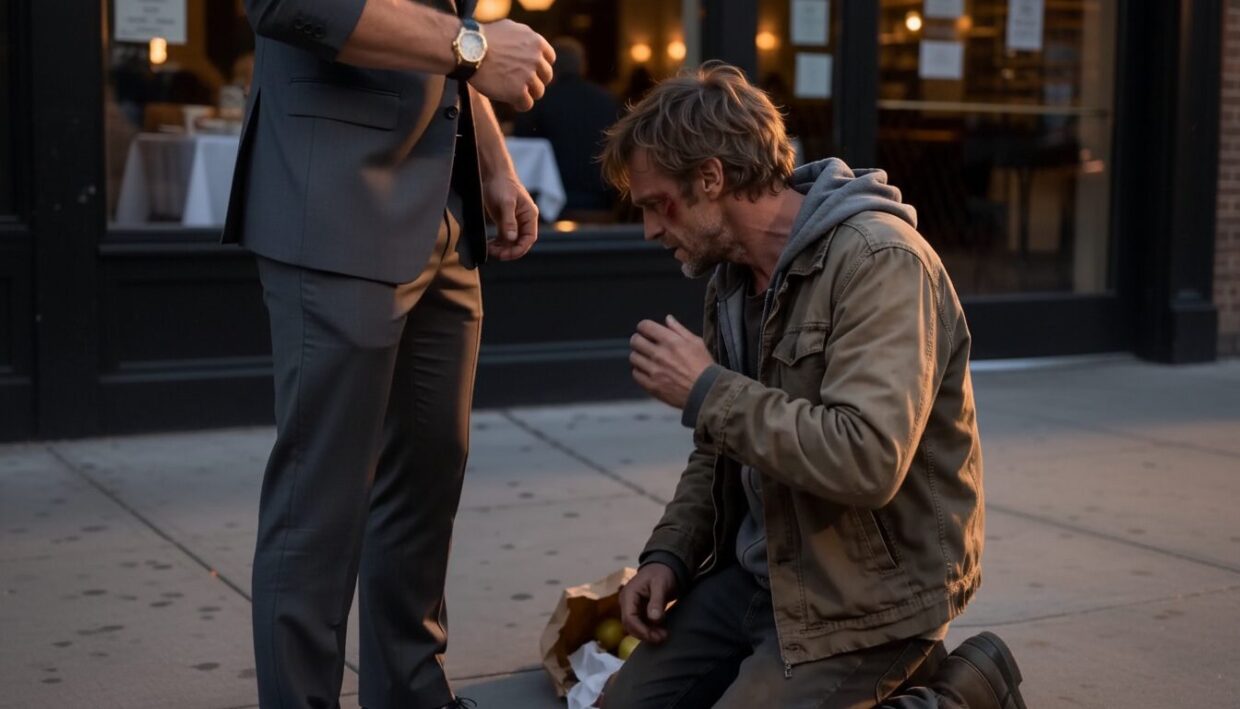
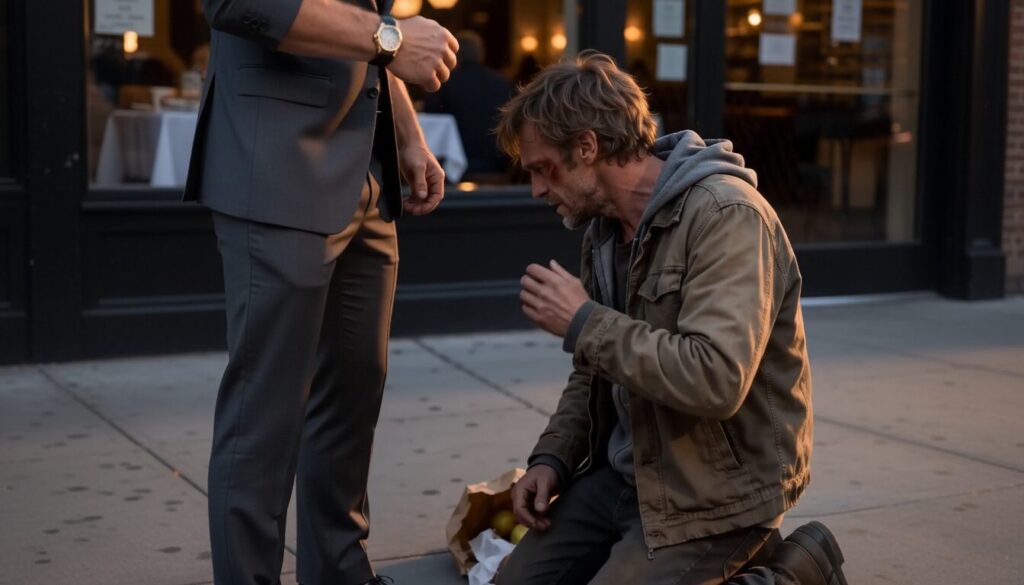
He was maybe forty-five. Weathered face, a faded olive jacket that had seen a lot of winters, a brown paper grocery bag on the pavement beside him. He wasn’t panhandling. He wasn’t looking at us. He was eating a piece of bread out of the bag like he was trying to make it last.
Brad stopped.
“Look at this,” he said.
“Brad. Just walk.”
“No, look at this. Middle of the sidewalk. Middle of a Thursday.”
He walked up to the man. The man’s eyes flicked up and went back down to his bread.
“Hey. Buddy.”
The man didn’t answer.
“Buddy. I’m talking to you. You see all these people walking past you and you don’t feel any shame?”
I caught his sleeve. “Brad. Please.”
He shook me off. I didn’t even recognize the face he made.
“Stop begging and get a job,” he said.
And he slapped him.
It wasn’t a hard slap. It didn’t need to be. The sound of it carried across the sidewalk like something small breaking that couldn’t be put back together.
The man didn’t drop the bread. He lifted his free hand to his cheek.
“…I just wanted something to eat,” he said.
It was the softest voice I’d ever heard from a grown man.
Brad opened his mouth to say something else. Something about how people like that were a disease on the city. I know, because he’d said it to me before, in bed, laughing, like it was funny.
He didn’t get to say it.
Because that was when I looked past him. And I saw the man crossing the street.
He was older. Late fifties. Silver hair, swept back, the kind of haircut that cost more than my rent. A long charcoal overcoat, unbuttoned, over a navy suit. One hand in his coat pocket. His eyes were locked on Brad.
He walked like he had all the time in the world.
I recognized him before Brad did. I’d seen him on the cover of a business magazine in my dentist’s waiting room two months earlier. I’d read the whole article because I was bored and the dentist was running late.
Edward Vance. Vance Industries. The man who owned more of this country’s industrial heartland than most people realized.
The article had mentioned that Vance Industries was the single largest investor in three private equity funds.
One of them was Whitman-Kohler Capital.
Brad’s firm.
Brad hadn’t turned around yet. He was still mid-sentence.
Edward stopped about three feet behind him. He didn’t raise his voice. He didn’t have to.
“You picked the wrong person,” Edward said.
Brad turned.
I watched his face do the math. The recognition didn’t come all at once. It came in stages, like a loading bar. The overcoat. The haircut. The posture. The face. Then the name. Then what the name meant.
By the time Brad got to what it meant, all the color had left his face.
“Mr. Vance.”
“Mr. Whitman.” Edward’s voice was almost pleasant. “I believe you work for my friend Tom.”
“Sir, I — I was just—”
“That’s my brother,” Edward said.
He said it the way you’d tell someone the time. Like a fact that had just become relevant.
He stepped around Brad without touching him, walked past us, crouched down in front of the man on the curb, and put a hand on his shoulder.
“Danny. You okay?”
The man nodded. He didn’t look at Brad.
Edward helped him stand. His movements were slow, patient, practiced — like he had done it many times. He picked up the grocery bag. He brushed off Danny’s jacket.
“Let’s go inside,” he said. “Michael’s holding our table. Your soup’s going cold.”
Danny nodded again. He glanced at me, briefly. His eyes were steady. He did not look like a man who had just been slapped. He looked like a man who had been slapped before, and knew it would pass.
Edward turned back to Brad.
“You’ll want to stay right here,” he said. “I have one phone call to make. Then someone else will be joining us.”
Brad started talking. I have never, in my life, heard a grown man talk that fast. He was saying he hadn’t known. He was saying it was a misunderstanding. He was saying he’d had a bad day. He was apologizing to the sidewalk, to the street, to Edward’s overcoat, to the valet across the way who was staring at us with his mouth open.
Edward wasn’t listening. He was pulling out his phone.
“Tom,” he said into it, after a moment. “It’s Edward. I need you to come outside. I’m in front of Vincenzo’s. Your nephew just put his hand on my brother on the sidewalk. I’ll wait.”
He listened.
“No, Tom. I’ll wait. Right now.”
He hung up.
Brad was shaking. Actually shaking. I had never seen a grown man do that outside of a movie.
“Megan.” He turned to me. “Megan, tell him. Tell him I didn’t — tell him it wasn’t like that—”
I looked at him. I mean, I really looked at him. The way you look at a person you’ve been pretending not to see clearly for eight months.
“I’m not telling him anything,” I said.
He opened his mouth again, and then he closed it, because he was a smart enough kid to know there was nothing he could say that wouldn’t make it worse.
Tom Whitman came around the corner a minute later. Short, red-faced man in a blazer, moving fast. He saw Edward first. Then his nephew. Then Danny, who was standing quietly by the restaurant door now, one hand still on his cheek.
Tom stopped in front of Edward. “Edward. Jesus. Is he—”
“He’s all right. No thanks to your nephew.”
Tom turned on Brad. His face changed. I hadn’t met Tom Whitman before, but I understood, in that moment, the difference between the men who had built something and the men who had been handed it.
“Tell me this is a misunderstanding,” Tom said.
“Uncle Tom, he was—”
“Tell me this is a misunderstanding, Bradley.”
“Uncle Tom, listen—”
“Badge. Give me your badge.”
Brad’s mouth opened.
“Give me your badge. Right now. On this sidewalk. In front of me.”
“I don’t have it on me, I—”
“Then your phone. Your work phone. Now.”
Brad dug into his inside pocket with shaking hands. He handed it over.
“You’re terminated effective immediately,” Tom said. “HR sends a letter in the morning. Do not come to the building. Do not email anyone at the firm. Do not contact a single client. Do you understand me?”
“Uncle Tom—”
“Do you understand me.”
“Yes.”
Tom turned back to Edward. “Edward. I’m so sorry. I’m so sorry. Whatever you need, whatever Danny needs—”
Edward put a hand on Tom’s shoulder. It was almost kind.
“Tom. It isn’t my decision what happens next.”
“What do you — oh.”
Tom turned. I turned. Brad turned.
Two police officers were walking up the sidewalk from the other direction.
I don’t know when Edward had called them. He hadn’t taken his phone out again. I think he might have called them before he’d even crossed the street. Before he’d spoken.
The older officer looked at Edward, then at Danny, then at Brad.
“Sir. We got a report of an assault at this location.”
“Yes, officer. My brother, Daniel Vance. Assaulted by this gentleman here.” Edward gestured at Brad. “Several witnesses, including his own girlfriend.”
The officer turned to me. “Ma’am?”
I was surprised by how steady my voice was when I answered.
“I saw him slap him,” I said. “Unprovoked. He said, ‘Stop begging and get a job,’ and then he hit him.”
Brad looked at me like I had shot him.
The officer nodded once. He turned to Brad. “Sir, turn around. Put your hands behind your back.”
Brad tried to say something. I don’t remember what. It didn’t matter.
They cuffed him right there, in front of the restaurant, in front of the valet who was still staring, in front of me. They read him his rights. Brad kept looking at me the whole time. I held his eyes. I didn’t owe him anything else.
“Megan,” he said, as they turned him to walk him to the cruiser. “Megan, come on.”
“Goodbye, Brad,” I said.
They put him in the back of the car. It pulled away. The valet went back to the stand. The sidewalk slowly became a sidewalk again.
I realized I was still holding Brad’s jacket — he’d handed it to me earlier, when he’d wanted his hands free to gesture. I didn’t know what to do with it. It felt heavier than it was.
Edward came over to me. Danny was behind him, the grocery bag back in his hand.
“I’m Edward,” he said. “This is my brother Daniel.”
“I know,” I said. “I mean — I know who you are. I’m Megan.”
“Megan.” He nodded, like the name was being filed somewhere specific. “I’m very sorry you had to see that.”
“I’m sorry he was there to do it.”
Daniel looked up at me. “You tried to stop him,” he said. His voice was still soft, but steady. “I heard you.”
I didn’t know what to say to that.
“Come inside,” Edward said. “Eat something. It’s been a hard night. You shouldn’t walk home on an empty stomach.”
“I don’t want to impose—”
“You’re not imposing. I’m asking.”
So I went inside.
Vincenzo’s was the kind of place where the menus had no prices. The maître d’ greeted Edward by name, and Daniel by name, and didn’t blink at me. Their table was in the back corner, set for two. They added a third chair. A bowl of minestrone appeared in front of Daniel. He ate it slowly, with both hands on the spoon.
Edward ordered me a glass of red wine and a pasta I didn’t have to think about. I don’t remember tasting it.
At some point I asked, “How long has Daniel — how long have you—” I didn’t know how to end the sentence.
Edward understood anyway.
“Six years,” he said. “Since he got back from his third tour. Combat medic. Special Forces. He saw things I’ll never see. He came back different. He doesn’t want to live with me. He doesn’t want the apartment I keep trying to move him into. He wants his studio on Fifty-Second, his market, his walks, his Thursday dinners here with his little brother. So that’s what he has.”
“He’s not homeless,” I said, stupidly.
“No. He’s my older brother. He was a medic in three wars.”
Daniel looked up from his soup. “Two and a half,” he said quietly. “The third one doesn’t count.”
Edward smiled at him. There was so much love in that smile it was embarrassing to witness. I looked down at my pasta.
After a while I said, “I’m going to go.”
Edward didn’t try to stop me. He gave me his card.
“If Brad tries to contact you, or his family tries to pressure you, or anyone from the firm reaches out — call this number. Not 911. This one. It goes to someone who handles my affairs.”
“Thank you.”
I stood up. Daniel stood up too. He didn’t shake my hand. He just nodded at me, the way a man nods at another person who has understood something difficult.
I left.
I called my roommate from the sidewalk. She came and got me. I sat in her passenger seat and didn’t cry, because the crying would have been for Brad, and Brad didn’t deserve any of it.
At home I texted him one line. We’re done. Do not contact me. Then I blocked him on everything.
In the morning I called my building’s super and asked him to change my locks. Brad had a key.
The rest happened fast, and most of it happened without me.
Brad was arraigned Friday. Simple assault. He pleaded not guilty. His bail was set at ten thousand dollars. His uncle did not post it.
Saturday, the city’s business blog ran the story. By name. Whitman-Kohler Capital issued a terse statement confirming Brad’s termination and condemning the assault. The statement did not mention Edward by name. It didn’t need to.
Monday, three of Whitman-Kohler’s other limited partners requested emergency calls with Tom. By end of day Tuesday, Vance Industries had formally pulled its allocation from the Whitman-Kohler flagship fund. That allocation was forty percent of their assets under management.
Wednesday, two more LPs followed.
Thursday — one week after the sidewalk, exactly — Whitman-Kohler’s senior partners called an emergency meeting. By Friday, the firm had announced a restructuring. By Monday, Tom Whitman had taken what was described in the press release as “an indefinite leave of absence.”
Brad, meanwhile, had taken a plea deal. Misdemeanor assault. Community service. A suspended sentence. No jail time.
He also got something permanent that no plea could fix.
In his industry — in that narrow, gossipy, reputationally paranoid industry — everyone knew his name, and everyone knew the story. No one would hire him. Not in private equity. Not in banking. Not in consulting. Not in any of the places his uncle’s network had reached, because that network had been set on fire.
He moved back in with his parents in Connecticut. I know this because my roommate’s cousin works in his father’s office, and told me six weeks later.
I don’t know what he’s doing now. I don’t really care.
I ran into Daniel once, about two months later. I was walking to the farmer’s market. He was walking the other way, with a grocery bag, exactly like the first time. I didn’t know if he’d remember me. I said hello anyway.
He stopped. He looked at me steadily.
“Megan,” he said. “The girl from Vincenzo’s.”
“Yes.”
“You all right now?”
I thought about the question.
“Yeah,” I said. “I really am.”
“Good,” he said. And he nodded once, and he walked on.
For a long time after Brad, I kept thinking I’d been too picky. Too sensitive. Too much. The whole catalog of things women are told they are when they notice something isn’t right. Six months of small, quiet gut feelings I’d been ignoring, talking myself out of, giving the benefit of the doubt.
It turns out I hadn’t been too anything. I just hadn’t had proof yet.
Brad handed it to me himself. On a sidewalk. In under a minute. In front of the one witness in the city who could make it count.