Everyone on that Greyhound thought the old man two seats up was just sleeping… A ten-year-old orphan boy was the only person on the bus who could tell he was dying.
On the morning Mason Riley buried his grandmother, he boarded a Greyhound bus alone with eighty-six dollars folded inside his left sock — and the man two seats up was already dying.
He didn’t know that yet.
What he knew was this: he was ten years old, his only family was now lying under three feet of Ohio soil, and he had a one-way ticket to Pittsburgh to live with an aunt he had only met once, when he was four. He carried a black backpack with two changes of clothes, his grandmother’s reading glasses wrapped in a sock, and a creased photograph of her smiling on her front porch with a cup of coffee she would never finish.
The bus left Mansfield at 7:14 in the morning. Mason took the first empty window seat he found — third row from the back, on the left side. He pressed his forehead against the cold glass and tried not to cry where strangers could see him.
Two seats up and across the aisle sat a man he wouldn’t have looked at twice. Late sixties. Gray hair, neatly cut. A long charcoal coat folded in his lap. A silver cane resting against his knee. He looked tired in the way Mason’s grandmother had looked tired toward the end — not sleepy. Worn.
The bus rolled out of the station.
For the first hour, Mason watched the highway peel past in a gray ribbon. He counted exit signs to keep from thinking about the dirt on his grandmother’s coffin. He named the colors of cars passing in the opposite lane. He chewed the inside of his cheek until it bled.
Around the second hour, the man across the aisle dropped his book.
It wasn’t a dramatic drop. The book just slid out of his fingers and hit the floor with a soft slap. The man didn’t bend to pick it up. He didn’t move at all.
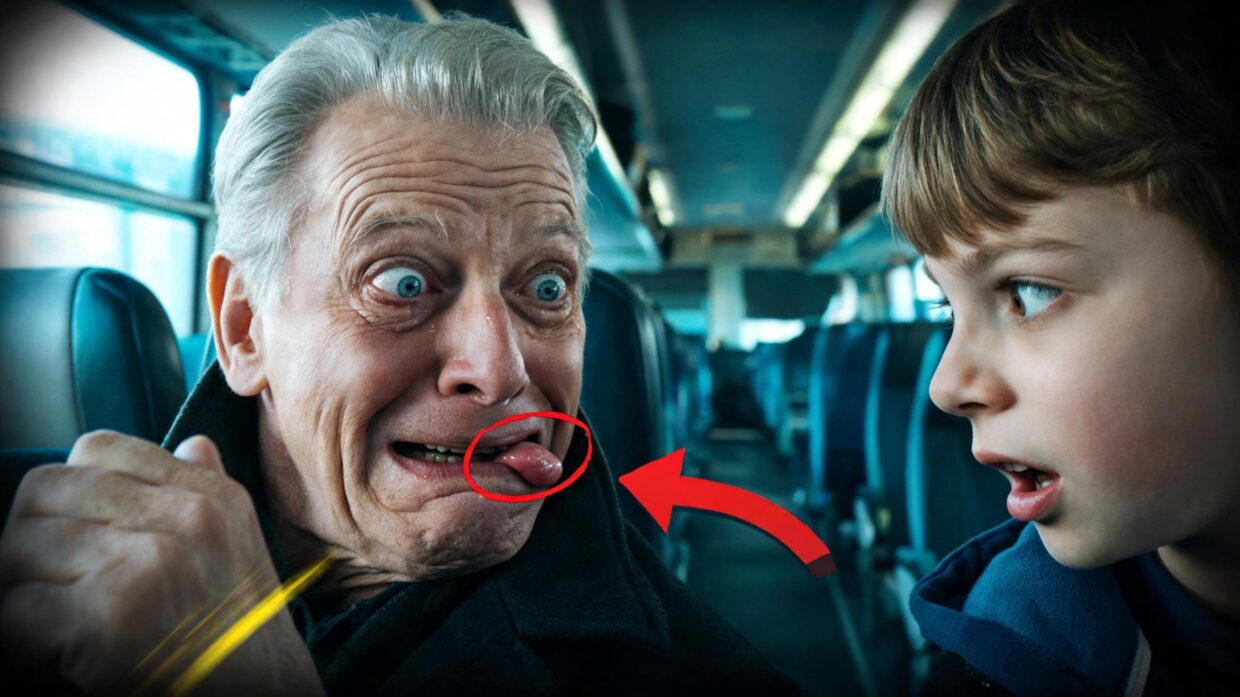
Mason watched him for a moment. The man’s right hand was curled in his lap like a small dead thing. The corner of his mouth on that side was pulled down — just a little. Not enough for anyone busy with their phone to notice.
Mason had seen that face before.
He had seen it on his grandmother, two years earlier, sitting at the kitchen table with a cup of tea cooling in front of her. He had seen it in a pamphlet a nurse had pinned to their refrigerator afterward, in a row of cartoon faces under three big letters: F-A-S-T.
Face drooping. Arm weakness. Speech difficulty. Time to call.
Mason felt the inside of his chest go very quiet. He stood up. His legs felt like wood. He crossed the aisle, slid into the empty seat beside the old man, and looked into his face.
“Sir,” he said. “Can you smile for me?”
The man’s eyes — pale blue, a little watery — turned toward him very slowly. The right corner of his mouth twitched. The left side did not move at all.
“Sir, can you raise both your arms?”
The man’s left hand lifted six inches. The right one stayed curled. Mason watched the man’s eyes widen as he understood what was happening to him.
“Don’t try to talk,” Mason said. He had heard the nurse say that to his grandmother. “Don’t try to talk. Just look at me.”
He turned in his seat and shouted up the aisle.
“Driver! Sir, please — the man back here is having a stroke!”
A woman in the row behind him gasped. The driver — a heavyset man with a gray ponytail — looked into the mirror.
“Son, sit down.”
“He’s having a stroke!” Mason shouted again, louder. “His face is falling on one side! He can’t move his right arm! Please, you have to call someone!”
The driver pulled the bus onto the shoulder so hard a duffel bag slid down from the overhead rack and landed in the aisle. He grabbed the radio.
A young woman two rows up stood up with her phone in her hand. “I’m calling 911,” she said, already dialing.
“What time is it?” Mason asked her.
She looked at him. “What?”
“The time he started. They need to know the time he started. Tell them ten-oh-three. He dropped his book at ten-oh-three.”
The woman repeated it into the phone, voice shaking. “Ten-oh-three. We’re on I-76 eastbound, mile marker — driver, what’s the marker?”
The driver shouted a number. The woman shouted it back into the phone.
Mason stayed in his seat next to the old man and laid one small hand on top of the curled hand in the man’s lap.
“Sir, my name is Mason. The ambulance is coming. I’m gonna keep talking to you, okay? You don’t have to answer. Just look at me.”
The old man’s eyes filled with tears. He couldn’t speak. But he didn’t take his eyes off Mason.
“My grandma had a stroke when I was eight,” Mason said. “I’m gonna tell you what the lady at the hospital told her. It’s gonna feel scary, but the medicine they give you works really good if you get there fast. We just have to keep your brain working until then. So I’m gonna talk, and you’re gonna look at me. Okay?”
The man blinked once. Slow. Deliberate.
“Okay.”
Mason talked.
He talked about his grandmother’s garden, about the tomato plants she grew on the side of the house, about how she made him pick worms off the leaves on Saturday mornings. He talked about his fourth-grade teacher Ms. Peters, who had once cried in front of the whole class because someone had brought her flowers. He talked about a stray cat under their porch named Hubcap. He talked about a fishing trip his grandmother had promised him for his eleventh birthday in November.
He talked the entire seventeen minutes it took for the ambulance to reach them.
Paramedics in dark uniforms boarded the bus and surrounded the old man. A woman with a stethoscope around her neck looked at Mason and asked, “Son, who are you?”
“I’m — I’m just sitting next to him.”
“Did you call the symptoms?”
Mason nodded.
She held his gaze for a beat. “You did good. You did real good.”
They lifted the old man onto a stretcher. As they wheeled him down the aisle, his good hand reached out, stopped at Mason’s shoulder, and squeezed once. His eyes said the words his mouth couldn’t.
Then he was gone.
The bus rolled the last hour to Pittsburgh in a strange, embarrassed quiet. People kept turning around to look at Mason. An older woman pressed a granola bar into his hand and didn’t say anything. The driver came back twice to ask if he was okay.
Mason was not okay. But he didn’t know how to say that to a stranger.
When the bus pulled into the Pittsburgh Greyhound station at 12:42 in the afternoon, Mason stepped down onto the platform with his backpack slung over one shoulder, his grandmother’s photograph pressed flat in his front pocket, and the granola bar still uneaten in his fist. He stood by the curb and waited for his Aunt Carol.
He waited an hour.
He waited two hours.
By four in the afternoon, the granola bar had been eaten. By six, the inside of the station had gotten loud and smelled like microwave food and bleach. His phone — a cracked-screen prepaid his grandmother had bought him the year before — had two percent battery and no signal where he stood. He moved closer to the doors and tried the only number Aunt Carol had ever given him.
It rang four times and went to a recording. The voicemail was full.
He tried again. Same recording.
He tried a third time. He tried it for an hour.
By eight at night, a security guard had asked him twice if he was waiting for someone. Both times Mason said yes. The second time, the guard’s face had softened in a way that scared Mason more than the question.
By ten, the station was thinning out. Mason sat on a metal bench just outside the main doors, his backpack between his feet, his grandmother’s photograph in both hands. A wind off the river had come up and gone through his hoodie like it wasn’t there.
He told himself he wasn’t going to cry. He told himself he wasn’t going to cry.
He cried.
He fell asleep at some point on the bench, hood pulled up, knees tucked under his chin. The sky was a bruised gray when he woke up. A bus rolled past, headed somewhere else. His teeth were chattering. His phone was dead. His stomach hurt.
The black SUV pulled up to the curb at 6:47 in the morning.
Mason saw it stop in front of him through the steam of his own breath, and assumed it was for someone else. Two men in dark coats stepped out of the front seats first. Mason watched, half-curious, half-numb, as a third man emerged from the back — slowly, leaning on a silver cane.
Mason’s hands stopped shaking around the photograph.
The old man from the bus walked toward him on the sidewalk. His right side was a little stiff, his right hand a little slower, but his face was his face again — both corners of his mouth, both eyes alert. He was wearing a different coat. He looked thinner.
He stopped in front of the bench.
“You,” the old man said. His voice was a low, careful rasp. “You saved my life.”
Mason looked up at him without moving. “I just did what my grandma taught me.”
The old man stared at him for a long second. Then he did something Mason did not expect. He sat down. On the cold metal bench. In his expensive coat. With his cane between his knees. He sat down beside Mason like he had nowhere else to be.
“I’m Henry,” he said. “Henry Calloway.”
“Mason.”
“I know. The driver told the paramedics. The paramedics told the hospital. The hospital told me.” Henry’s pale blue eyes searched the boy’s face. “I made some calls last night. I tried to find your aunt.”
Mason felt his throat close.
“Mason,” Henry said quietly. “Your aunt’s not coming.”
Mason stared down at the photograph in his hands. The smile on his grandmother’s face blurred.
“I’m sorry, son. She’s — she’s not in a place to take care of anyone right now. The county knew. They were going to call you when you got off the bus. The number they had was disconnected.”
The wind picked up. Mason wiped his nose on the back of his hand.
“I’m gonna go to a shelter,” he said. The words came out small.
“No,” Henry said. “You’re not.”
Henry shifted on the bench. From the inside pocket of his coat, he drew a small folded photograph — old, soft at the corners, the kind that had been carried for years. He held it without looking at it for a long moment.
“Twenty-two years ago,” he said, “I lost my daughter. Her name was Megan. She was nineteen years old. She died in a hospital while I was in another country signing papers I cannot now remember. I had more money than I knew what to do with, and I couldn’t buy back the four hours it took me to fly home.”
He looked at Mason. His eyes were wet, but his voice was steady.
“For twenty-two years I have told myself I am the man who could not save his daughter. Yesterday morning, on a bus I didn’t even need to be on, a ten-year-old boy I had never met saved my life because his grandmother taught him to look at strangers.”
He paused. Set the photograph down on the bench between them. It was a young woman with long dark hair, laughing at something just outside the frame.
“I’m not gonna pretend I know what you need, Mason. I’m not gonna pretend I can replace what you’ve lost. But you’re not sleeping on this bench again. Not while I have a say in it.”
Mason looked at the photograph. He looked at the old man. He looked back down at his grandmother in his own hand.
“What do you want me to do?” he asked.
“I want you to come with me,” Henry said. “I want you to eat something hot. I want you to sleep in a bed. After that — after that, we will figure out what we do, the right way. Lawyers. Social workers. Judges. Whatever it takes. You will not disappear into a system. Not on my watch.”
Mason was quiet for a long time.
“My grandma,” he said finally. “She wouldn’t want me to go with a stranger.”
Henry nodded, slow. “She wouldn’t. She raised you right.” He pulled out his phone. “So we’re not going to be strangers. I’m calling the social worker on call for Allegheny County right now. Her name is Linda Park. She’s gonna come down here and she’s gonna be in the room for every conversation you and I have today. If at any point you decide you don’t want to come with me, she takes you. Deal?”
Mason looked at him.
“Deal,” he said.
Linda Park was a tired woman in her fifties who arrived in twenty minutes flat. By breakfast at a diner three blocks from the station, she had Mason’s case file open on the table beside the menu. By lunchtime at the same diner, she had verified Henry’s identity, his bank, his attorneys, and the year-old contact form he had quietly filed with the state to be considered as an emergency placement for a child in crisis. He had filled it out the day after a conversation with his therapist about Megan. He had never received a call.
“You filed this fourteen months ago,” Linda said, looking up over her glasses.
“I did.”
“And you never told anyone.”
“I had nothing to tell.”
Linda looked at Mason. She looked at Henry. Then she looked at her phone.
“Mason,” she said. “It is one hundred percent your call. You can come home with me tonight. We have an emergency placement family in Squirrel Hill. They’re nice people. Or you can — under my supervision, with paperwork I will personally file this afternoon — you can spend tonight at Mr. Calloway’s house. I will be there in the morning. You will have my number. If any single thing makes you uncomfortable, you call me, and I am there in twenty minutes. Do you understand?”
“Yes, ma’am.”
“What do you want, honey?”
Mason looked across the table at Henry. Henry was watching him very still, waiting, hands flat on the formica.
“I want — I want to go where there’s a phone charger,” Mason said. His voice cracked. “And I want to call my grandma’s neighbor and tell her I’m okay.”
Henry’s eyes went wet again.
“Done,” he said.
Linda closed her folder. She looked at Mason for a long moment, the kind of look a person gives when they have seen too many of these conversations end the wrong way.
“One more thing, honey,” she said. “Look at me.”
Mason looked at her.
“You don’t owe this man anything,” she said. “Not one single thing. He doesn’t get to be your family because you saved his life. He gets to be your family because you decide. Are you hearing me?”
“Yes, ma’am.”
“Good.” She slid her business card across the table to him. “My cell. Day or night. You don’t even have to tell me why.”
“Yes, ma’am.”
Henry folded both hands on the formica and didn’t say a word.
That night Mason slept in a quiet guest room three floors above a downtown Pittsburgh street he didn’t know the name of, in a bed that smelled like clean cotton, with a charger plugged into the wall and the social worker’s card on the nightstand. Henry’s housekeeper, a woman named Mrs. Alvarez who had cried when she met him, had made him grilled cheese and tomato soup. He had eaten three bowls.
Linda Park came in the morning. She came every morning for the next eleven days.
By the end of the second week, the home visits had stopped being a stack of forms and had started being a folder, and the Pittsburgh papers had figured out where Henry had been for the last two weeks.
The story broke on a Sunday.
“BILLIONAIRE TAKES IN BOY WHO SAVED HIM ON GREYHOUND.”
The cameras came. So did the questions. So did the cousins of Aunt Carol who suddenly remembered they had always loved Mason very much. Henry’s lawyers handled them. Mason saw none of it.
What Mason saw was a tutor named Mr. Yoon who came three afternoons a week, so he wouldn’t fall behind on fourth grade. He saw Henry at breakfast every morning, drinking coffee with his good hand and reading the paper out loud. He saw Mrs. Alvarez teach him how to crack an egg one-handed. He saw a grief counselor named Dr. Nelson once a week, in a small office downtown, where he learned the words for what was happening inside him.
He did not see Henry rush out for a meeting. He did not see Henry leave the country. He did not see Henry on his phone at the dinner table.
What he saw was a man, unhurried, doing what he had not done for his own daughter.
One afternoon in the third week, Mason sat on the kitchen floor with the photograph of his grandmother in his lap. Henry sat down next to him, slow, both knees popping.
“You know what she’d say,” Mason whispered, “if she could see me here?”
“Tell me.”
“She’d say I should be making myself useful. She’d say no one likes a kid who eats and don’t help.”
Henry let out a small, surprised laugh — the first one Mason had ever heard from him.
“Then we should probably wash some dishes.”
“Yeah.”
Three months after the bus, in a courtroom Mason had now been in twice, a judge named Patricia Reeves looked across her bench at the small boy in a button-up shirt and the old man in a dark suit beside him, and signed the order for permanent legal guardianship.
“Mr. Calloway,” she said, looking up, “I want you to understand something. This court has reviewed every page of this file. Every interview. Every home visit. I am not signing this because you are wealthy. I am signing this because, in twenty-six years on this bench, I have rarely seen a guardianship case where the child’s voice was so consistent and so clear about what they wanted.”
She looked at Mason.
“Mason. You’re sure.”
“Yes, Your Honor. I’m sure.”
The judge signed.
Two months later, Henry hosted a charity dinner for a foundation he had quietly funded for nineteen years — a foundation that trained inner-city kids in CPR and stroke recognition. He had founded it the year after Megan died. He had never spoken at one of its events.
That night he did.
Mason sat in the front row in a borrowed jacket and his own shoes, the photograph of his grandmother in his front pocket where he always kept it. Henry walked to the podium and looked out across two hundred faces.
“Twenty-two years ago,” he began, “I lost my daughter Megan. She died in a hospital while I was on a plane. The people around her did not recognize what was happening to her in time. I have spent two decades and a great deal of money trying to make sure that doesn’t happen to another family. Trying. Not enough. Hiding behind the checks I wrote, so I wouldn’t have to stand up here and say her name.”
He paused. His good hand tightened on the edge of the podium.
“On a Tuesday morning this past September, on a Greyhound bus to Pittsburgh, a ten-year-old boy named Mason Riley saved my life. He recognized the signs of a stroke because his grandmother — who had passed away the day before — had taught him. He did not freeze. He did not look away. He sat next to a stranger and held his hand and talked to him for seventeen minutes until the ambulance came.”
Henry looked at Mason in the front row.
“I am here tonight because of him. I am here, and I am speaking, and I am saying my daughter’s name out loud in public for the first time in twenty-two years, because of him.”
He extended one hand.
“Mason. Come up here, please.”
Mason walked up onto the stage in front of two hundred people. He had been told this was going to happen. He had practiced not crying. He had been doing better with that lately, but not tonight.
Henry put one hand on his shoulder.
“This is my son,” he said clearly. “Three months ago, the courts of Allegheny County agreed. Tonight I want everyone in this room to agree too.”
The room rose to its feet.
Mason looked out and could not see any single face. The lights were too bright. He felt Henry’s hand on his shoulder, steady and warm and a little weaker on that one side, and he thought — clearly, all at once — about his grandmother on her front porch with her cup of coffee. He thought she would have liked Henry. He thought she would have told him to take the casserole dish back when he was done.
Six months after that, on a clear November afternoon, Mason turned eleven. Henry took him fishing for the first time, on a small lake two hours outside of Pittsburgh that an old colleague had mentioned. They caught nothing. Henry slipped twice on the wet boards of the dock. Mason laughed for the first time in nearly a year, and Henry — who had not laughed loudly in twenty-two — laughed with him.
On the drive home, Mason fell asleep in the front seat of the SUV with his grandmother’s photograph in his lap.
Henry kept both hands on the wheel.
He did not turn on the radio. He did not check his phone. He drove the long way home, past the exit for the airport he had not used in three months, and he watched the small steady rise and fall of his son’s chest in the seat beside him.
For the first time in his life, he was exactly where he was supposed to be.