


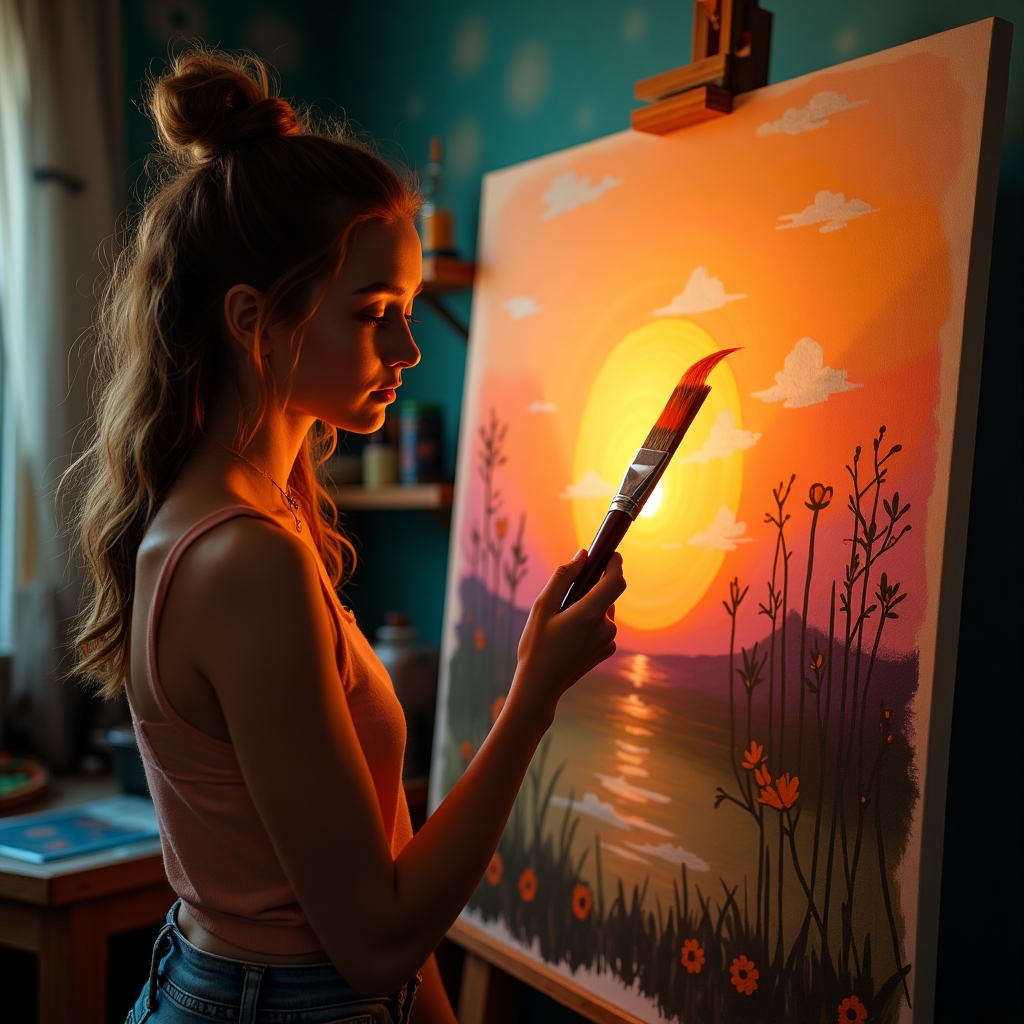
In the heart of a bustling city, beneath the constant thrum of its life, Layla navigated her world with a delicate balance. The city, with its towering skyscrapers and bustling streets, mirrored the internal labyrinth she walked every day. Her life was a tapestry woven with contrasting threads of personal dreams and familial expectations.
Layla had always known she was different. From a young age, she dreamed of being an artist, of painting the world in the colors that danced in her mind. But being the daughter of first-generation immigrants, her life’s path was drawn long before she took her first step. Her parents envisioned a future where she followed a steady profession, secure and respected—a future they had sacrificed so much to provide.
Her father, an architect, often spoke of the pride and stability his career brought to the family. At dinner, the table was a stage where Layla would listen to stories of structures and blueprints, where her father would sketch imaginary cities on napkins, his eyes alight with passion. Her mother, a teacher, believed in the power of education to transform lives. She held out hope that Layla would carry forward their dreams, amplifying their sacrifices through her own success.
Yet, Layla’s heart sang a different tune. Her soul vibrated with the need to create, to express. The colors she imagined were bright and vivid, yearning to spill onto blank canvases. Each stroke of a brush was a whisper of freedom that her heart longed to shout.
The internal conflict was subtle, a quiet storm that brewed beneath her skin. It wasn’t loud or violent, but a persistent turbulence that left her restless. The weight of her family’s expectations pressed upon her shoulders like an invisible yoke. Sessions with her paintbrush were interspersed with the guilt of dreams unaligned with familial hopes.
Layla began to retreat into herself, her life becoming a series of unspoken compromises. At university, she enrolled in architecture, a field adjacent to her father’s dreams. She spent her days drawing precise lines and perfect angles, while her nights were consumed by clandestine meetings with her canvas.
There was a certain solace in the quiet of the night, where her dual lives intersected under the moon’s gentle gaze. Yet, the duality was exhausting, and Layla found herself wrapped in a cocoon of melancholy, her heartstrings tugged in opposing directions.
It was during one of these nights that the moment of clarity arrived. Layla stood in her small, cluttered studio—a narrow room tucked away at the top of an old building. The walls were adorned with her unsanctioned creations, a riot of colors that seemed to pulse with their own life.
She was working on a new piece, a sunset that melded into a cityscape. Her strokes were hesitant, as if her brush knew the weight of her hesitation. The vivid hues of the sky contrasted with the rigid lines of the buildings—her two worlds colliding on canvas. As she painted, the silence of the night wrapped around her, a quiet witness to her struggle.
Layla paused, her hand suspended mid-air, a vivid orange dripping from her brush tip. Her eyes, dark like the earth, reflected the kaleidoscope before her. And in that instant, it happened—a soft whisper from within, an echo of a truth that had lingered unspoken.
‘You are not a betrayal,’ it seemed to say, ‘but an extension.’
A tear slipped down her cheek, not from sadness, but relief. Relief in the realization that her dreams did not negate her parents’ sacrifices, but rather built upon them. Her art was not a rejection, but an homage to the freedom they had fought to give her.
With renewed purpose, Layla continued painting, her strokes confident and fluid. The canvas transformed, reflecting not just a sunset but a sunrise—a new beginning. It was a moment that encapsulated her quiet rebellion—gentle, yet powerful—a declaration to live authentically within the tapestry of expectation and self.
In the days that followed, Layla worked on bridging the silent chasm between her worlds. She began introducing her family to her art, not with grand declarations, but through small invitations to understand. Each painting was a conversation starter, a dialogue that wove their dreams and hers into a shared narrative.
Layla came to realize that the weight of expectations need not be a burden but a seat for shared stories and hopes. In the quiet, she found her emotional courage to be both loyal to her heritage and true to herself. Her journey was one of subtle steps towards generational healing, where past and present danced in harmony.
Her parents, though initially bewildered, began to see their daughter in a new light. They learned to appreciate the beauty of her art, and with it, the beauty of her spirit. Slowly, they embraced the idea that her happiness was a testament to their sacrifices, a living canvas of dreams realized.
In this newfound understanding, Layla found peace. The quiet storm within her had settled, leaving behind a clear sky where the jasmine-scented wind whispered of a future where she could be both artist and beloved daughter, free to color her life as brilliantly as she dared.