
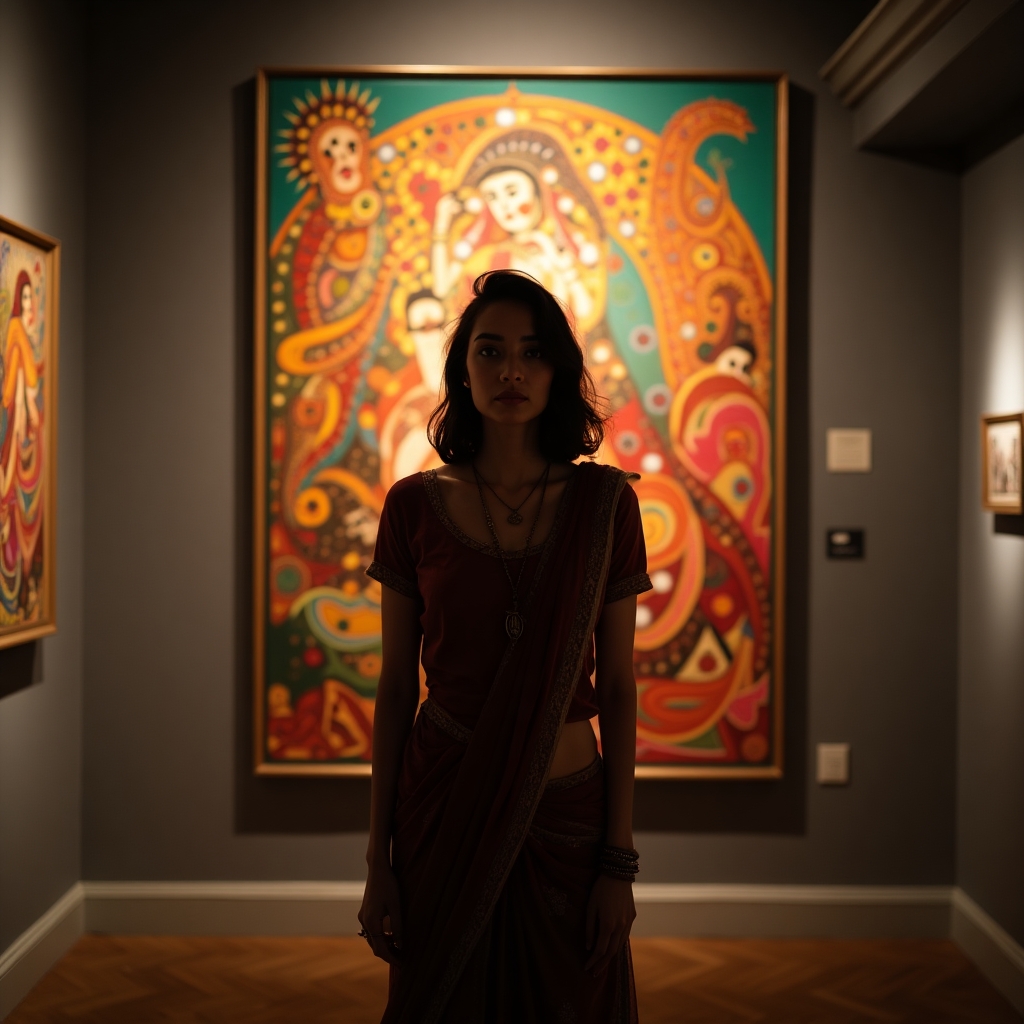
Maya sat at the small wooden desk in her dimly lit bedroom, the rhythmic hum of the ceiling fan a soothing counterpoint to the storm in her mind. Her laptop glowed softly in the darkness, an essay on identity only half-written, blinking cursor taunting her indecision. Outside, the rain tapped lightly against the windows, a gentle percussion that seemed to underscore her quiet torment.
Raised in a household where the veneration of tradition was stitched into the very fabric of daily life, Maya felt the weight of her ancestry as though it were a shadow she could never quite escape. Her family had immigrated from India before she was born, bringing with them not only the warmth of their culture but also the unyielding expectations that came with it.
Every evening, her grandmother would recount stories of the old country, the fields they had tilled, and the temples where her ancestors had prayed. She would tell Maya, in her melodic accent, about the strength of their people and the importance of carrying forward their legacy. Maya loved these stories; they were tales of courage and resilience. Yet they were also stories of conformity and sacrifice.
Her parents, both engineers, had steered Maya towards the sciences from a young age. “Stability,” her father would say, “is found in the certainty of numbers.” Yet, Maya’s heart thrummed with the chaos of colors, sketches and notes that were more art than equation. She ached to pursue her passion for painting, but the unspoken rule was clear: art was a hobby, not a career.
Maya found herself increasingly silent at family gatherings, nodding along to discussions of college applications and internships that did not align with her dreams. She was present, yet absent. Her silence was her rebellion, though it felt like a betrayal.
One evening, her mother entered her room, the air thick with the smell of incense from the prayer room. “Have you thought about the applications, beta?” her mother asked, her voice gentle but firm, the implication clear.
Maya hesitated, the words she longed to say tangled in her throat. “I’ve been thinking,” she started cautiously, “about taking a gap year… to explore painting more deeply.”
Her mother’s silence was heavy, a pause that stretched unbearably. “You have such a gift for science,” her mother finally replied, a note of disappointment coloring her words. “Why waste that?”
Maya nodded, her heart sinking. It was a familiar refrain. Her parents had sacrificed so much for their family; how could she, in good conscience, choose a path that seemed so uncertain and frivolous?
The internal struggle was not a sudden tempest but a slow, persistent erosion, a conflict between loyalty to her family’s dreams and fidelity to her own. Maya’s friends encouraged her creativity, her art teacher praised her talent, yet each compliment felt like a distant echo against the louder, immediate chorus of her family’s expectations.
Weeks passed, and Maya continued to juggle assignments and art, her life a delicate balancing act. She watched classmates prepare for college, feeling like an outsider in her own story.
Then came the day of the Art Fair, an annual event that showcased the work of emerging young artists. Her teacher insisted she submit her latest series, vibrant depictions of her cultural duality. Reluctantly, she agreed, under the condition that her parents not be informed.
The fair was a kaleidoscope of color and energy, a sensory overload that filled Maya with both excitement and dread. As she wandered through the gallery, she felt an unfamiliar lightness, a sense of belonging.
Her paintings hung in a quiet corner, each piece a narrative of her journey, blending tradition with individuality, duty with desire. As she stood there, a woman approached, her eyes lingering on Maya’s work. It was a stranger, yet her appreciation was palpable, a silent understanding that crossed the boundary between artist and observer.
“Your work is deeply moving,” the woman said, her voice warm. “You have a gift.”
In that moment, standing before her paintings with a stranger’s validation, Maya felt a tide turn within her. It was a subtle but profound shift, the realization that her truth, her vision, could not be confined by others’ expectations.
Returning home that evening, she sat with her parents. “I need to talk to you,” she began, her voice steady, though her heart raced. “I’ve been accepted into an arts program, and I’ve decided to pursue it.”
Her parents listened, their expressions unreadable. Her father’s brows furrowed, her mother’s lips pressed into a thin line. “Maya,” her father began, “we want what’s best for you.”
“What I want,” Maya interrupted gently, “is to honor what you’ve given me by being true to myself.”
There was silence in the room, thick with unspoken fears and hopes. “I am not leaving behind our heritage,” she continued, “but carrying it with me into a new space.”
Her mother sighed, a sound heavy with the weight of dreams reframed. “I just want you to be happy, beta.”
Maya nodded, tears prickling her eyes. “I think this is the first step towards that.”
The moment was not a dramatic rupture but a quiet accord, a delicate understanding that the path to happiness was a bridge between what was expected and what was felt. In the weeks that followed, Maya worked to repair the quiet rift, inviting her parents into her world of color, showing them what inspired her.
Slowly, they began to see the beauty in her vision, their acceptance a soft balm on the edges of her lingering fears. It was not a complete reconciliation of ideals, but a beginning—a mutual respect for a journey that was both uniquely hers and inherently theirs.
Maya learned that courage was not just in the bold assertion but in the gentle insistence on living one’s truth. Her path was not yet clear, but she knew she was not alone—her family was with her, each step a testament to love and compromise, a dance of generations learning to heal and embrace anew.