




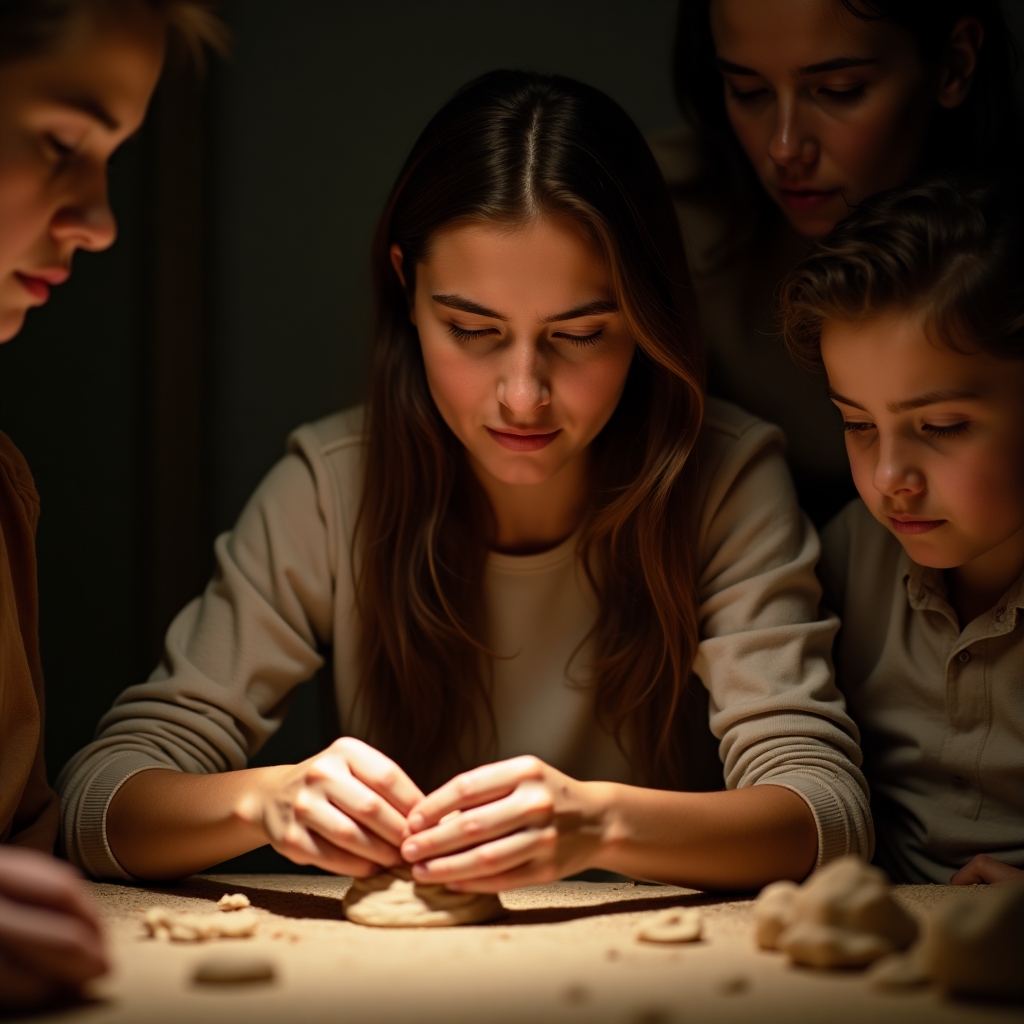
In the dense weave of a bustling city, nested between sun-drenched buildings and alleys lined with flickering street lamps, lived Nia. At twenty-three, she was a tapestry of quiet perseverance and subdued dreams, her life a testament to measured steps taken under watchful eyes. Her family, a mosaic of rich cultural traditions and unspoken expectations, had sculpted a path laid out long before her birth.
Nia’s parents had journeyed from their homeland with stars in their eyes, dreams penned in another language, colored with the weight of sacrifices untold. They arrived in this city, cradling their aspirations, planting them in the fertile yet foreign soil of opportunity and hope. For them, Nia was the living embodiment of their legacy, the one to root these dreams in permanence.
She was raised in a household where duty intertwined with love, where the silence between words held more gravity than the words themselves. Sundays were painted with rituals, where the air hummed with the scent of spices, and the warmth of familial bonds wrapped everyone in an invisible embrace. Yet, beneath these layers, Nia found herself ensnared by the very traditions that promised cohesion.
Her heart danced to different rhythms—ones not bound by the predictability her family held sacred. Nia harbored secret desires for a life painted with creativity, her fingers yearning to sculpt stories from clay, to mold and shape characters the way she imagined life could be reshaped. But the weight of expectation sat heavy, a constant reminder of the dreams her parents had deferred for the possibility of her own.
The tension in Nia’s life was as subtle as the fading light at dusk—a gradual, almost imperceptible shift. She moved through her days carrying a quiet storm within her, a discord between filial piety and personal fulfillment. Conversations around the dinner table, though cordial, carried an undercurrent of unvoiced hopes. Her father, with his gentle yet firm voice, often spoke of responsibility, of the honor in following the path laid out by family lore.
Her mother, soft-spoken and understanding, sensed the turmoil within Nia. In the smallest of gestures—an unexpected squeeze of the hand, a lingering gaze—she communicated her silent support, offering a sanctuary of empathy in a household otherwise governed by stoicism. Yet, even this tacit approval was not without its own weight. For in the acknowledgment of Nia’s struggle lay the risk of acknowledging her own.
Nia’s escape was found in the quiet moments she carved for herself. She frequented a small studio on the outskirts of the city, a place where the clamor of expectation receded like the tide. Here, she immersed herself in the malleable earth, her hands speaking truths her voice dared not express. In these creations, she glimpsed worlds where her desires and family’s dreams could coexist, albeit in forms not yet realized.
It was during one of these solitary sessions, with her fingers deep in clay, that revelation gently crept upon her like a whisper. As she sculpted, she saw reflected in her work a delicate balance—the interlacing of textures and forms that echoed the complexity of her own struggle. The revelation was not sudden but unfolded with the grace of a dawning realization: she was not a solitary contender against tradition but a part of a continuum, a bridge between the past and future.
With clarity came the courage to embrace her truth without forsaking her lineage. She began to understand that honoring her parents did not necessitate the abandonment of her dreams. Instead, she could redefine the parameters of her path, crafting a narrative that encompassed the richness of her heritage alongside her own aspirations.
The day she shared her finished sculpture with her parents was a quiet affair. There were no dramatic confrontations, no raised voices. The room buzzed with an electric silence as Nia placed her creation on the table, a testament to her inner reconciliation. Her father, eyes moist with emotion, traced the contours of the piece with his gaze, seeing in it not only Nia’s courage but also their family’s journey.
“Beautiful,” he murmured, his voice a soft echo of pride and understanding. It was in this moment that Nia felt the binding threads of expectation gently loosen, weaving instead into a tapestry of mutual respect and newfound freedom.
In the delicate dance of acceptance and change, Nia found her truth—not in rebellion, but in quiet resilience. Her story, now intertwined with her family’s legacy, promised a future where the echoes of the past harmonized with the whispers of her own dreams.