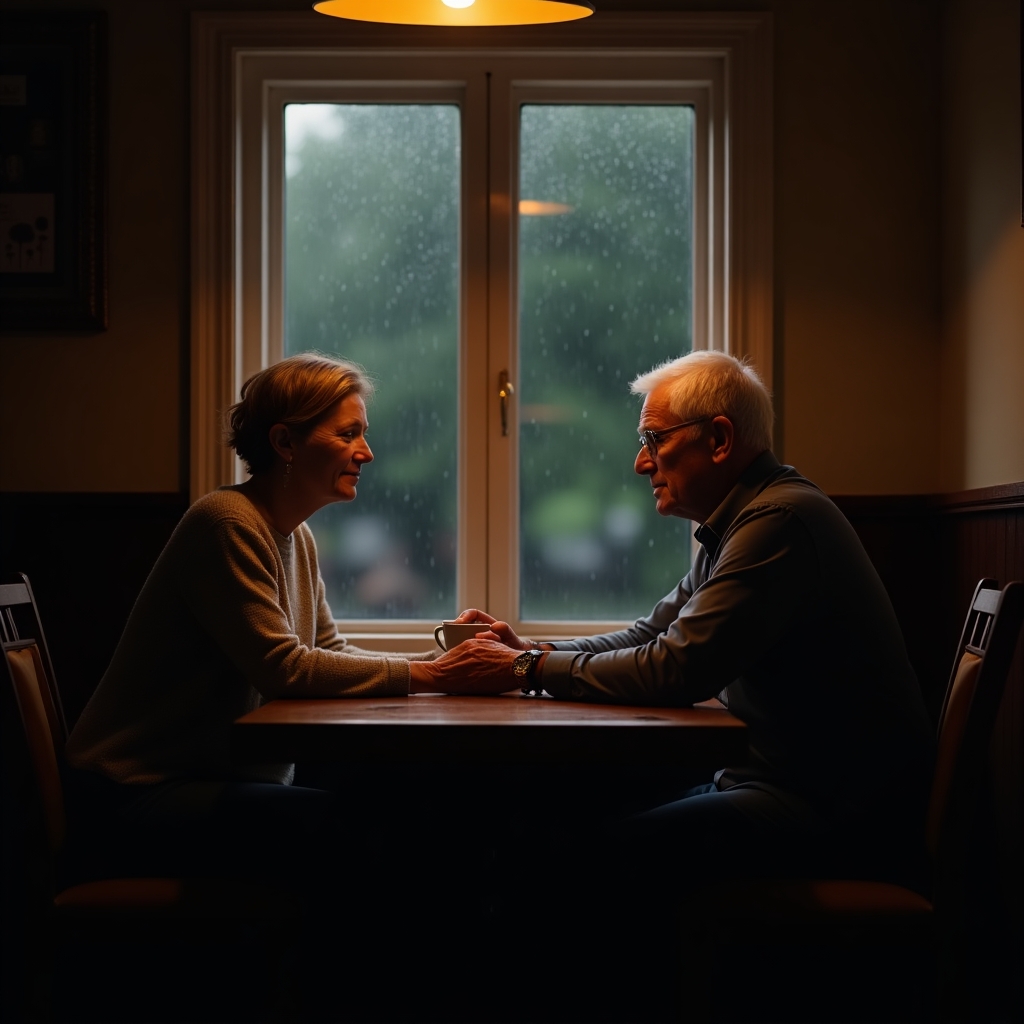





The rhythmic clinking of porcelain cups reverberated through the small living room, a staccato symphony of Sunday afternoon rituals that had been passed down through generations. Arjun sat quietly on the edge of the couch, his gaze fixed on the golden tea swirling in his cup, though his mind was miles away. His mother, Leela, sat across from him, a gentle yet expectant smile on her face, and the scent of cardamom from the brewing chai intermingled with her floral perfume—a familiar combination that was both comforting and suffocating.
Leela had always seemed to know what was best for Arjun, or at least she believed she did. Her values were deeply rooted in tradition and family honor, her life a testament to the sacrifices made to uphold these principles. Arjun respected her fervor, appreciated the warmth and cohesion it often brought to their family gatherings, yet as he grew older, he found himself chafing against the invisible boundaries those same values imposed on him.
The expectations were not always direct commands but rather a subtle undercurrent, a gentle but persistent pressure that shaped decisions with the deft touch of a potter molding clay. “Have you thought more about the position at the firm your uncle mentioned?” Leela’s voice broke through Arjun’s thoughts, her question deceptively casual, a mere ripple on the surface of deeper waters.
“Yes, I have,” Arjun replied, careful to keep his tone neutral. “I’ve just got a lot on my plate right now with the design project at school.”
Leela nodded, though the brief flicker of disappointment in her eyes was unmistakable. “Of course, education is important,” she affirmed, yet the unspoken continuation lingered in the air—’but stability and tradition are important too’.
Arjun’s passion lay in graphic design, a career that promised creativity and innovation, a life less tethered to convention. But each time he tried to express this, he felt the weight of his familial obligations pulling him back, like a kite struggling against the string that bound it to earth.
As the weeks passed, the tension mounted. It was not a question of love or respect; those were constants. Rather, it was a quiet, persistent conflict between self-identity and expectation. Arjun’s thoughts often drifted to the stories of his grandparents, immigrants who had fought hard to establish roots in a new country, their dreams of prosperity woven into the very fabric of the family’s heritage.
One afternoon, Arjun found himself alone in the attic, searching for a box of old books when he stumbled upon a photo album. The images were faded, but the smiles were vibrant—his grandparents posed in front of their first home, his parents’ wedding day, his own blurry childhood snapshots. As he flipped through the pages, a letter slipped from between the pages, handwritten in his grandfather’s neat script.
“My dear Arjun,” it began, “never forget that courage is not the absence of fear, but the triumph over it. You come from a lineage of dreamers and doers. As you carve your path, remember that the greatest honor you can give us is to live your truth.”
Arjun’s eyes welled with tears, the words a balm to his conflicted heart. He closed the letter gently, his fingers tracing the lines of his grandfather’s penmanship. It was in this attic, under the watchful eyes of his ancestors’ captured moments, that understanding dawned upon him. His family’s legacy was not about adhering to a single narrative, but about embracing the courage to forge his own.
The following Sunday, as Arjun sat across from his mother in the living room, the familiar scents and sounds enveloping him, he felt a new sense of clarity. “I’ve decided,” he spoke, his voice steady, “to pursue a career in graphic design.”
Leela’s eyes searched his face, the silence stretching between them. “But why, Arjun?” she asked, the question layered with concern, not accusation.
“Because it’s who I am,” he replied softly. “I want to honor everything our family has built by being true to myself, just as Grandpa did when he wrote me that letter.”
The mention of her father brought a softness to Leela’s expression, a flicker of understanding passing between them. “Your happiness matters most,” she finally said, her voice tinged with resignation, and perhaps, pride.
In the quiet that followed, Arjun felt the tension ease, not with a dramatic rupture, but with a gentle shift, like a river subtly altering its course. He realized that this was the essence of emotional courage—not in defying the past, but in acknowledging its role in shaping the future.
As the clinking of cups resumed, Arjun knew that the journey ahead would not be without challenges. Yet, he felt fortified by the knowledge that every step taken in pursuit of his truth was a tribute to the legacy from which he came.