


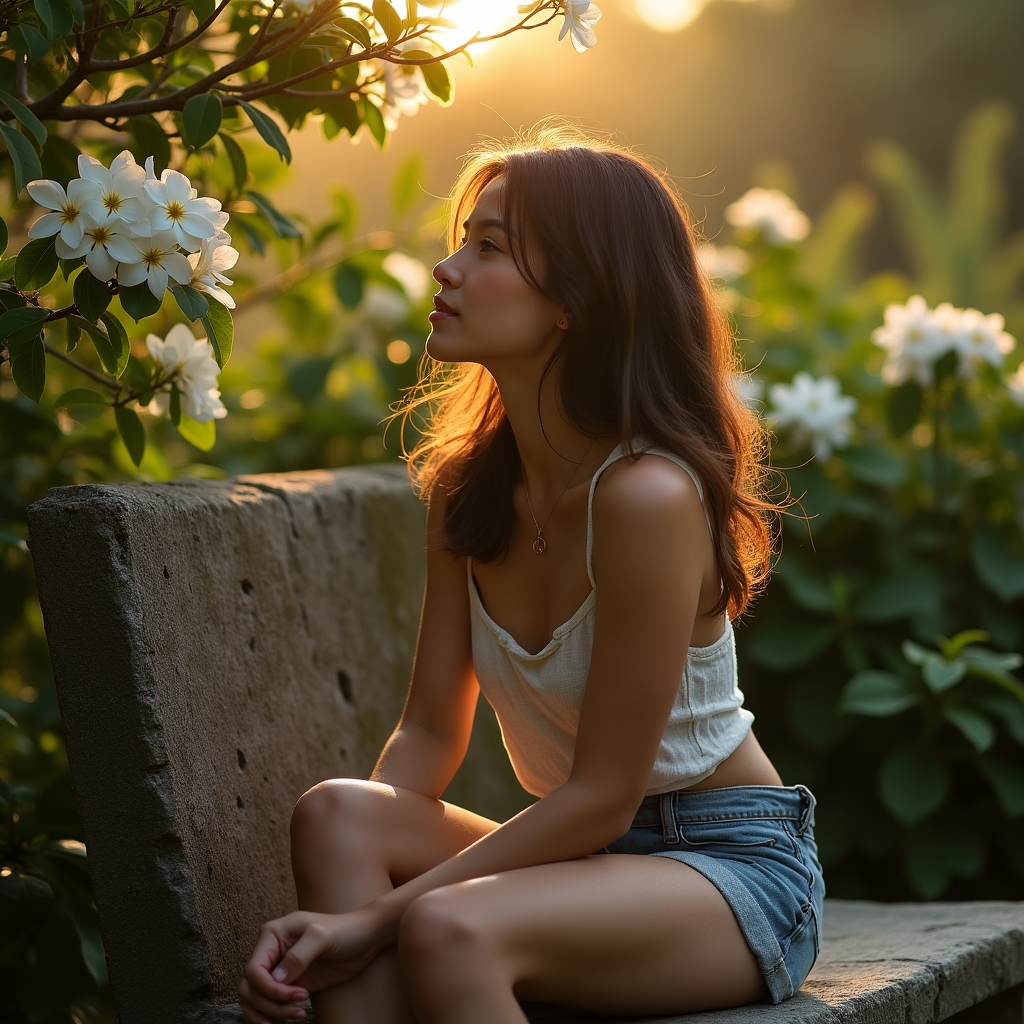
Meera sat on the faded stone bench in her grandmother’s garden, the aroma of blooming jasmine enveloping her. The garden was a sanctuary, a place where time seemed to drift softly like the petals that carpeted the ground. Here, away from the bustling city and her family’s expectant eyes, she grappled with the silent storm within her.
Growing up in a traditional Indian household in Delhi, Meera was no stranger to the push and pull of familial expectations. Her parents, both respected professionals, had always emphasized the importance of family duty and cultural heritage. Her future was imagined as a direct extension of these values, a seamless continuation of carefully preserved traditions.
Yet, Meera was different. Inside, she harbored dreams of choosing her own path, one that might lead her far from the beaten trails of her ancestors. She longed to study art history in Paris, to lose herself in the stories told by canvases and sculptures, to live amidst the art that spoke to her soul. But these dreams were whispered in hushed tones, hidden under layers of obligation and fear of disappointing those she loved most.
Her parents never voiced explicit demands; their expectations were woven into the fabric of everyday life, a gentle but unyielding pressure that pressed against Meera’s own desires. It was in the way her mother spoke proudly of Meera’s brother, who had chosen a stable career in engineering, and how her father’s eyes lit up when discussing possible suitors at community gatherings.
Meera’s heart felt split between two worlds: the one she yearned for and the one she lived in. Every day was a delicate balancing act, trying to please her family while keeping her dreams alive. Her nights were spent sketching in secret, capturing moments and emotions on paper with strokes of charcoal and splashes of color.
One evening, as the sun dipped below the horizon, painting the sky in hues of orange and pink, Meera sat at her grandmother’s knee in the garden. The old woman, with her gentle demeanor and wise eyes, had always been Meera’s confidante. Her stories of the past were laced with wisdom and a quiet understanding of the heart’s complexities.
“Tell me, my little artist,” her grandmother said, her voice like a soft lullaby, “What troubles you so deeply?”
Meera hesitated, her eyes tracing the intricate patterns of the jasmine vines. “I feel like a bird in a cage, Dadi,” she finally whispered, her voice barely above the gentle rustle of leaves.
The old woman nodded, her gaze fixed on the blossoms swaying gently in the breeze. “The cage is not always made of steel,” she murmured. “Sometimes, it’s made of love, fear, and expectations.”
Her grandmother’s words lingered in the air, resonating deeply within Meera’s heart. Here was someone who understood the invisible chains that bound her. The realization brought both comfort and an intensified longing for freedom.
Over the following weeks, Meera continued her internal struggle. Her parents spoke of their pride in her, their hopes and dreams so intricately entwined with their own lives that Meera’s own voice felt drowned out. Yet, amidst this chaos, the words of her grandmother stayed with her, feeding the fire of her resolve.
It was not until a quiet afternoon in the garden, surrounded by the heady scent of jasmine and the warmth of the sun, that clarity finally struck. Meera was painting, lost in the fluidity of her art, when she suddenly paused, the brush suspended in mid-air. In that moment, she saw her life stretched out before her, not as a linear path dictated by others, but as a vibrant tapestry she had the power to weave herself.
The realization was both terrifying and liberating. She understood that asserting her truth would mean disappointing her parents, at least initially. But she also knew that living a life not true to herself would be the greater betrayal.
Meera packed her sketchbook, feeling a newfound lightness as she walked back inside. Her steps were sure, her heart steady. That evening, as she gathered the courage to speak to her parents, she carried with her the wisdom of her grandmother and the quiet strength of the garden.
Her heart raced as she approached them, but the resolve within her quieted the fears. “I need to talk to you about something important,” she began, her voice firm yet gentle.
The conversation that followed was long and emotional, but Meera stood firm. She spoke of her dreams, her need to forge her own path, and her love for art. It wasn’t easy, and there were tears and silence, but slowly, her parents began to understand. They saw not rebellion, but a passionate plea for understanding and support.
In the end, it wasn’t their approval that mattered most to Meera, but the acceptance of her own truth. As she sat in her room that night, the faint scent of jasmine drifting through the open window, she felt a profound sense of peace. It was the beginning of a new chapter, one that respected both her roots and her wings.