



It’s terrifying to put this out in the world, but I need to share this. Perhaps it will bring me peace, or maybe it will help someone else find their own truth. Either way, here goes.
For as long as I can remember, there’s been an inexplicable weight in my heart—a kind of lingering sadness I could never quite understand or shake off. It’s not that I had a particularly difficult upbringing. My family life was something out of a storybook: loving parents, a happy home, all the support a child could ever wish for. But still, there was this undercurrent of sorrow, like a song that plays softly in the background, just out of earshot.
A couple of months ago, while helping my parents clean out their attic, I stumbled upon a dusty box wrapped in layers of old newspapers and tied with fraying twine. “Just old paperwork,” my mom said with a wave of her hand, dismissing its significance like one might over an outdated magazine. But something, some tug at the core of me, insisted that I look closer.
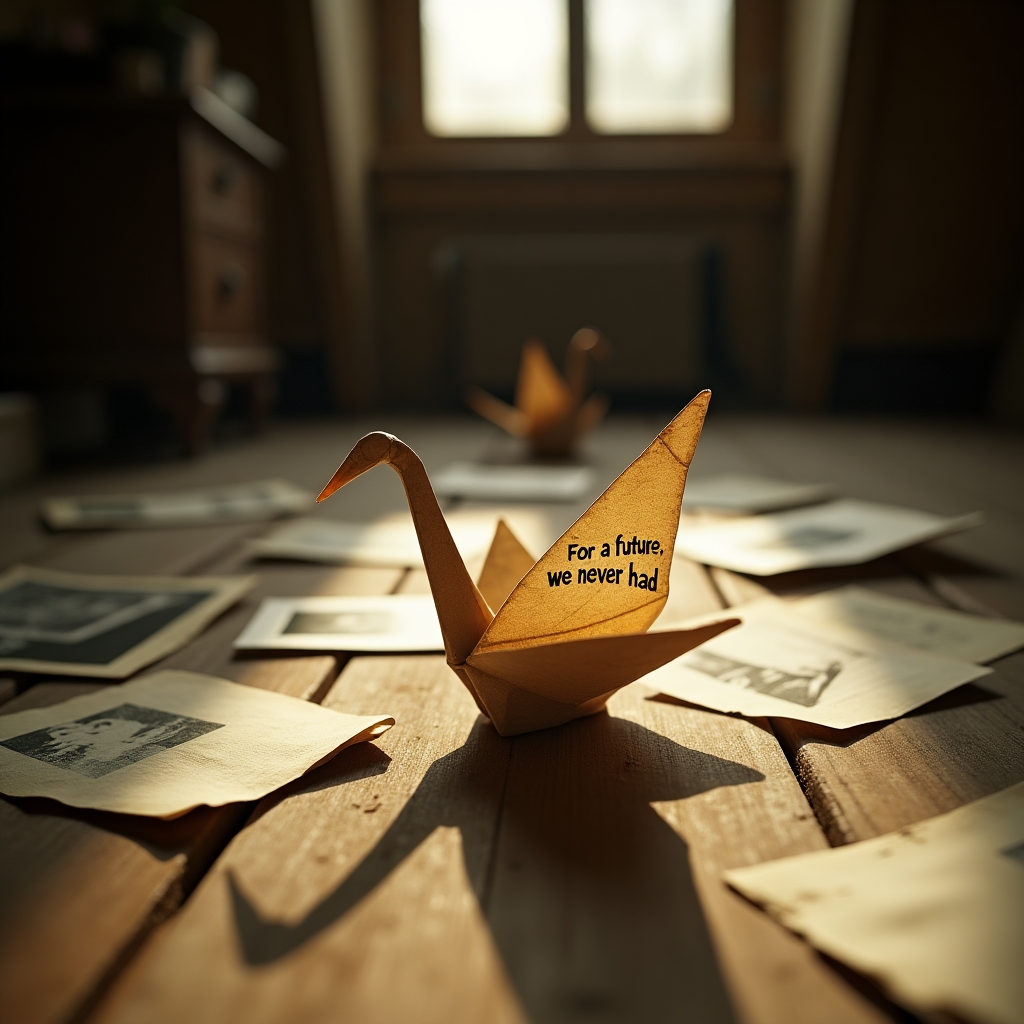
Back in my room, curiosity got the better of me. I opened the box and found a jumble of papers, old photographs, and a fragile, faded paper crane – its edges curled with age. It was the crane that caught my attention. There was something about its delicate folds, the way it was crafted with care, that seemed out of place among the documents. My fingers moved over it gently, uncovering a small, almost hidden message in faded ink on one of its wings. “For a future we never had.”
Those words lingered in my mind, haunting me with their vagueness and the sorrow they seemed to carry. I couldn’t put it aside, and so, I started to dig deeper, asking my parents gentle questions, hoping to unravel the mystery in a way that felt respectful.
One chilly evening, I sat with my mom over tea, the steam forming tendrils in the air. As the words spilled over my lips, “Mom, who made this crane?” her face changed in a way I had never seen before—a mix of surprise and a profound, unguarded sadness. Her hands trembled slightly as she reached across the table to hold mine.
“You were never meant to find that, but maybe it’s time,” she said softly, her voice barely above a whisper.
And so, the story unfolded. Many years before I was born, my parents had another child, a baby girl named Emily. She was frail from the start, and despite their hopes and prayers, she lived only a few short months. They had kept the secret hidden, buried beneath the layers of their own grief and the decision to protect me from that pain.
The paper crane was Emily’s. My father had crafted it, hoping for a future where she might grow up to fold cranes of her own. The message was his way of saying goodbye, a farewell to dreams that would never see the light of day.
I understood then that the quiet sorrow I always felt wasn’t mine alone—it was a thread of grief that connected us all. It was the unspoken loss of someone I never knew, yet, in a strange way, felt a kinship with. My parents carried this burden alone for so long, and unknowingly, I had been part of it my entire life.
Tears welled up in my mother’s eyes as she shared stories of Emily, and as we talked, it became clear that the sadness I felt was not just mine to carry—it was a shared history, a shared love for someone who had shaped our lives in ways I was only beginning to understand.
Eventually, the conversation turned from melancholy to something more comforting. In sharing Emily with me, my parents found a lightening of their own hearts, and in accepting this truth, I felt a strange sense of peace settle in my soul.
We decided to keep the paper crane, not as a reminder of sorrow, but as a symbol of our connection, our shared love. It now sits in a small glass case in our living room, a testament to the past, and a guardian of the future we now strive to cherish together.
In ways I can’t fully express, that fragile crane led me to a deeper understanding of myself and my family. And maybe, this story will help you find your own paper crane, whatever form it might take.