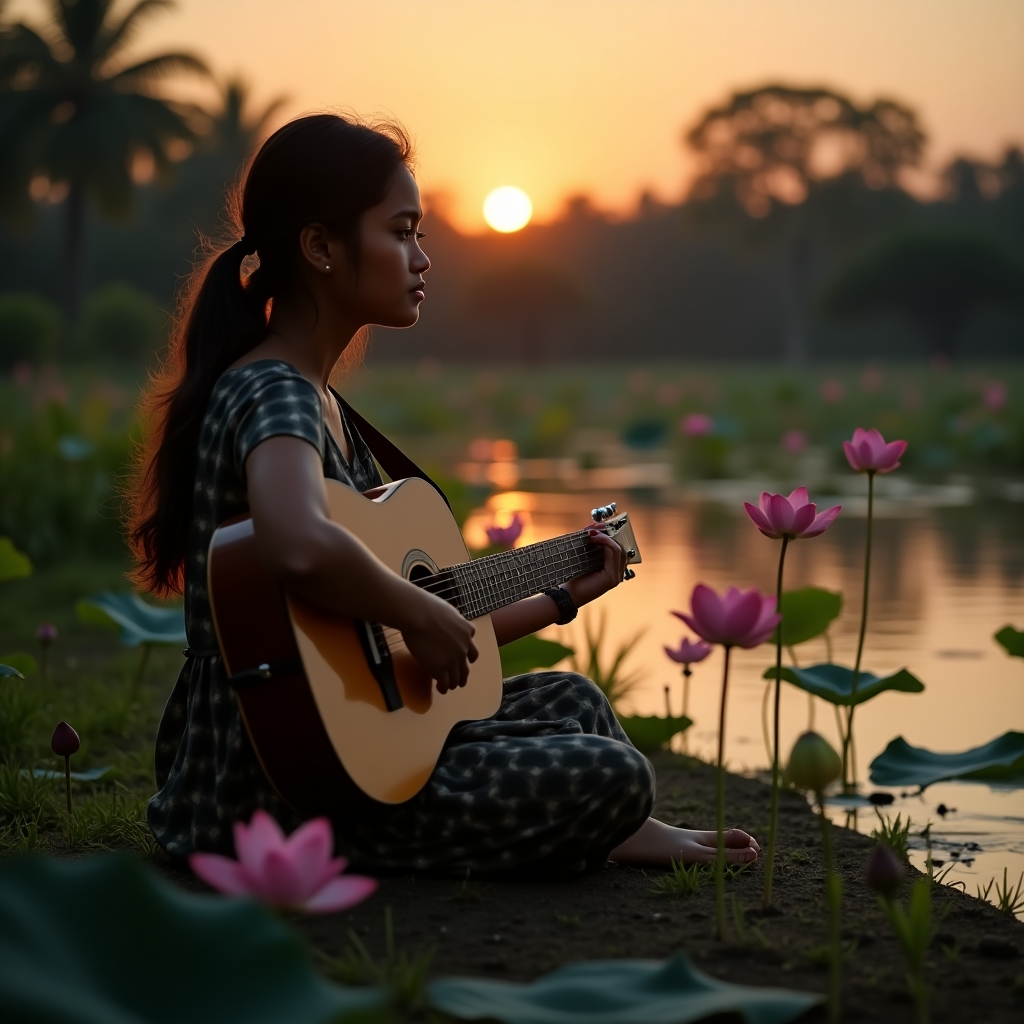





In the heart of a quaint coastal town, where the sea’s whispers mingled with the rustling leaves of the ancient banyan tree, lived Aria Patel. Aria was a young woman of twenty-three, caught in the delicate dance between tradition and her own burgeoning dreams. The Patels had lived in this town for generations, their roots as deep as the banyan’s, and with that history came expectations as steadfast as the tides.
Aria was the only daughter in a family where sons were traditionally the torchbearers of legacy. Her father, Ramesh, a man of quiet strength, hoped she would carry forth the family’s cultural heritage. For Ramesh, this meant Aria would marry a suitable boy from the community, take her place among the esteemed women of their lineage, and uphold the values that had defined their family for decades.
Yet Aria’s heart cradled a different reverie. Her soul soared with the music she composed, melodies that spoke of other worlds and untold stories. Each note was a thread, weaving a tapestry of her innermost self—a self yearning to break free from the confines of expectation.
It was a Sunday afternoon, the sun casting gentle beams through the banyan’s canopy, when Aria sat by her window overlooking the sea. There was serenity in the waves, a rhythm that matched the beating of her heart as she penned down notes for her latest composition. Music was her sanctuary, a silent rebellion against the path laid before her.
Her mother, Meera, would often enter her room, ostensibly to tidy up but primarily to watch over Aria with loving concern. Meera knew of Aria’s dreams, and she both envied and feared them. She had once been like Aria—full of dreams. But life had a way of folding dreams into neat, unassuming packages, tucking them away in the corners of one’s heart.
“Aria,” Meera would say gently, “the community gathering is next week. It would be good for you to attend. Many nice families will be there.”
Aria would nod, aware of the unspoken dialogue between them. Meera’s eyes carried a tender conflict, a silent understanding of Aria’s plight.
The psychological tension simmered quietly, like an undercurrent in the ocean. Aria felt herself pulled between her love for her family and her own desires. She longed for their approval but feared losing herself in their dreams. It was a conflict that twisted silently within her, a storm beneath a calm facade.
One evening, as dusk painted the sky in hues of lavender and gold, Aria found herself at the banyan tree. Its ancient branches stretched wide, offering solace and wisdom. Here, stories of her ancestors lived, whispered by the wind through the leaves. Aria often came to the tree when her heart felt heavy, seeking clarity amid its comforting embrace.
Sitting beneath the tree, Aria closed her eyes and let the cool breeze wash over her. She thought of her father, of the legacy he hoped she would continue, and of her mother, who yearned for her daughter to have more than what tradition prescribed.
In that moment of solitude, surrounded by memories and the weight of expectation, Aria felt a profound clarity. She realized that she could honor her family without sacrificing herself. Her music was not a rebellion but a continuation of their story, transformed through her own voice.
With this realization, Aria felt a surge of emotional courage. She saw a path where her values and dreams converged—a delicate harmony of tradition and individuality.
The next morning, over breakfast, Aria spoke with a newfound strength. “Papa, Mama,” she began, her voice steady yet filled with emotion, “I love our family and our traditions. They are part of who I am. But I need to follow my music, to find a way to be true to myself within our legacy.”
Ramesh looked at her, his eyes reflecting a spectrum of emotions. Meera reached for his hand, a silent support. The room was filled with the weight of generations, yet within that silence, understanding blossomed.
“Aria,” Ramesh said finally, his voice softening, “your happiness is what matters most. If your music is your path, then you must follow it. Let it be the way you carry our legacy forward.”
In that moment, beneath the ancient banyan, a new chapter began—one that wove Aria’s dreams with the tapestry of her family’s history. It was not a resolution but the beginning of a journey toward healing the chasm between tradition and the self.
Aria’s heart swelled with gratitude and love, feeling the quiet power of emotional courage. She knew the road ahead would not be without challenges, but she felt ready to walk it, carrying her family and her truth side by side.