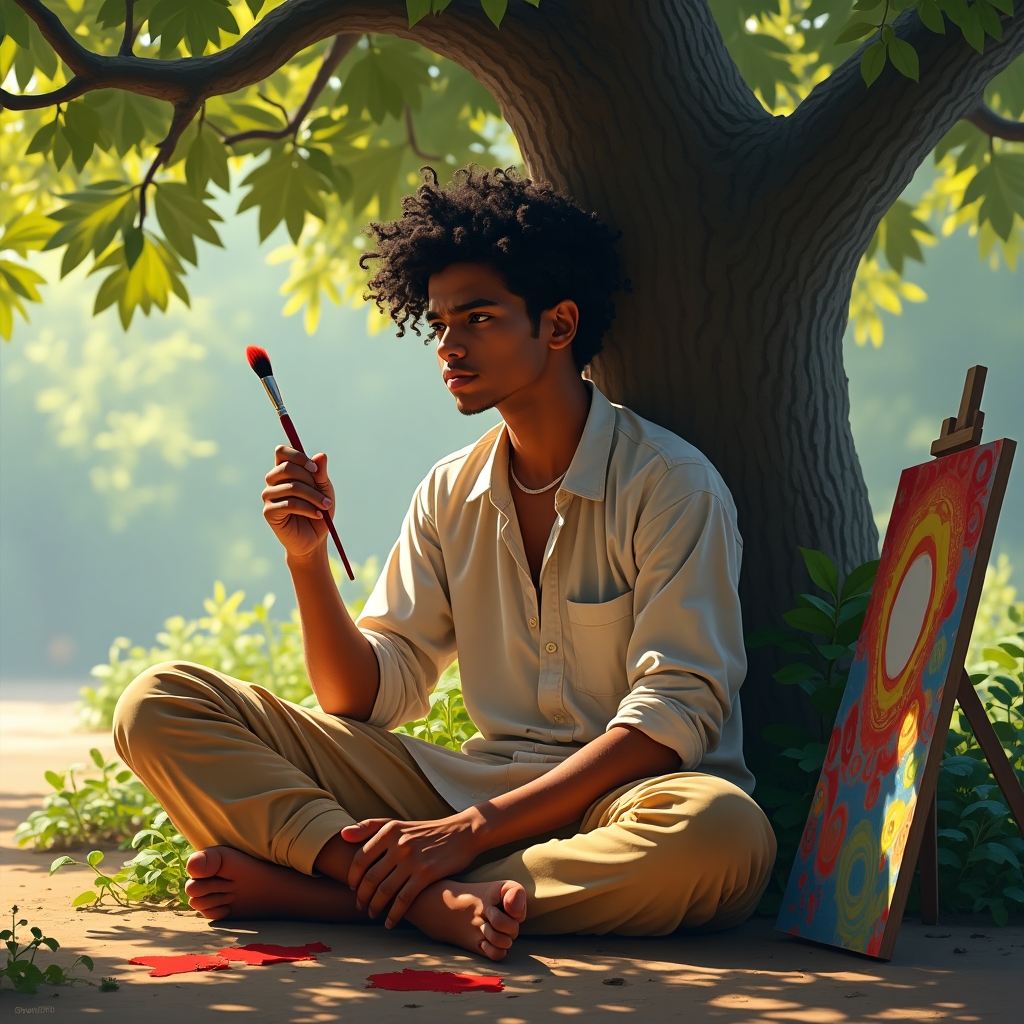




Aarav stepped onto the dew-laden grass of his family’s backyard, the soft morning light casting a serene glow on the garden. He often sought solace here, among the tender smiles of marigolds and the wise, ancient banyan tree that stood sentinel over generations. To his parents, the garden symbolized continuity and the preservation of tradition—a sanctuary where the past and present coexisted harmoniously. For Aarav, however, it was where he grappled with the invisible chains of expectation.
Born into a family that cherished their cultural roots, Aarav had always been depicted as the heir to a lineage defined by age-old customs and norms. From a young age, stories of ancestors who served the community, carried forward traditional values, and upheld familial honor were woven into bedtime tales. His mother, Shanti, often shared stories of his grandfather, a revered man in their village, who dedicated his life to upholding the family’s reputation.
As Aarav grew, so did a quiet dissonance within him—a muffled yearning to explore a life unbound from the predestined script written by others. He had a passion for painting, where he found a voice in colors and strokes that he could not articulate in words. Imagining vibrant canvases filled with stories untold, Aarav felt alive. Yet, this love remained a whispered secret, nurtured away from the prying eyes of familial expectations.
The internal struggle gnawed at him quietly, manifesting in a subtle tension that colored his interactions at family gatherings, where future plans were discussed with an implicit understanding of conformity. Aarav often listened in silence, caught between understanding the cultural narrative that defined his lineage and the personal truth that pulsed beneath his skin.
One afternoon, while the house was humming with preparations for a festive celebration rooted in tradition, Aarav found himself drawn to the garden. A gentle breeze whispered through the leaves, as if inviting him to unburden his heart. He sat beneath the banyan, its shadow a comforting embrace, and closed his eyes, letting the sounds of nature fill the void of unspoken words.
In the quiet embrace of the afternoon, Aarav began to paint. His brush danced across the canvas, colors merging and diverging, forming a kaleidoscope of emotions that words failed to capture. It was here, amid the symphony of colors, that he found a semblance of clarity.
With each stroke, Aarav unraveled the knot of expectation and fear, painting not just an image, but a narrative of his own making. The swirling hues captured not only his inner turmoil but also his burgeoning resolve. As he stepped back to observe his creation, a quiet revelation settled over him. The painting was more than an expression of rebellion; it was a testament to his truth, an assertion of identity amidst the cacophony of expectations.
Aarav’s moment of clarity was neither loud nor defiant. It was a gentle understanding that his identity was a tapestry woven from both the threads of heritage and the colors of his aspirations. He realized he could honor his family’s past without negating his individuality.
As he stood there, a new determination took root within him, tender yet resilient. Aarav decided that his path would not be dictated solely by tradition nor completely detached from it, but rather a harmonious blend of who he was and who he desired to be.
In the days that followed, Aarav began to share his paintings with his family, revealing not only his passion but his journey towards self-acceptance. At first, there was silence—a pause laden with the weight of unspoken expectations. Yet, as the family gathered around his canvases, the silence gave way to curiosity and eventual understanding.
His mother, Shanti, was the first to break the silence, her eyes reflecting a complex mix of emotions. “These are beautiful, Aarav,” she said softly, a trace of wonder in her voice. There was a pause, a moment of connection as she saw the heart within the art.
In that quiet exchange, Aarav felt the beginnings of a bridge—a way to traverse the divide between familial loyalty and personal truth. It was not a resolution, but a step toward healing, a way to honor both the past and the future.
Aarav learned that emotional courage often took the form of quiet persistence, a gentle insistence on one’s truth amidst the static of tradition. Through his paintings, he discovered a voice that resonated, not as an echo of the past, but as a melody of the present, guiding him forward.