




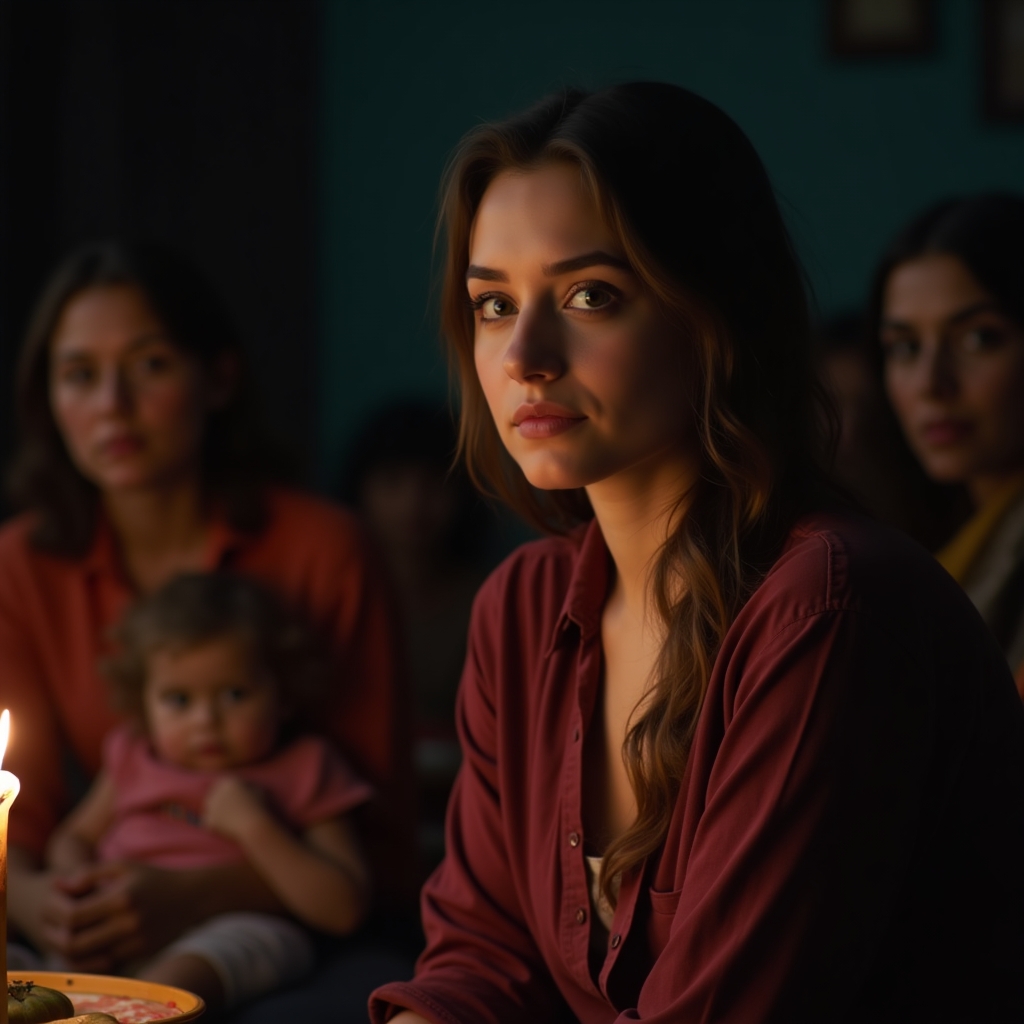
In the heart of a bustling city, nestled in a modest neighborhood, lived a young woman named Leila. At twenty-six, she stood at the precipice of adulthood, where youthful dreams mingle with the weighty expectations of family heritage. Her Iranian parents had fled their homeland, seeking freedom and a brighter future, treasures they had diligently pursued and attained over the years. Yet, their dreams bore the silent chains of cultural fidelity.
Leila worked as a marketing consultant, her office a sterile cube filled with the incessant hum of fluorescent lights and the soft clatter of keyboards. While her colleagues were absorbed in upward mobility, Leila’s mind often drifted to the colorful markets and winding alleys of her childhood visits to Tehran. The paradox was clear: her heart swayed to the rhythms of a past life, yet her feet were firmly planted in a world defined by different values.
Every evening, the familial home resonated with a different harmony — one of tradition and expectation. Her parents, Amira and Kasra, had always emphasized the importance of community and family, a foundation that had been their anchor in a foreign land. Discussions over dinner frequently centered on relatives and family friends, their triumphs, and, more covertly, their failures. It was in these conversations that an unspoken expectation took root: Leila was to marry a suitable man, someone who could uphold their family’s standing and heritage.
Leila’s parents were kind and loving yet firm in their beliefs. Her mother, Amira, often reminisced about the lavish weddings of her youth, her eyes glistening with nostalgia. ‘When you marry, it will be the celebration of the year,’ Amira would muse, her hands weaving stories in the air. Kasra, her father, would nod in agreement, his voice steady with the wisdom of experience. ‘Marriage is a partnership, a commitment to our history and future.’
But Leila’s heart was restless. In the quiet moments of her life — the dawn walks through the city park, the solitary evenings spent painting in her tiny apartment — she felt the stirrings of a different calling. It was as if the winds of her own aspirations whispered secrets meant only for her ears. She longed to travel, to write, to immerse herself in stories of people and places yet unknown.
The tension between her desires and her family’s expectations grew slowly, like the steady drip of rainwater eroding a stone. She often found herself lost in thought, a gentle frown creasing her brow as she considered the path laid before her and the one she wished to forge.
Then came the day that reshaped her perspective. It was during a family gathering, one of those lively affairs where laughter and boisterous conversations mingled with the aroma of saffron-infused dishes. As she sat quietly observing the joyous chaos, her cousin Ramin, known for his eloquence, began to speak of his recent experiences abroad. He spoke passionately about a project that had taken him to Africa, where he worked with communities to develop sustainable farming practices.
Leila listened, enraptured by his tales of adventure and impact. Ramin had chosen a path of his own, one that resonated deeply with her. After his speech, Leila hastily followed him to a quiet corner of the room.
‘How did you do it?’ she asked, her voice barely above a whisper. ‘How did you choose this life?’
Ramin smiled, a knowing glint in his eyes. ‘I realized that honoring our heritage doesn’t mean following the same path. Our generation has the chance to redefine what it means to be true to ourselves and our roots.’
In Ramin’s words, Leila found a mirror to her innermost thoughts. A sense of clarity washed over her, a realization that she could forge her own path without forsaking her family’s legacy. It was a quiet, yet profound shift, much like the gentle turning of a leaf caught in the breeze.
That evening, as the celebration wound down and guests began to depart, Leila sat with her parents amidst the remnants of a joyful gathering. Her heart was full, and she knew it was time to speak her truth.
‘Mom, Dad,’ she began, her voice steady but soft, ‘I want you to know how much I love and respect everything you’ve given me. You’ve taught me the value of family and tradition, but there’s a part of me that yearns for more. I need to explore the world, to find my own way.’
Amira and Kasra exchanged a glance, a silent conversation passing between them. Kasra spoke first, his voice tender. ‘Leila, we understand. We came to this country for freedom, for you to have choices we never did. Your path may be different, but it is yours to choose.’
Tears welled in Leila’s eyes, a mixture of relief and gratitude. The quiet struggle within her had found a voice, and though the journey was just beginning, she felt an overwhelming sense of peace. In that moment, she realized that staying true to oneself doesn’t have to mean abandoning the past, but rather, weaving it into a future of one’s own making.