




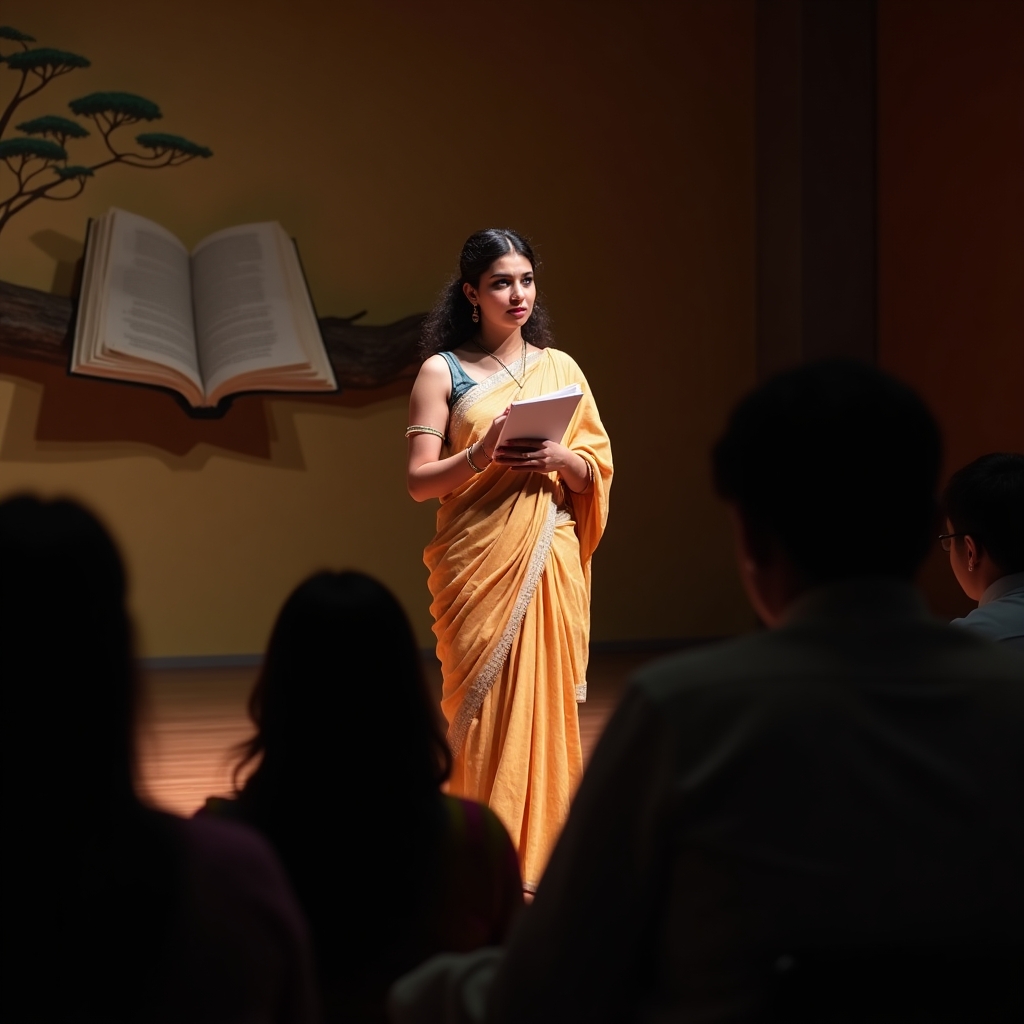
In the quaint town of Elmvale, nestled between forested hills and whispers of the past, lived a young woman named Anika. Her life, much like the meandering river that cut through the town, was shaped by the contours of tradition and expectation. The daughter of Indian immigrants, Anika was raised on stories of resilience, sacrifice, and the weight of family legacy.
From a young age, Anika was acutely aware of the dichotomy between her own aspirations and the path her parents had envisioned for her. Her parents, who were once newcomers in a foreign land, had woven a tapestry of dreams from their struggles: a respected career in medicine or engineering, marriage to a suitable partner, and a life that seamlessly integrated into their adopted home while preserving the essence of their heritage.
Yet Anika’s heart danced to a different rhythm. She found solace in the quiet company of books, where the world’s complexities were untangled into words, and languages spoke in hues her parents’ expectations couldn’t paint. More than anything, she longed to be a writer, to tell stories that bridged the chasm between cultures.
This internal conflict simmered beneath the surface, manifesting in subtle signs—a lingering glance at a bookstore window, the quiet way she folded the corner of a page as if preserving a secret. Her parents, oblivious to these signs, planned her life with love-stained certainty, believing they were securing her future.
As Anika approached the zenith of her collegiate life, the pressure mounted. Her parents were eager for her to choose a practical major, one that promised stability and respect. “Anika,” her father would gently remind her over dinner, “there’s dignity in having a profession that serves others.” She would nod, her heart a silent cacophony of withheld desires.
The tension, though quiet, was palpable. Anika navigated her days with perpetual uncertainty, her small acts of rebellion muted but persistent. She joined the college’s literary club, secret meetings that felt like stolen moments of authenticity. There, among kindred spirits, she learned to articulate her thoughts, weaving narratives that danced around her dreams and fears.
In her final year, a cultural festival was announced—a celebration of heritage, an opportunity to showcase the richness of their community. Anika was chosen to present a piece that represented her cultural background. This was it, a chance to honor her parents while subtly inscribing her truth.
As the festival approached, Anika pored over her writing, experimenting with stories that blended folklore with her own voice. She crafted a tale of a young girl who conversed with pines, each tree a keeper of ancestral wisdom and silent witness to generational change. Through the story, Anika whispered her struggles, hopes, and the tension that twisted her heart.
The night of the festival arrived, and Anika stood backstage, cloaked in a sari her mother had lovingly chosen. Her hands trembled, the script a fragile testament to her quiet rebellion. As her name was announced, she walked onto the stage, met by a room filled with familiar faces—friends, teachers, and her parents, seated in the front row, their expressions a blend of pride and expectation.
Her voice, initially tentative, gained strength as she wove her story. Words flowed like the river of Elmvale, her narrative revealing the complexity of her inner world. Anika spoke of the girl who conversed with pines, each whisper echoing the silent battles waged in the shadows.
As she finished, an unexpected hush enveloped the room. It was in that silence that Anika experienced a profound clarity. She realized her struggle was not a betrayal of her parents’ dreams but a continuation of their journey. They had crossed oceans for a voice; hers was merely a different timbre.
Her parents, eyes glistening with a nuanced understanding, embraced her as she stepped down from the stage. In that moment, Anika understood that the strength to assert her truth lay not in defiance, but in the quiet courage to be herself within the tapestry of her heritage.
From then on, Anika balanced her path with grace, pursuing a double major in literature and anthropology, a compromise that allowed her to honor her roots while exploring her passion.
The whispering pines of Elmvale continued their eternal vigil, witnesses to the evolving narrative of a young woman who learned to live in harmony with the echoes of her past and the promise of her future.