



Asha sat on the worn, mustard-yellow couch in her family’s modest living room, her heartbeats syncing with the steady tick of the wall clock. The room was a canvas of heritage, with photographs of stern ancestors and the musky fragrance of sandalwood lingering in the air. Her grandmother’s sari-clad figure bustled in the kitchen, her bangles clinking like wind chimes—a melody Asha had known since childhood.
At twenty-three, Asha felt the weight of expectation more acutely than ever. Her family, rooted deeply in tradition, hoped she would marry soon, preferably before the next monsoon washed over the village. Marriage was not just a union but a binding thread in the fabric of their cultural identity. Yet, Asha’s heart longed for something beyond what her village and family envisioned.
Her dreams were painted with vibrant hues—vivid, abstract images of cities bustling with art galleries, libraries, and conversations that lingered into moonlit nights. The desire to study architecture at a prestigious university in the city was growing, a seed planted during a school trip when she first stood amidst the towering, modernist buildings that spoke to her more than any suitor ever had.
While her mother recounted tales of neighborly weddings, Asha nodded politely, her mind adrift on the possibilities of a life yet unlived. Her father, once a young man who had traveled far for his education, now seemed resigned to the rituals of their lineage. He often shared stories of his youthful adventures abroad but always concluded with a reminder of his return, emphasizing the importance of coming back to one’s roots.
The subtle tension encased her like a tight cocoon—each day a silent battle between her dreams and the implicit duty of fulfilling familial roles. She maintained her silence, allowing the unspoken dialogue to unfold within her. But when in solitude, beneath the ancient banyan tree just outside their home, she dared to dream aloud.
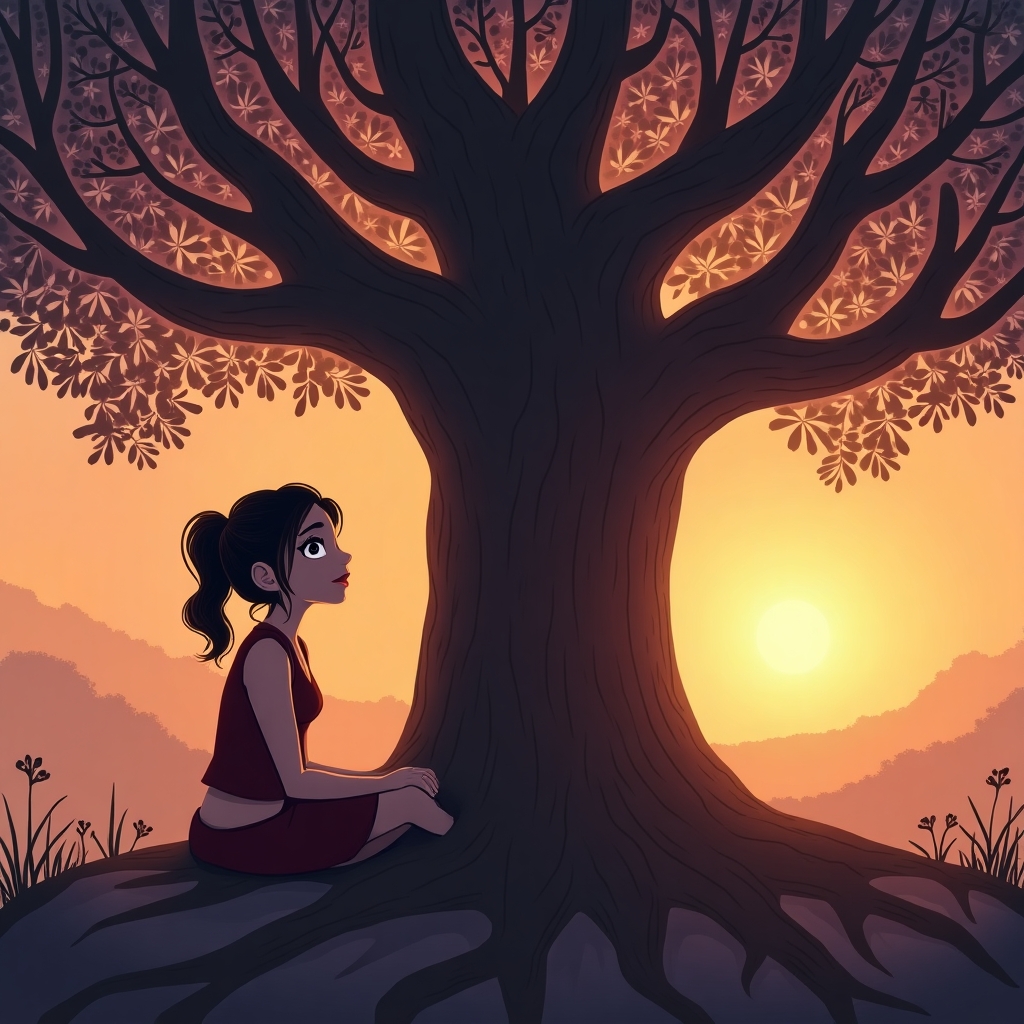
It was here that the clarity slowly seeped into her consciousness, each root of the banyan mirroring her internal struggles. The tree, a symbol of time and resilience, echoed her dilemma: the need to grow yet remain grounded. She often sat there until dusk, when the sky blushed a soft pink, and the air turned cool, pondering how her desires and responsibilities might coexist.
One evening, as the sun dipped below the horizon, painting the sky in a palette of orange and purple, Asha found herself under the banyan once more. Her fingers traced the rough bark, her thoughts a tangled web of obligation and aspiration. She closed her eyes, letting the whispering leaves become a chorus of her consciousness.
In that moment, a breeze swept through the branches, rustling the leaves like a mother’s gentle caress. It was as if the tree was whispering a truth she had known all along but feared to acknowledge. The realization came not as a bolt of lightning but as a gentle ray of sunlight breaking through morning mist: she did not have to choose one over the other.
Asha could embrace the wisdom of her ancestors while forging her own path. Her roots could anchor her, providing the strength she needed to soar. The insight was both a liberation and a revelation. She could envision herself returning to this place, to these people who loved her, not out of duty but out of choice.
With this newfound clarity, Asha felt a surge of emotional courage, invisible yet palpable. It was subtle, almost fragile, but unmistakably there—a quiet strength that would guide her conversations and decisions in the days to come. The banyan tree, steadfast and unwavering, had borne witness to her silent transformation.
The next morning, Asha approached her parents, her heart steady, her voice calm. She spoke of her dreams and her love for her family, weaving them together in a tapestry that no longer felt torn. Her parents listened, their initial apprehension softening under the weight of her sincerity.
Her mother, eyes brimming with unspoken understanding, reached for Asha’s hand. Her father nodded, seeing a reflection of his own youthful ambitions in Asha’s determined gaze. It was not an easy acceptance, but it was one born from love and respect—the first step towards a new generational narrative.
In the days that followed, Asha prepared for her journey to the city. Her heart was lighter, not because the expectations had vanished, but because she had found a way to carry them with grace. The banyan tree stood as a silent testament to her resolve, its roots deeply entwined with the soil of her past, its branches reaching for a sky full of future possibilities.