


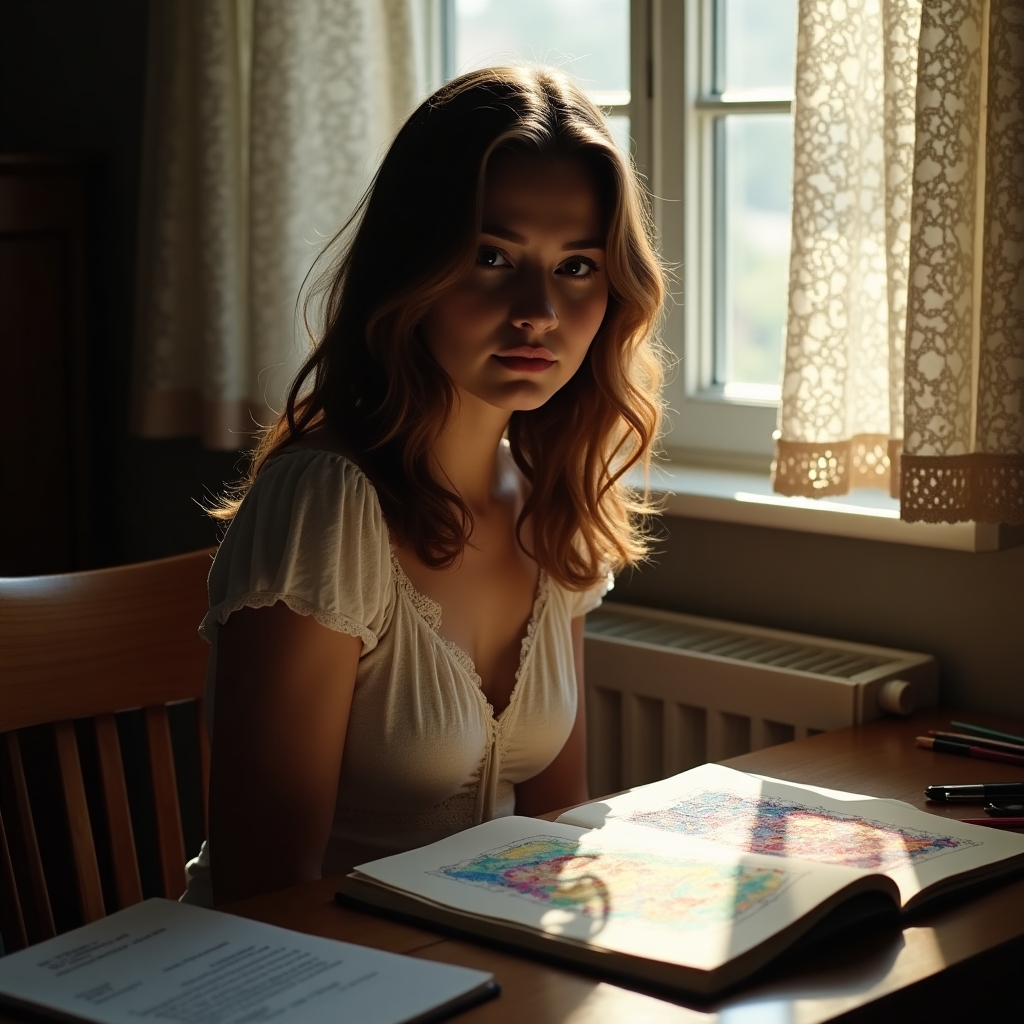
Adeline Chau sat quietly in her room, the late afternoon sun casting patterned shadows of the lace curtain onto the wooden floor. Her fingers traced over the letters of an unopened acceptance packet from the prestigious art school she had dreamed about since she could remember. It lay on her desk like a beacon of hope that also illuminated a path of uncharted complexity. All around her, family photos adorned the walls, reminders of the rich and binding tapestry of expectations and dreams her family envisioned for her—none of which involved the word ‘art’.
Adeline was a second-generation immigrant. Her grandparents had fled their war-torn homeland with little but the clothes on their backs and the hope of a better future for their descendants. Their sacrifices had sewn heavy quilts of obligation, woven with thread that whispered both encouragement and restraint. Her parents, a doctor and an engineer, had worked tirelessly, always with the unspoken expectation that Adeline would follow suit—choosing a path of security over passion.
Yet, her heart had always been drawn to the creative. Colors, textures, and the stories they could tell fascinated her more than any equation or scientific theory. Her sketchbook, tucked beneath her mattress like a secret lover, was filled with portraits and landscapes, capturing moments and emotions in a way that spoken words could not.
Dinners at the Chau household were a silent waltz of unspoken words and shared glances. Her parents, while loving and supportive in their own way, often discussed the future in terms of stability, security, and familial pride. Adeline, the dutiful daughter, nodded along but felt a gnawing discontent that simmered just below the surface.
She found solace in her art teacher, Mrs. Li, who had seen the spark in Adeline from her first tentative brushstrokes. “Art is not just the creation of beauty,” Mrs. Li would say, “but a conversation with your soul.” It was Mrs. Li who had encouraged her to apply to the art school, recognizing her talent and the deep yearning that Adeline had tried to keep buried.
Every time her parents asked about her college applications, Adeline would mention the other, more practical universities she had applied to, conveniently leaving her acceptance to the art school unspoken. It was a dance of omission, one she had practiced to perfection.
One evening, as her family gathered around the dinner table, the conversation inevitably turned to college. Her younger brother chattered excitedly about his plans to study engineering, basking in the approving nods from their parents. Adeline’s heart pounded in her chest, a cacophony of fear and longing.
As the meal drew to a close, her mother turned to her, eyes filled with expectation, “Adeline, have you made a decision yet? Your father and I are proud of all you’ve achieved, but you know how important it is to think about your future.”
The room felt smaller, the air dense with the pressure of generations staring at her. Her fork clattered against her plate, the sound a jarring note in the symphony of family life.
“I… I need to think a little more,” Adeline replied, her voice barely above a whisper, the practiced response automatic yet hollow.
Later that night, as silence draped the house like a heavy blanket, Adeline lay in bed, her mind swirling with images and words. Her heart ached with the weight of choices and consequences. She thought of her grandparents, of the bravery it took to leave everything they knew for the unknown. She realized that bravery wasn’t just in action but in truth, in living a life that honored both oneself and those who came before.
As dawn broke, painting the sky with vibrant hues, Adeline sat at her desk once more, the acceptance packet before her. Something shifted within—a quiet resolve, like the gentle yet unyielding tide reshaping the shore. She understood now that pursuing art didn’t mean rejecting her family’s hopes, but rather expanding them.
With steady hands, she picked up a brush, dipping it into her favorite cerulean blue. She painted her emotions onto the canvas, the colors a dialogue between heart and heritage. As she worked, the fear slowly ebbed away, leaving space for something new.
The following weekend, as the family gathered for dinner, Adeline felt the familiar knot in her stomach but also a new sense of purpose. The clinking of cutlery and familial chatter filled the room as Adeline cleared her throat.
“Mom, Dad,” she began, meeting their eyes with newfound courage, “I’ve made a decision.” The room fell silent, anticipation palpable.
“I’ve been accepted into the art school,” she said, her voice steady and unyielding. “It’s where I feel I can best honor the legacy you’ve given me and find my own path.”
Her parents exchanged a glance—a silent communication woven from years of shared life. Her mother spoke first, a softness in her voice Adeline had not expected, “We’ve always wanted you to be happy, Adeline. It may not be what we envisioned, but we trust you.”
In that moment, the tension that had long divided the family seemed to dissolve, replaced by a deeper understanding. Adeline realized that the legacy of her family was not in the paths they assumed she would take, but in the courage to forge her own.
The room, once filled with unspoken words and expectations, now brimmed with possibility.
Adeline felt a profound sense of peace, the kind that comes from embracing one’s truth and trusting that love would find a way to heal and connect across generations.