
In a quaint town nestled by a river glistening like molten silver under the sun, there lived a young woman named Aria. Her days were filled with the soft hum of weaving looms and the vibrant hues of hand-dyed yarns, as her family ran the oldest textile shop in the region. For generations, the Loom & Thread was not just a business but a legacy, a tapestry of history woven with culture and tradition.
Yet, for Aria, the loom held a different sound. It was not the soft hum of creativity but rather the rattling chains of expectation. Each thread she spun seemed to tighten the bind of familial duty around her, knotted with her mother’s gentle reminders and her father’s silent disappointments. While her heart pulsed with the rhythm of creation, her soul yearned for the painter’s palette, the brush, and the canvas.
Aria’s earliest memory was of her grandmother’s gentle hands guiding hers across a loom. “Every thread tells a story, Aria. Our stories,” her grandmother had said, her eyes glistening with pride. But instead of resonating with this inheritance, Aria dreamt in colors beyond the thread’s spectrum, in landscapes not contained by the confines of a loom.
Her family’s expectations were an unspoken language, communicated through the quiet persistence of daily life. Her mother’s eyes would linger on her loom, subtly urging her to be faster, to be better. It was a soft pressure, like the weight of a warm quilt—a presence that was comforting yet suffocating. Her father, though quieter, possessed an imposing silence that spoke of generations of sacrifice and hard work.
The psychological tension within Aria simmered like a pot on the verge of boiling over, though no one seemed to notice. She wore her responsibilities like a cloak, heavy but familiar, until one afternoon when clarity found her in the most unexpected way.
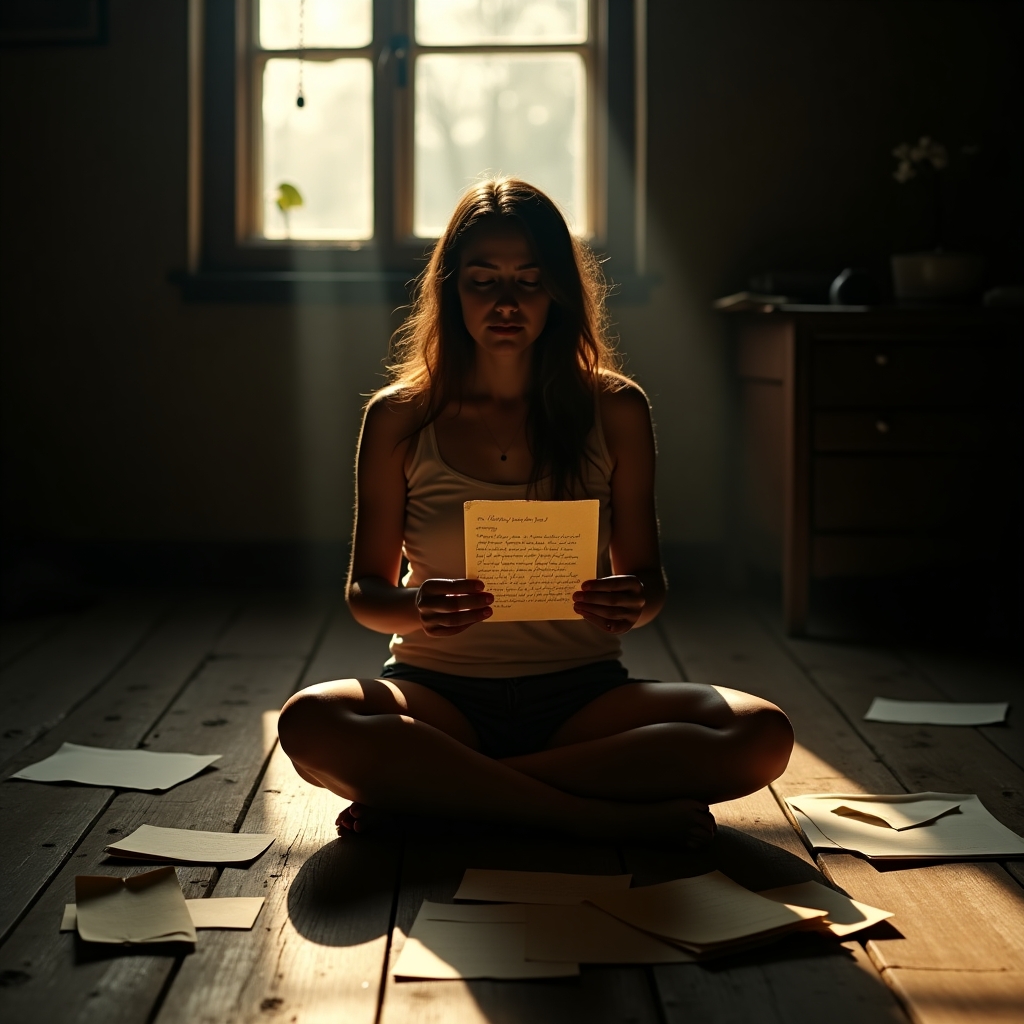
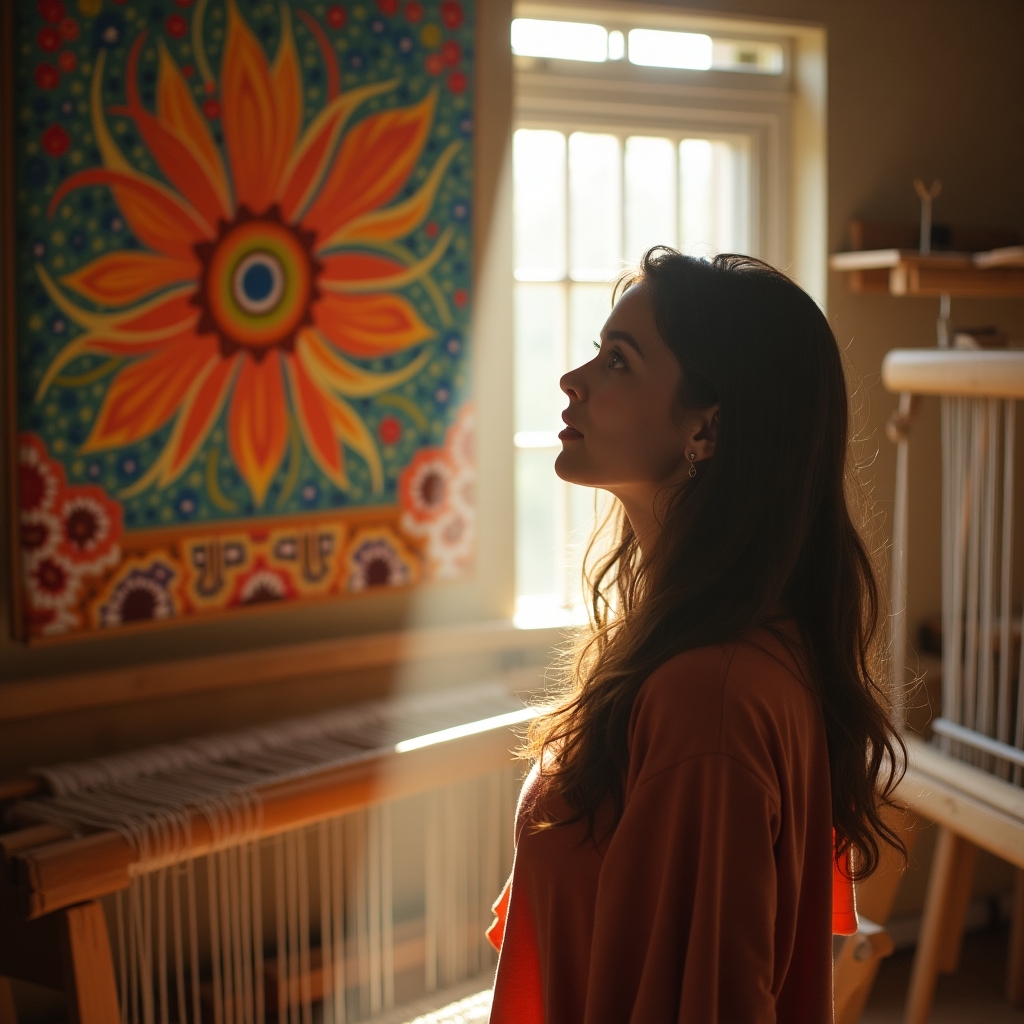
It was a day like any other, with sunlight sifting through the shop’s windows, painting golden patterns on the wooden floor. Aria was lost in her thoughts, the rhythmic clack of the loom merging with her internal cacophony. As she worked, she found herself staring at a faded painting hanging high above the shop—it was an abstract piece, vibrant and untamed, starkly contrasting the orderly rows of colored yarns.
The painting was a relic from an art fair Aria’s mother attended in her youth—a brief flirtation with artistic freedom before life settled her into her role. It was a piece that had always intrigued Aria, its colors swirling like a thunderstorm, capturing the chaos she felt inside.
In that moment, as sunlight illuminated the painting, something shifted within Aria. She realized that the painting was not just an anomaly in her world of meticulous order, it was a window—a portal into a realm where freedom and tradition could coexist. The threads of burden loosened, unraveling into new possibilities.
Aria felt an emotional clarity wash over her, a deep understanding that to honor her family, she didn’t have to forsake her own dreams. Tradition was not a chain, but a thread, capable of weaving new patterns into the fabric of life.
With this realization, Aria decided to speak her truth. That evening, around the dinner table where words were often sparse, she found her voice. “I need to paint,” she said, her voice steady but quiet, like the first drops of rain after a long drought. Her parents looked at her, eyes wide with surprise.
Her mother was the first to speak. “But… the loom, our family…”
“I know,” Aria replied softly, “and I love it. But I also love painting. I believe I can honor both.” Her words hung in the air, a delicate tapestry woven from courage and vulnerability.
The silence that followed was not one of disappointment, but contemplation. Her father’s eyes softened, the tension dissolving into understanding.
“Do what you must, Aria,” he finally said, his voice a hushed whisper of acceptance. “Create your own story.”
In that moment, Aria felt the gentle release of generations past, a blessing to forge her path without severing the roots from which she grew. The shop, the loom, the threads—they would always be a part of her, but now they would dance with the strokes of her brush.
As the stars emerged, casting a tranquil glow over the town, Aria sat at her easel, paintbrush in hand, ready to weave her own narrative, one color at a time.