



I’ve never been one to lay my heart bare online. Keeping things close has always felt safer, like sipping tea while wrapped in a shawl my grandmother wove, its texture a reminder that certain stories are spun from threads no one else can see. But today, I feel this quiet need to share.
A week ago, I was rummaging through the attic. Not out of nostalgia or a desire to declutter, but rather because a leak had crept its way into a corner no one bothered with for years. I stumbled upon a box that, at first glance, seemed no more significant than the others. It was dust-covered and unmarked, unlike the boxes that screamed of past Christmases, family vacations, or my rebellious teen years.
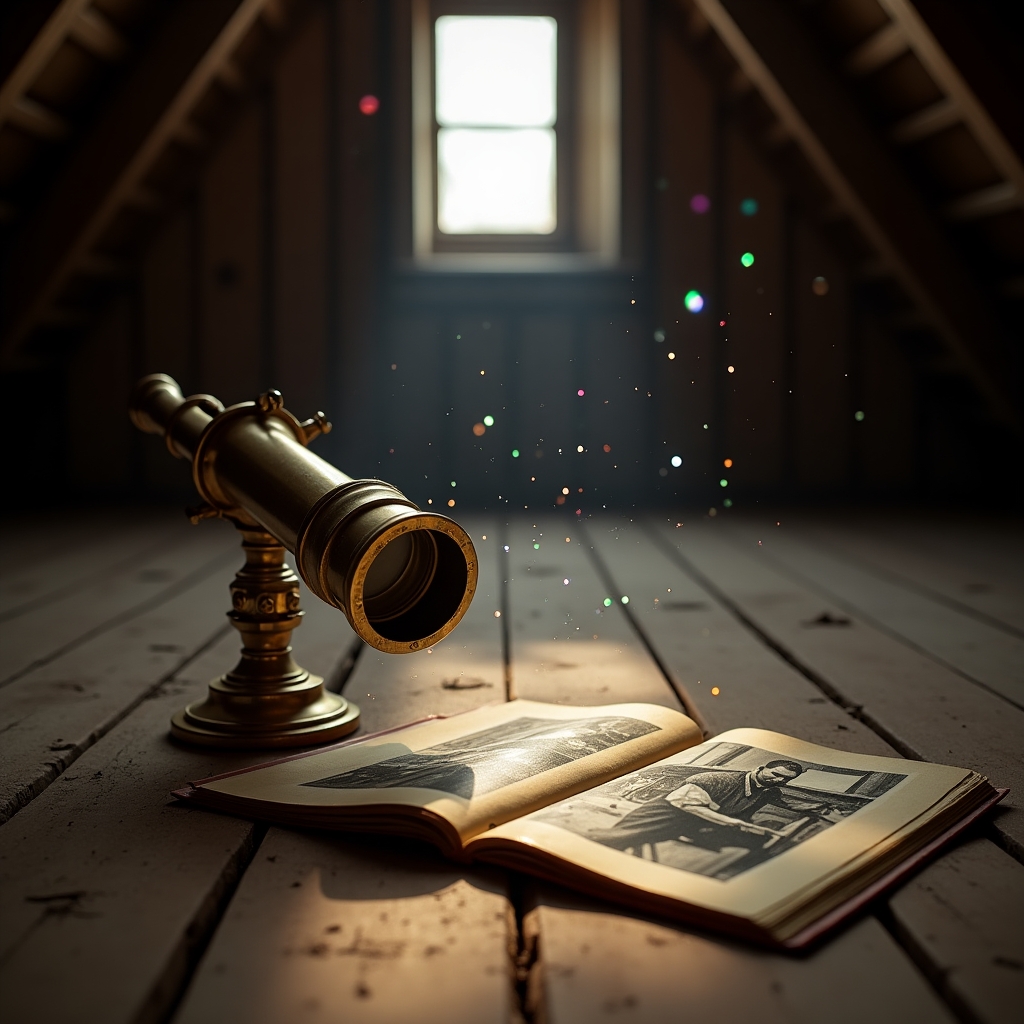
Inside, I found a kaleidoscope. Not the kind you’d expect—a child’s toy of plastic and primary colors—but an elegant tube of polished brass and stained glass. Its presence was strange, yet it stirred a familiarity I couldn’t place. As I turned it, watching the shards of light shift and form new patterns, I felt a pull towards something buried deep.
Later that evening, I called my mother. I described the kaleidoscope, unsure of the memories it stirred. Her voice paused, a rare hesitation that prickled my skin.
“That was your father’s,” she said softly. “He used to make them.”
I was stunned; my father, the man whose absence was a quiet shadow over my life, had made this beautiful thing. I had always known him as a stern, pragmatic figure from the sparse stories I heard. There was no hint of this creative side—that side which now reflected in shards of colored light.
“Why didn’t you ever tell me?” I asked, voice trembling.
“I thought it was one of those parts better left in the past,” she replied, a veil of old pain in her voice.
For the next few days, I found myself drawn to the kaleidoscope, letting its colors seep into me like a stream that finds its way into the cracks of parched earth. Each rotation felt like a piece of a puzzle promising something more. It wasn’t just the light that shifted; it was my perception of my father.
I visited my mother, bringing the kaleidoscope with me. It sat between us on the kitchen table like a fragile truce. We sat in silence, letting its presence do the talking. Eventually, she brought out a photo album I’d never seen. There were pictures of my father at work in a small workshop, eyes intent and hands nimble. I could see in his expression a passion that mirrored something within me—my love for painting, a love I’d assumed was simply mine.
“He wasn’t always sad,” she said, her voice a crackling whisper. “There was happiness in his life, more than you know.”
I realized then that my father had been a man whose life wasn’t just a series of absences, but whose joy had been eclipsed by overshadowing sadness. And yet, here was a fragment of his spirit, a kaleidoscope he had crafted to bring light into the world.
I left my mother’s house with a new understanding nestled among the kaleidoscope and photo album. I saw threads of him in me, woven into the fabric of who I am, in ways I never noticed.
As the week passed, I found myself painting more, the strokes guided by a hand that suddenly felt guided by generations. There was a clarity that settled in my bones, a realization that life is too multifaceted to be defined by singular truths.
When I look at that kaleidoscope now, it’s not just an object but a connection—a bridge between what was lost and what remains. And maybe, just maybe, it’s a way to reach him in the only way possible: by embracing the light he left behind.