
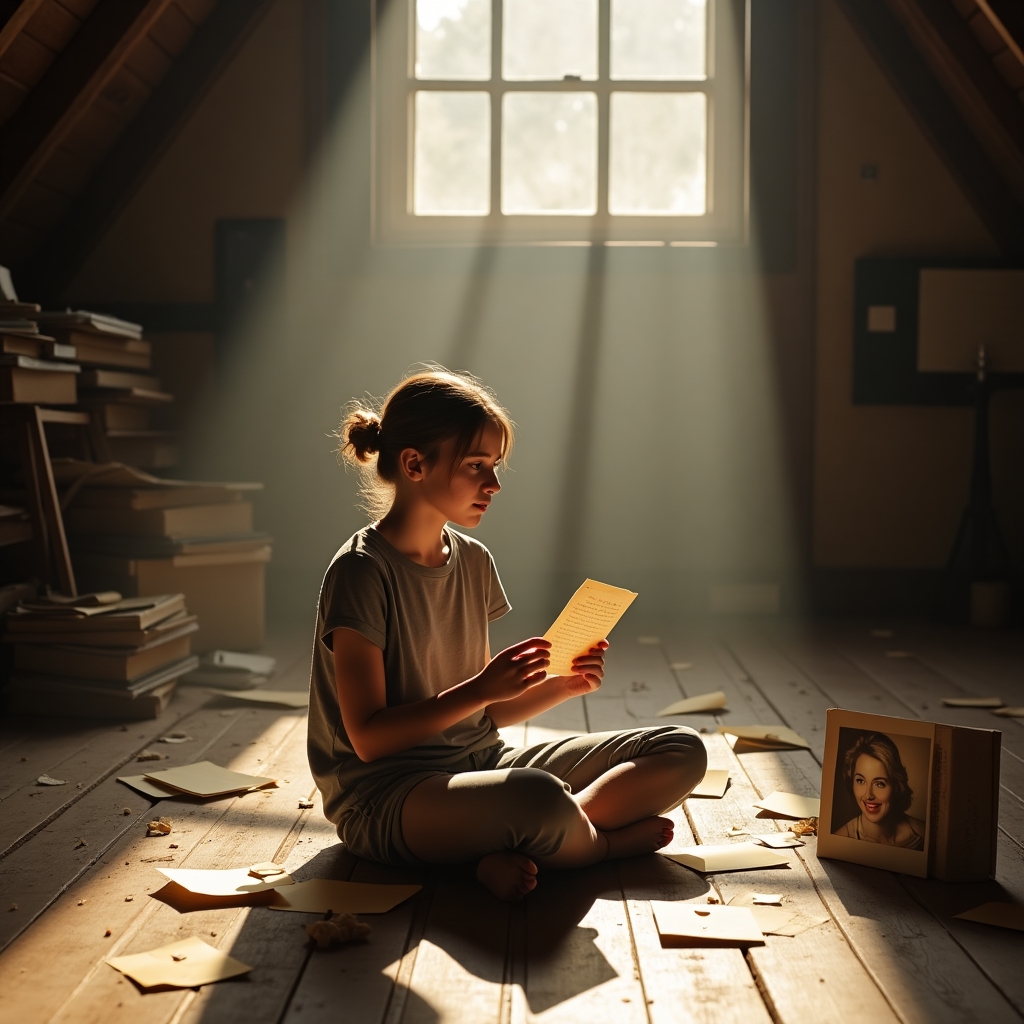




The jasmine-scented air of early evening settled in the courtyard, where the faint glow of the hanging lanterns began to awaken. Ada sat quietly on the worn steps of her family’s ancestral home, her fingers tracing the delicate patterns of her grandmother’s ancient shawl draped around her shoulders. This place, with its age-old walls and whispers of history, had always cradled her in its familiar embrace, yet it was also the very heart of her unrest.
Growing up, Ada had been entranced by her family’s rich cultural heritage. Each festival, each ritual had a rhythm, a melody she was part of. Her parents, firm believers in the continuation of tradition, had imparted in her the weighty responsibility of legacy. Ada’s mother was particularly adept at reminding her of familial expectations, often weaving stories of the past with subtle cues about the future they envisioned for her.
But Ada was also a child of her time. The world beyond the courtyard held its own allure with its new ideals and novelties. Her education had opened her eyes to new perspectives and ways of being that resonated with a part of her soul she had only recently begun to discover. There was a growing dissonance within her—the pull of two worlds, seemingly irreconcilable, tearing at her inner peace.
Evenings like this, when the world was hushed and contemplative, were when Ada felt the tug most deeply. Her grandmother would often join her, wrapping them both in the shawl, lending warmth with her presence. She would hum gently, the tune of an old lullaby, its melody slipping softly into the night, drawing memories and questions to the surface.
“What weighs on your heart, child?” her grandmother would often ask, her voice a gentle caress.
Ada would hesitate, torn between the desire to confide and the instinct to protect her family from her inner turmoil. Tonight, however, she felt different. Weary from the constant internal battle, she found herself admitting, “I feel caught between two worlds, Grandma.” Her voice was barely a whisper, but it carried the weight of her struggle.
Her grandmother paused, her hand gently squeezing Ada’s. There was silence, the kind that urges reflection rather than demands it. “Two worlds?” she prodded softly.
Ada nodded. “Our traditions, our family’s expectations, but also… the world beyond. There’s so much I want to explore, to become, that feels at odds with what is expected of me.”
Her grandmother listened, the lines of her face softening as she absorbed Ada’s words. “Every generation must find its own balance,” she mused. “We carry the past with us, yet it is the present where we must decide how to honor it. Your heart will know the path that is true to you.”
In the weeks that followed, Ada quietly navigated the subtle tensions of her life. She attended family gatherings, participated in rituals, yet she also allowed herself the space to explore her own aspirations—joining discussions that challenged her worldview and pursuing studies that others deemed unconventional.
Each step was tentative, like walking on a tightrope strung between tradition and self-discovery. She often gazed at herself in the mirror, searching for the reflection of someone who knew where she belonged. It was in these small, quiet moments of introspection that Ada began to understand that her journey was not about choosing one world over the other but rather weaving them together.
The breakthrough came one evening, as she stood in the courtyard once more. The air was crisp, the lanterns flickering with a welcoming glow. She felt the warmth of the shawl around her shoulders, her grandmother’s presence a comforting constant.
In that moment, Ada realized she wasn’t torn between two worlds; she was the bridge that could unite them. Her personal values and her family’s expectations were not enemies but rather threads of a single tapestry. With this clarity, she felt a deep-seated peace, the kind that gives wings to speak one’s truth.
Ada turned to her grandmother, a gentle resolve in her eyes. “I will honor our traditions, but I will also honor my path,” she declared, her voice steady and true.
Her grandmother nodded slowly, a knowing smile gracing her lips. “Then you have found your harmony, my dear.”
From that day on, Ada walked with a quiet confidence. She participated in family traditions with renewed appreciation, knowing they were not chains but roots. Simultaneously, she pursued her ambitions, carving a path uniquely her own. Ada’s journey had taught her that the strength to live authentically comes not from choosing one side but from embracing the fullness of her heritage and her individuality.