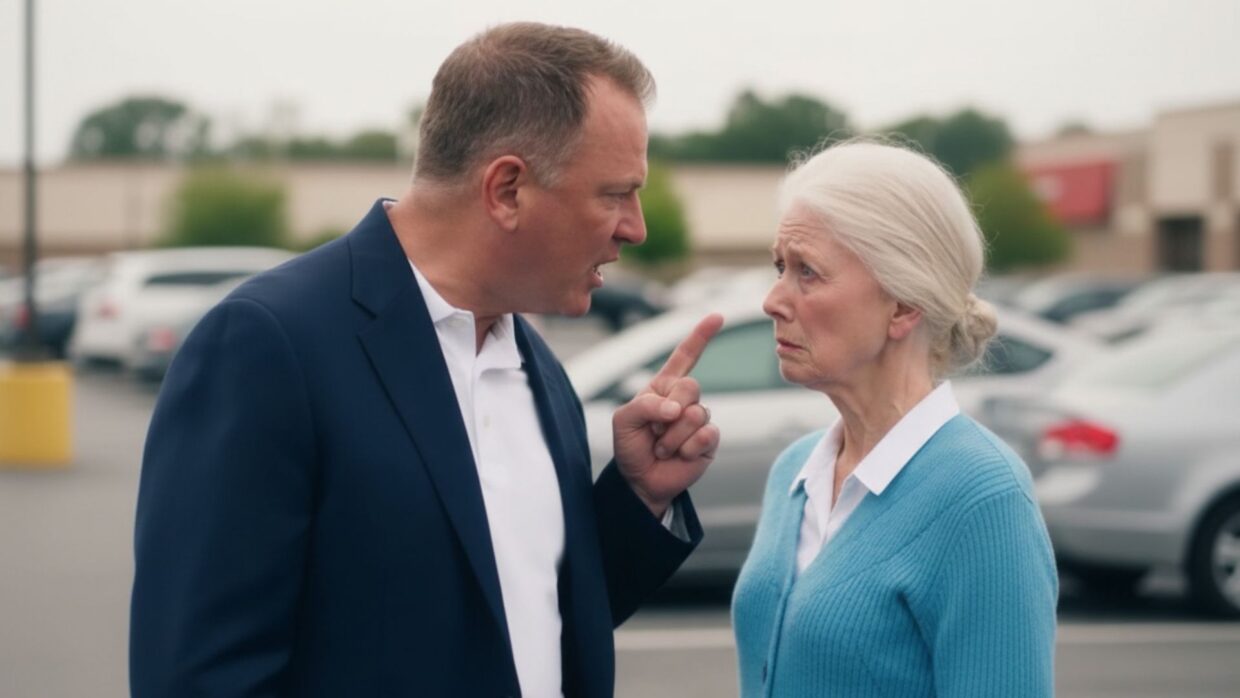
A wealthy couple cornered an elderly woman in a parking lot and screamed she owed them thousands… But the security guard who walked over had footage that turned every accusation back on them…
Margaret Calloway was seventy-one years old, five foot two, and had never once in her life raised her voice at a stranger.
That record almost broke on a Tuesday.
She had parked her 2009 Honda Civic — the one with the cracked side mirror she kept meaning to fix — at the far end of the Ridgeway Plaza lot. It was the spot she always chose: away from traffic, away from carts, away from people who drove like they owned the road because, in their minds, they did.
She’d spent forty minutes inside the grocery store. Celery, low-sodium soup, the good bread from the bakery section that her doctor said she shouldn’t eat but that she bought anyway because she was seventy-one and had earned the right.
She came out with two bags and a receipt and a small, private satisfaction that she’d saved $3.40 with her loyalty card.
She was reaching for her door handle when she heard it.
“Hey. Hey! Don’t you walk away from me!”
Margaret turned around slowly.
A man was crossing the lot in long, aggressive strides. He was maybe forty-five, wearing a sport coat over a polo shirt, the kind of outfit that said I could dress up but I choose not to because I’m already above you. His face was flushed, jaw set, eyes locked on her like she’d done something unforgivable.
Behind him, a woman in oversized sunglasses and a cream-colored blazer followed, arms crossed, chin tilted up.
Between them and the lane was a black Mercedes-Benz GLE — gleaming, polished, utterly perfect-looking — parked two spots over from Margaret’s Civic.
“That your car?” the man snapped, stopping three feet from her.
Margaret looked at her Civic. “Yes.”
“You scratched mine.”
She blinked. “I beg your pardon?”
“My car.” He pointed at the Mercedes. “Right there on the rear panel. Fresh scratch. You were the only one parked near it.”
Margaret looked at the Mercedes. From where she stood, she couldn’t see a single mark on it. “Sir, I just came out of the store. I haven’t touched your vehicle.”
“Didn’t ask if you touched it. I’m telling you it’s scratched and you were right next to it.”
The woman in the blazer stepped forward. Her sunglasses were the kind that cost more than Margaret’s car payment. “We have a $90,000 vehicle,” she said, as if that were a complete sentence. As if that explained everything.
“I understand that,” Margaret said carefully. “But I didn’t scratch it.”
“You were parked right there.”
“Yes. And I opened my door once, facing that direction—” Margaret pointed the opposite way. “I couldn’t have reached your car if I’d tried.”
The man shook his head with the slow, theatrical disgust of someone who had never once been contradicted without consequences. “Lady, I don’t have time for this. You scratched it. I need your insurance information.”
“I’m not giving you my insurance information because I didn’t do anything.”
That’s when his voice went up.
“Do you understand what that car costs?!” He stepped closer. Not close enough to be legally threatening — these people always knew exactly where that line was — but close enough that Margaret had to resist the urge to step back. She refused. She planted her feet and held her grocery bags and looked at him steadily.
“I understand what your car costs,” she said. “I don’t understand why you think I scratched it.”
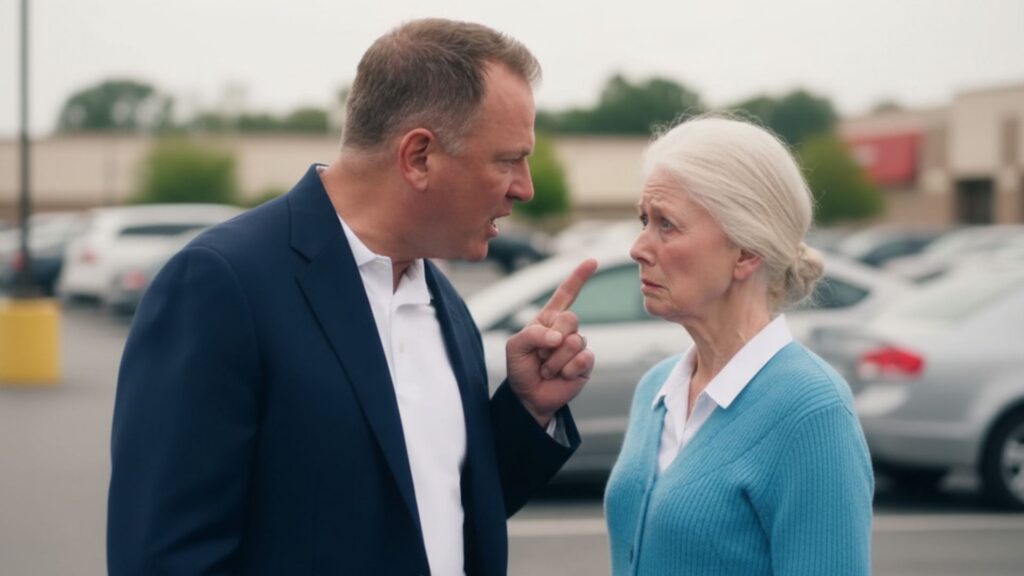
“Because you were the only one parked near it!”
“The lot was half full when I arrived.”
“I don’t care when you arrived, I care about—”
“David.” The woman touched his arm. Not to calm him down. To redirect him. “Get her plate number. We’ll file a claim.”
“You’re not filing a claim against me,” Margaret said. “Because I didn’t do anything.”
“You people always say that.” The woman’s voice was flat, bored, the tone of someone who had delivered this line before and been very satisfied with it.
Margaret felt something tighten in her chest. “You people,” she repeated quietly.
“Elderly drivers. No offense.”
“That is offense.”
“David, get the plate.”
The man pulled out his phone and walked toward the back of Margaret’s Civic, photographing her license plate with the practiced efficiency of someone who’d done this before — someone who used bureaucracy as a weapon, who knew that even a false claim filed correctly could cost an old woman months of phone calls and stress and fear.
A small crowd had begun to drift their way. Two teenagers near a cart return. A mother with a stroller who’d stopped twenty feet off. An older man sitting in a pickup truck with his window down.
Margaret stood very still. She had learned, over seventy-one years, that stillness was not the same as weakness. She had outlasted a husband’s death, a house fire, a company that laid her off at sixty-three and called it “restructuring.” She had outlasted a great many things that thought they could move her.
She was not moving.
“You’re going to hear from our lawyer,” the man said, pocketing his phone.
“That’s your right,” Margaret said.
“You think this is funny?”
“I think this is wrong.”
“Write her a check, David. Skip the lawyers.” The woman’s voice had shifted into something almost cheerful, the tone of someone who had decided the performance had gone on long enough. “Fifteen hundred. Just to cover the deductible. We’ll call it even.”
Margaret stared at her. “You want me to write you a check.”
“Or Venmo. Whatever’s easier.”
“For something I didn’t do.”
“For the scratch on our car.”
“Ma’am,” Margaret said slowly, “I will not.”
The man’s jaw clenched. He opened his mouth.
And that’s when they heard the footsteps.
A security guard — mid-twenties, heavyset, with the careful walk of someone who had learned not to rush into things — came across the lot from the direction of the plaza entrance. He had a radio on his belt and a tablet in his hand and an expression that was professionally neutral in a way that somehow made it more unsettling.
“Excuse me,” he said. He wasn’t addressing the couple. He was looking at Margaret. “Ma’am, are you Margaret Calloway?”
She blinked. “I am.”
“Did these individuals just accuse you of damaging their vehicle?”
She looked at the guard. Then at the couple. Then back. “They did.”
The guard nodded once. He turned to the man in the sport coat. “Sir, I’m going to need to ask you to hold on a moment.”
“Who are you?”
“Ridgeway Plaza security. We monitor the entire lot.” He held up the tablet, angling it toward the couple. “Ma’am,” he said again, to Margaret, “I’m sorry this happened to you. I saw the confrontation on camera and came out as soon as I could.”
David took a step forward. “Good. Then you saw her scratch—”
“The cameras recorded everything,” the guard said. His voice didn’t rise. It didn’t have to. “And it wasn’t her fault at all.”
Silence.
The kind that has weight to it. The kind that falls over a crowd of onlookers and makes everyone go very, very still.
“The footage shows your vehicle arrived at 1:14 PM,” the guard continued, reading from the tablet. “This woman’s vehicle was already parked. A shopping cart — from that return over there — rolled into your rear panel at approximately 1:22. No person was involved. Cart impact. Clear as day.”
The woman in the blazer lowered her sunglasses. Just slightly. Just enough to show that the bored confidence had cracked.
“We have seven cameras covering this section of the lot,” the guard said. “I have the timestamp, the angle, and fourteen minutes of footage showing this woman’s car did not move after she parked.” He paused. “And I have footage of this interaction. Starting from when you first approached her.”
Margaret looked at the man named David.
His face had gone a particular color. Not red anymore. Something paler. The color of someone doing very fast mental math and coming up with terrible answers.
“We didn’t—” the woman started.
“You asked this woman for fifteen hundred dollars,” the guard said. It wasn’t an accusation. It was a recitation. Flat. Documented. Final.
“We thought—”
“I have it on camera. Audio and video.” He looked at her for a moment. “The footage is automatically uploaded to our cloud system and retained for ninety days. I’d recommend you both think carefully about what you’d like to do next.”
The mother with the stroller had drifted closer. The teenagers weren’t pretending to do anything else. The man in the pickup truck had his phone out now, though the guard had been there first.
David looked at the Mercedes. His perfect, gleaming, $90,000 Mercedes with a small, shallow scratch on the rear panel that a shopping cart had put there and that anyone at a body shop would’ve fixed for two hundred dollars.
He looked at Margaret.
Margaret looked back at him.
She did not say I told you so. She didn’t need to. Every person in that parking lot was saying it for her.
“Do you want to file a report?” the guard asked Margaret.
She considered it. She thought about the word you people. She thought about fifteen hundred dollars. She thought about a woman in cream-colored clothes looking at her the way people looked at things they planned to step over.
“Yes,” she said. “I do.”
What followed was not dramatic. That was the thing about real accountability — it was paperwork, not performance. The guard completed an incident report. He provided Margaret with a copy of the case number and told her the footage would be preserved. He told her, very quietly, that the plaza’s legal team would be in contact if she chose to pursue the matter of the false accusation and the demand for money, which, depending on how a lawyer looked at it, could be characterized several different ways.
The couple stood beside their car and spoke to no one.
David made one phone call. His voice was too low to hear but his posture said everything: shoulders dropped, hand pressed to his forehead, the body language of a man explaining a situation he had no good way to explain.
The woman in the blazer got into the passenger seat and closed the door and put her sunglasses back on and looked straight ahead.
The crowd dispersed in that slow, satisfied way crowds disperse when justice has shown up, done its job, and left without fanfare.
The guard walked Margaret to her car.
“Do you need anything else, ma’am?”
“No.” She put her groceries in the trunk, her celery and her soup and her good bread from the bakery. “Thank you.”
“You shouldn’t have had to go through that.”
“No,” she agreed. “I shouldn’t have.”
She drove home. She made lunch. She ate her bread.
Three weeks later, she received a letter from Ridgeway Plaza’s legal department informing her that the couple had been formally banned from the property pending review of the incident, and that a settlement had been offered in connection with the documented false demand.
She accepted it.
She used the money to fix the cracked side mirror she’d been meaning to fix for two years.
It felt like the right ending.