


In the quiet town of Willow’s End, the whispers of the wind carried the stories of its people, tangling them like the roots of ancient trees. Among these stories was that of Leena Patel, a young woman with eyes that mirrored the vast depth of a starlit sky. To her family, she was the bearer of legacy; to herself, she was a soul in search of her own song.
Leena’s days were governed by traditions as old as the hills surrounding her town. She was the firstborn in a family that held its values like sacred relics. Her mother, Asha, and father, Vijay, were the respected elders of the community, seen as the embodiment of honor and tradition.
Every morning, Leena awoke before dawn, her footsteps echoing through the silent corridors of their ancestral home. She performed her daily rituals with care, each gesture a prayer to continuity and respect. Beneath her calm exterior, however, her heart beat with the rhythm of unsung dreams.
Leena’s passion lay in art. She saw the world through hues and shapes, wishing to capture the raw beauty of life on canvas. Her parents had envisioned her as the eventual custodian of their family business—an emporium rich with history and prestige—but Leena’s brushes had a different destiny in mind.
At dinner, conversations were woven with threads of expectation. Asha would speak of the days when Leena would take over the family mantle, her words a gentle reminder of duty. Vijay, a man of few words, offered silent nods of agreement, his approval like the steady current of a river guiding its course.
Leena listened, her heart a tapestry of conflict. She loved them dearly, yet she longed for her own path. Her art brought her a joy that felt almost forbidden, a whisper of rebellion against the life mapped out for her.
This internal struggle played out in subtleties—a tenuous smile, a fleeting gaze at the easel in her room, a sigh that accompanied the closing of her sketchbook when duty called.
Her sanctuary was a hidden grove in the woods, where the light filtered through leaves in a dance of shadows and sun. Here, she painted—the world outside fading into a gentle murmur. It was in this grove that the seed of her resolution began to take root, nurtured by moments of quiet introspection.
Yet, each return home was a reminder of the tapestry she was expected to weave—one not of her own design.
The turning point came on a day painted in autumn’s hues. Leena sat by the window, watching the golden leaves performing their silent ballet upon the wind. Her gaze drifted to her parents, working in tandem at the shop, smiles touching their faces as they served their long-standing customers.
It struck her then, with a clarity as sharp as the chill in the autumn air, that their smiles were not just for their work but for the legacy they hoped to pass on. They lived their truth, and now, she realized, she must find hers.
Leena took a deep breath, the simple act resonating like a chord struck for the first time. She knew the path would not be without its challenges, but the alternative—living a life that was not her own—was a greater burden.
That evening, as the family gathered for dinner, Leena felt the quiet strength within her unfurl. Her voice, when she finally spoke, was steady—a reflection of the resolve she had found in the grove.
“Mama, Papa,” she began, her eyes meeting theirs in earnest, “there’s something I need to share with you.”
Her words unfolded like petals of a blooming flower, each sentence a step towards her truth. She spoke of her love for art, her need to pursue it, and her hope to honor the family in her own way.
There was silence—a thick, pregnant pause that held every emotion they had yet to express. Leena felt the weight of the moment, the air charged with possibilities. She dared not breathe too deeply, afraid it might shatter the fragile peace.
Vijay was the first to speak. His voice was calm, carrying the wisdom of years. “Leena, we have always wanted what’s best for you,” he said. “If your heart is set on this path, then we must trust you to walk it.”
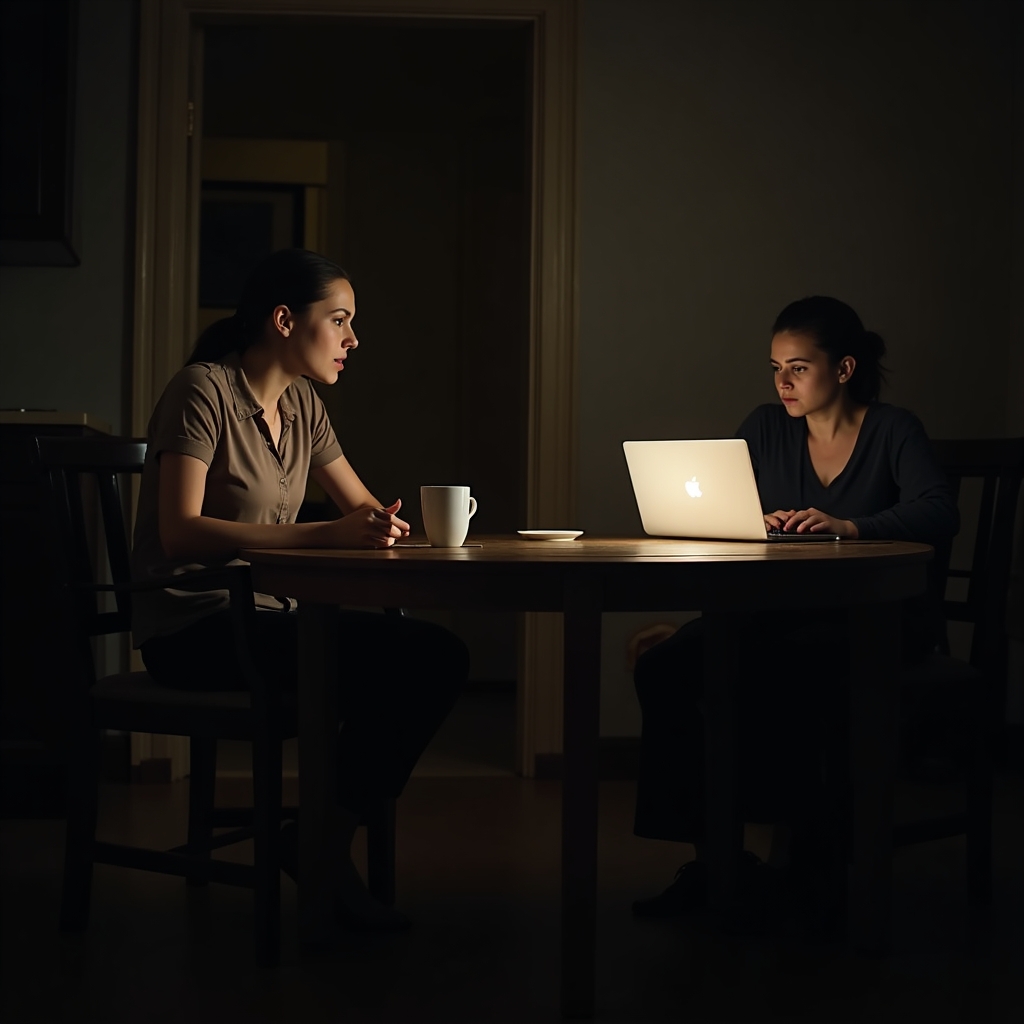
Asha’s eyes glistened under the dim light of the dining room. “You’ve always brought us pride, Leena,” she added softly, her voice a gentle embrace. “Your happiness is part of our legacy too.”
In that moment, the generational chasm that loomed large seemed to narrow, a bridge forming from understanding and love. Leena’s heart swelled with gratitude and a newfound freedom. The tension that had once been her silent companion eased, replaced by an openness she had longed for.
The days that followed were not without their challenges—every path has its stones—but Leena carried with her the strength born of that autumn evening. Her art flourished, as did her bond with her parents, now nurtured by mutual respect and shared dreams.
The grove remained her sanctuary, each visit a reminder of the courage it took to listen to the whispers of her heart. And in listening, she found her song, one that echoed through the generations with clarity and grace.