


Anna had always prided herself on her intuition. Her friends called her their human radar, able to pick up on the faintest of vibes or the slightest of shifts within the group dynamics. But when it came to Mark, her partner of three years, her radar seemed to be failing her. Or perhaps, it was being deliberately ignored.
It began subtly. A late night at the office stretched into early morning meetings. His once predictable schedule became erratic, punctuated by spur-of-the-moment business trips. Initially, Anna brushed it off as a result of the new project Mark had talked so passionately about. They needed the money, and his career was taking off in ways neither of them had imagined.
Yet, it wasn’t just his schedule that had changed. It was him — the way he held back, like he was perpetually on the brink of saying something but never quite able to. Their evenings, which once echoed with laughter and shared stories of their day, became filled with absentminded nods and conversations that trailed off into silence.
“How was your day?” Anna would ask, craving connection.
“Long,” he would reply, his eyes glazed over not with fatigue but with something else — something foreign that Anna couldn’t place.
She started noticing other things, too. The incongruences. A scent on his clothes that wasn’t hers or his. A receipt for a restaurant they hadn’t been to together. A muffled phone call that abruptly ended when she entered the room. Each discovery felt minor in isolation, but together they formed a chorus of dissonance that Anna could no longer ignore.
Her thoughts were a constant storm, oscillating between suspicion and self-doubt. Was she being paranoid? Or was Mark really hiding something? Every time she confronted the unease within her, she was met with the same reassuring smile Mark had always given her, a smile that was beginning to seem more like a mask.
Anna decided to test the waters. That weekend, she suggested a spontaneous trip to the cabin by the lake, a place that held fond memories for both of them. Mark hesitated, his reluctance barely masked by a faked enthusiasm. “Let’s plan for next month,” he suggested, citing work commitments, his voice devoid of its usual warmth.
The unease grew into a tangible entity, sitting heavily on Anna’s chest. She couldn’t shake the feeling that reality was warping around her, a mirage that shimmered dangerously close to shattering.
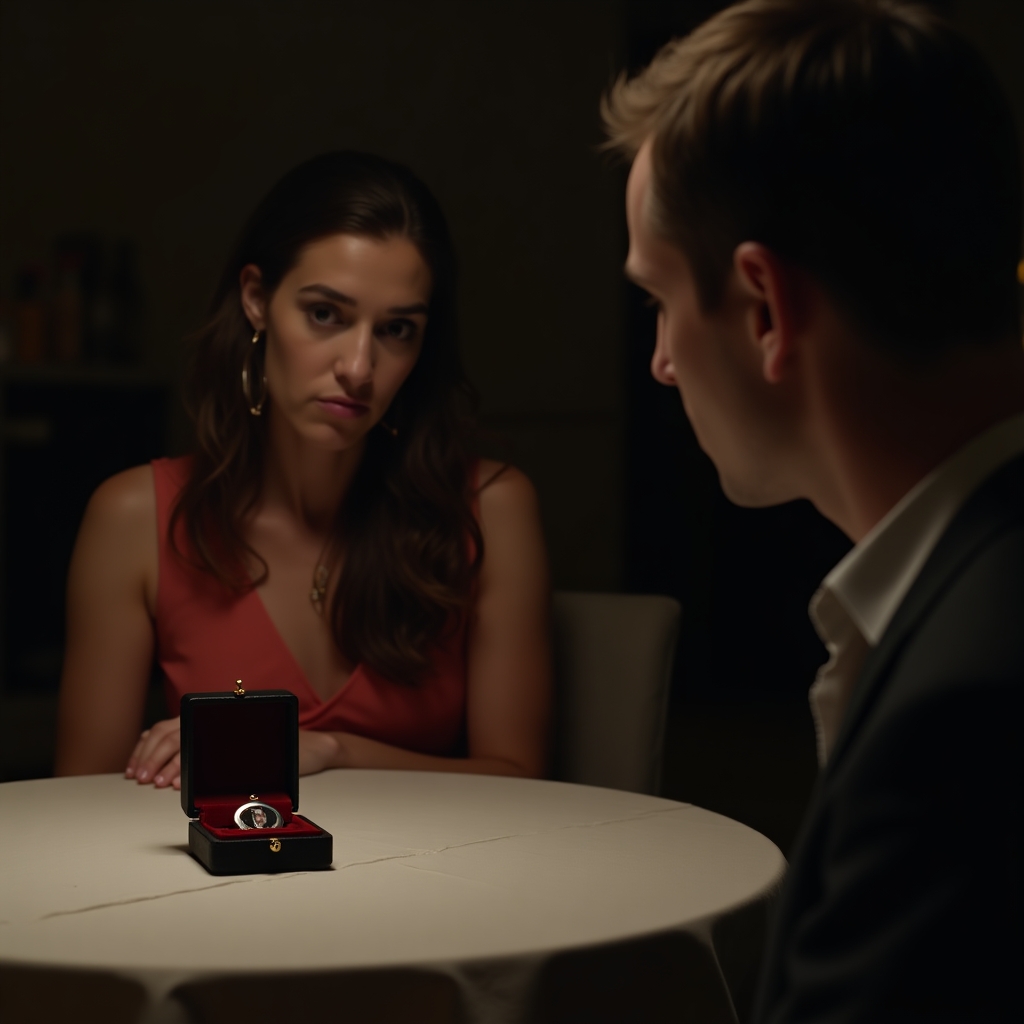
One evening, Anna took Mark’s jacket to the dry cleaner’s and found a small velvet box tucked into the pocket. Her heart stopped; was this what she had been feeling? A proposal? A promise of forever? She opened it with trembling hands, expecting a ring. Instead, she found a delicate silver locket with a picture of Mark and a young girl she didn’t recognize. Beneath the photo was a date in Mark’s handwriting that predated their relationship.
Her world spun. She hadn’t known Mark before they met at a mutual friend’s party. He had only ever spoken of his parents and a sister who lived abroad. No mention of a daughter, if that was who the girl in the photo was.
Anna decided to confront him. That night, she placed the locket on the dining table as they sat down to dinner. Mark’s eyes fell on it, his face draining of color.
“Who is she, Mark?” Anna’s voice was steady but laced with the undercurrents of the tumultuous sea inside her.
Mark’s silence was deafening. He reached for the locket, holding it as if it were the most fragile thing in the world. “Her name is Lily,” he finally whispered, eyes brimming with unshed tears. “She’s my daughter.”
The revelation hit Anna like a tidal wave, crashing down and sweeping everything familiar with it. She listened as Mark spoke of a past life, a relationship that ended in tragedy, and a daughter who lived with her grandparents. Guilt, shame, and fear of losing Anna had kept him silent all these years.
The betrayal was not the secret itself, but the emotional chasm it had created. Anna felt torn between empathy for Mark’s plight and the sharp sting of deceit. Yet, amidst the wreckage of her trust, there was a glimmer — a chance for understanding and rebuilding, if only they both dared to take it.
As Anna sat across from Mark, holding the locket that had been both a symbol of past secrets and now, potentially, future reconciliation, she realized that truth and trust were not always about absolutes. They were fragile, ever-changing constructs that required the courage to face, share, and heal.
In that moment, the opportunity for emotional justice was hers to claim, not through retribution but through a deeper understanding of the complexities that bind human hearts.