




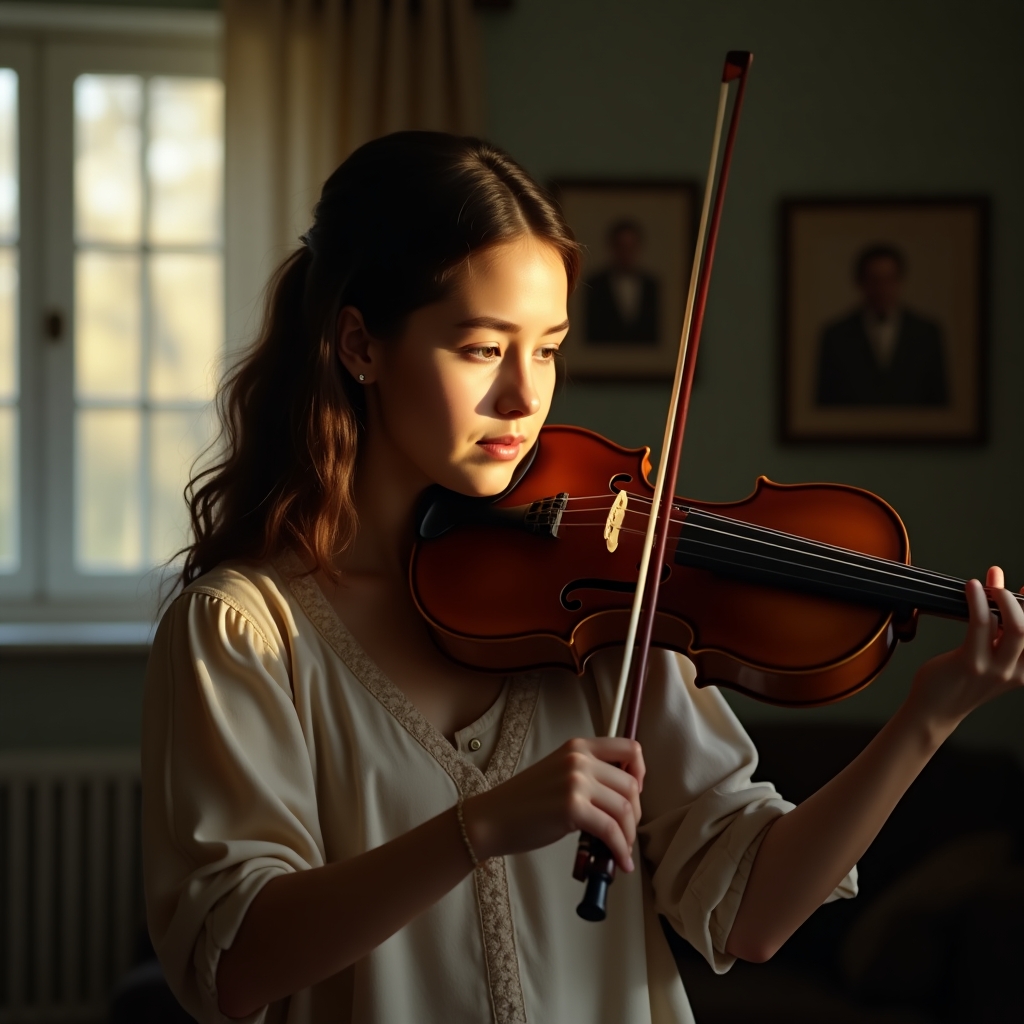
In the heart of a bustling city, framed by elegant high-rises and the unyielding flow of life, lived a young woman named Aisha. Aisha walked the fine line between two worlds—a world of her own making and that of her tightly knit family, whose roots were deeply embedded in traditions and cultural expectations.
Aisha worked at a classical music conservatory as a violin instructor, a vocation that was both her solace and passion. She found comfort in the symphony of strings, where the chaotic harmonies mirrored the cacophony within her heart. Her family, however, had woven a different narrative for her life—one where she followed a more conventional path that echoed generations before her.
Her parents were immigrants, their lives a tapestry of sacrifices. They had journeyed from their home country with dreams tucked away in the corners of their suitcase, dreams of a better life for Aisha. To them, success meant stability, a stable job in a respected profession, marriage to a respectable partner, and the promise of grandchildren.
These expectations weighed on Aisha like an invisible chain, binding her to an unrelenting tide. She navigated through these waters carefully, her true desires often hidden beneath the surface, unseen and unheard.
Evenings at family gatherings were a gentle reminder of her divergence. Conversations hummed around her like a beehive, buzzing with questions about her future, her plans, her prospects. Aisha would smile, nod, and offer vague assurances, her heart quietly rebelling.
The tension simmered beneath the surface, subtle yet palpable. Aisha was a master of silent defiance, yet every string she plucked on her violin was a testament to her inner conflict. Music was her diary, each note a word, each piece a chapter of her untold story.
It was after one such family dinner, wrapped in the warmth of her parents’ home, that Aisha found herself staring out into the night from her childhood room. The moonlight danced on the strings of her violin, whispering secrets of its own.
Her mother’s voice echoed in her mind—steady, loving, yet laden with expectations. “Aisha, you’re at a crucial point in your life. Think about what truly matters,” she had said, her eyes a mirror of hope and dreams that were both hers and not hers.
Aisha’s heart ached with the knowledge that she alone could neither fulfill nor shatter these dreams. She knew there would come a moment when she would have to choose—to carve her own path or follow the one laid out for her by tradition and familial love.
One quiet afternoon, while practicing in the empty conservatory, Aisha felt a stillness settle over her. She played a piece by Bach, its complex layers resonating with her emotional turmoil, until one note—unexpectedly sweet and pure—rang out. The sound hung in the air, a delicate balance between discord and harmony.
In that moment, clarity washed over her like a gentle wave. She realized that her life, like music, could hold both worlds in harmony. She didn’t need to choose between them outright, but rather find a way to honor each without losing herself.
The realization was liberating, a breath of fresh air in the suffocating room of expectations. She could honor her family’s sacrifices without sacrificing herself. She could weave her personal passion into the tapestry of her life, allowing both tradition and individuality to coexist in a symphony.
Aisha decided then to have the conversation with her parents—a conversation framed with honesty, vulnerability, and love. She would tell them of her dreams, her fears, and her unwavering love for music. She hoped that they would see her truth not as a defiance but as an evolution of their dreams.
That evening, as she played her violin for them in the family living room, they listened not just with their ears but with their hearts. Her music, her voice—both expressions of her truth—resonated deeply, creating a new understanding between them.
Aisha knew the path ahead was still strewn with challenges, but she had found the courage to walk it—a path where her personal values and her family’s expectations could meet, not in conflict, but in harmonious coexistence.