


Emma lingered in the kitchen, her hands absentmindedly tracing the smooth wood grain of the dining table. The morning light filtered through the half-open blinds, casting stripes across the faded blue walls. Her husband, Mark, sat across from her, engrossed in his phone, occasionally glancing up but saying nothing. It was a familiar silence, comfortable in its consistency yet suffocating in its predictability.
“Do you think we should repaint the walls?” Emma asked, her voice barely above a whisper. Mark glanced up briefly, his eyes scanning the room as if seeing it for the first time.
“They’re fine, Emma,” he said, returning to his phone without further thought.
Emma nodded, a habitual agreement that had become second nature. Her days were filled with these small concessions, each one a tiny thread in the tightly woven web of her life. She felt caught, trapped in a pattern she could barely recognize as her own making.
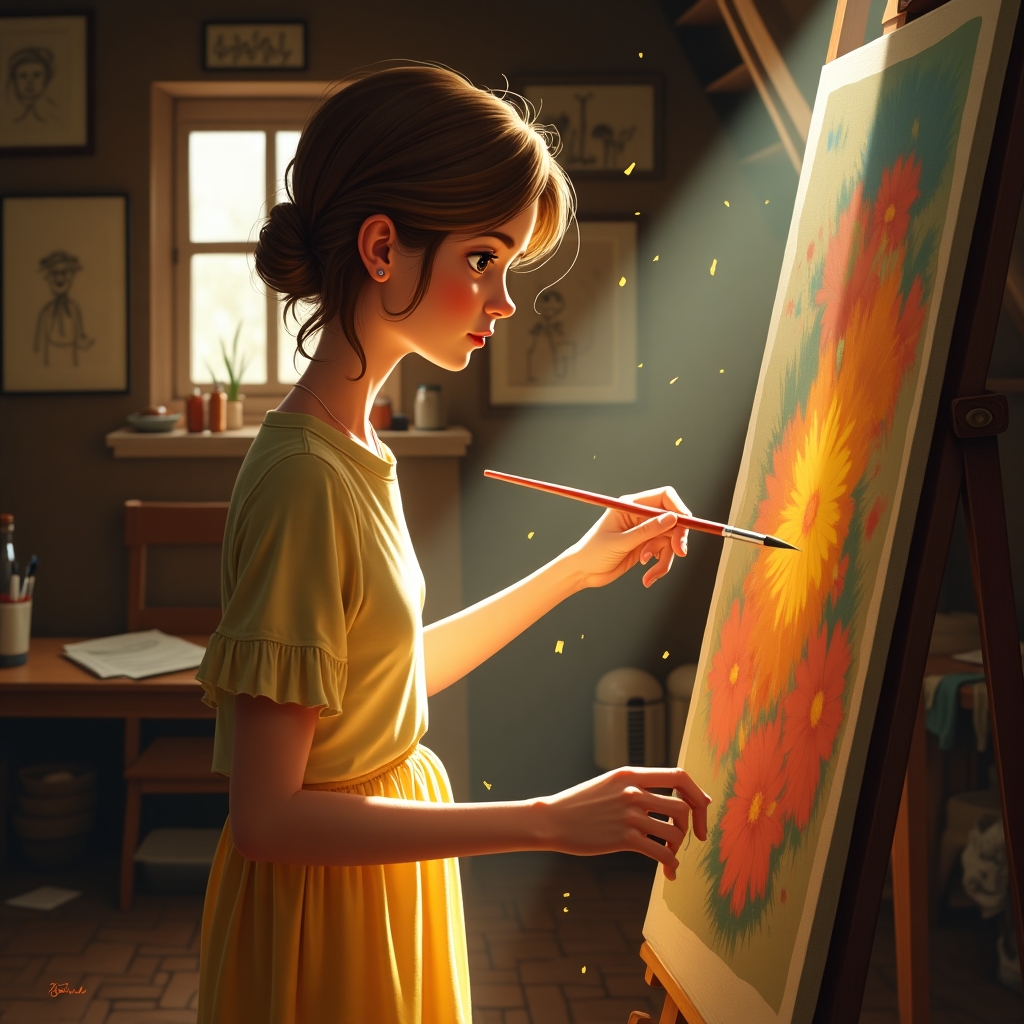
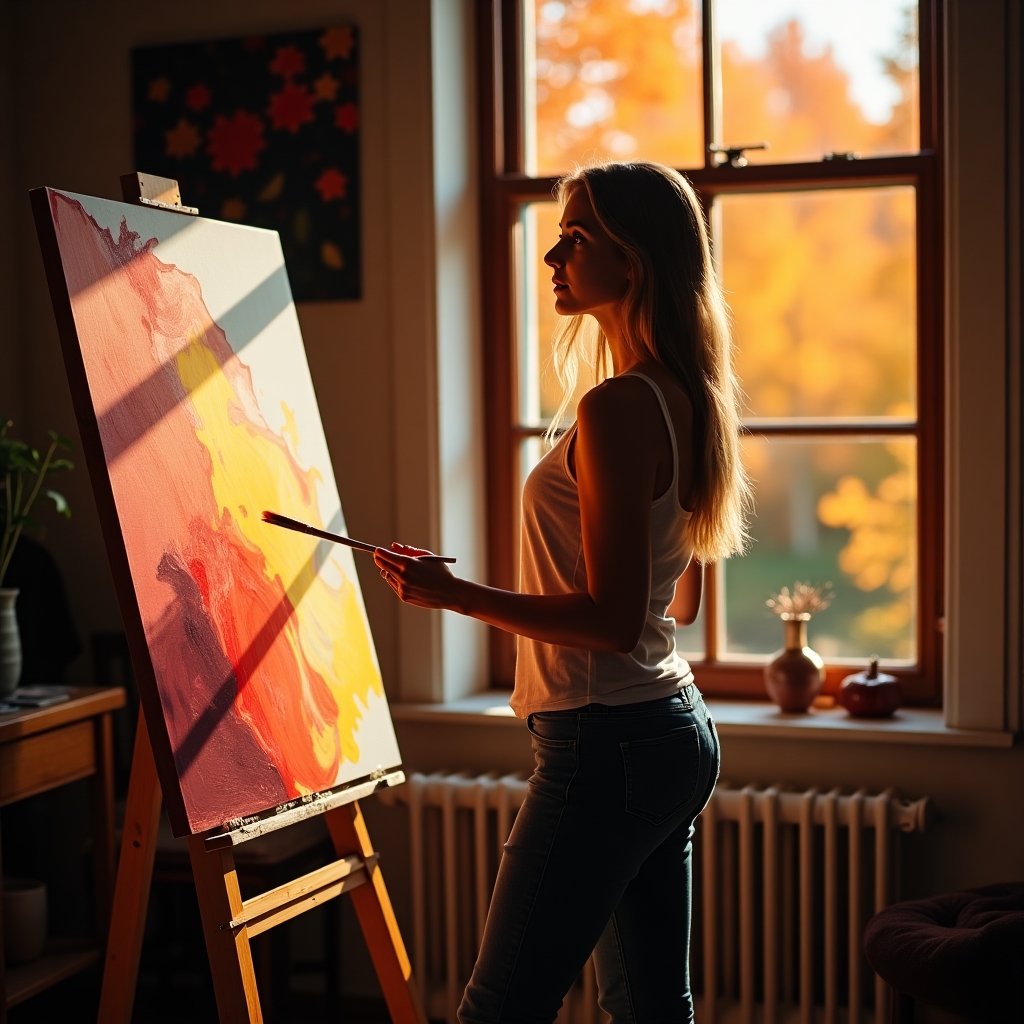
Emma’s thoughts drifted back to the art classes she had abandoned seven years ago, shortly after marrying Mark. She had loved painting—losing herself in the swirl of colors and the freedom of expression. They were dreams she had shelved, tucked away in a dusty corner of her mind labeled ‘for later.’
The day unfolded with its usual rhythm: breakfast cleanup, laundry, a trip to the grocery store. The cashier, a young woman with bright red hair and an easy smile, made pleasant small talk as she scanned Emma’s items. Emma nodded and smiled, engaging just enough to be polite.
“I love your earrings,” the cashier commented, motioning to the small, delicate hoops Emma wore.
“Thank you,” Emma replied, touching them lightly. Mark had bought them for her on their first anniversary, a memory wrapped in sentiment but also in the subtle tension of expectation.
Later, as she unpacked groceries at home, Emma noticed a flyer peeking out from between the cereal boxes. It was an advertisement for a local art exhibit—bold colors and abstract forms leaping off the page. Her heart fluttered with a mix of excitement and longing.
“Maybe I could go,” she thought, immediately dismissing the idea. “No, I have too much to do.”
But the thought lingered, like a persistent whisper that refused to be silenced. Emma spent the afternoon folding laundry, her mind drawn back to the flyer resting on the kitchen counter.
As evening fell, Mark returned home, carrying the air of someone content with the world and their place in it. They sat at the dinner table, the clatter of cutlery the only sound breaking the silence.
“There’s an art exhibit in town,” Emma said, trying to keep her voice steady. “I thought I might go check it out one afternoon.”
Mark looked up, his brow furrowed in mild surprise. “Art?” he asked, as if the concept was foreign. “When would you have time for that?”
Emma hesitated, a lifetime of conditioned responses bubbling to the surface. “I could make time,” she said finally, the words feeling both foreign and empowering.
Mark shrugged, uninterested. “Sure, if you think it’s worth it,” he said, dismissing her as easily as he dismissed the idea.
That night, as Emma lay in bed, she turned the possibility over in her mind. The idea of reclaiming a piece of herself seemed both daunting and exhilarating. Her heart raced at the thought, a mix of fear and anticipation.
The next day, she found herself standing in front of the gallery, its large glass windows revealing glimpses of vibrant canvases within. She hesitated, her hand hovering over the door handle. The noise of the city buzzed around her, and she felt acutely aware of her heart pounding in her chest.
Emma took a deep breath, gathering the courage she had forgotten she possessed. With a steady hand, she pushed the door open and stepped inside. The room was bright, filled with the scent of fresh paint and possibility.
Wandering from piece to piece, Emma felt something inside her begin to unfurl, as if a knot she hadn’t noticed was loosening. She lingered in front of a particularly striking painting, its bold strokes and vivid colors resonating with something deep inside.
In that moment, Emma felt a profound shift. A quiet, determined resolve settled over her. She could do this—she could reclaim these small, vital parts of herself and weave them back into the life she wanted.
That evening, Emma sat at the dining table with Mark, the silence between them a familiar companion. But this time, it held a different texture. Emma felt the weight of her decision, knowing that the path she was choosing was both liberating and fraught with challenges.
“I went to the art exhibit today,” she said, her voice steady.
Mark looked up, his gaze unreadable. “Did you like it?”
“I did,” Emma replied, meeting his eyes. “I think I’d like to start painting again.”
He nodded, distracted, his attention already shifting elsewhere. But it didn’t matter. For the first time in years, Emma felt the solid ground of her own autonomy beneath her feet. The quiet liberation of that moment was hers alone—small, yet immensely powerful.
Emma smiled to herself, feeling the spark of something new and deeply familiar rekindling within her.