
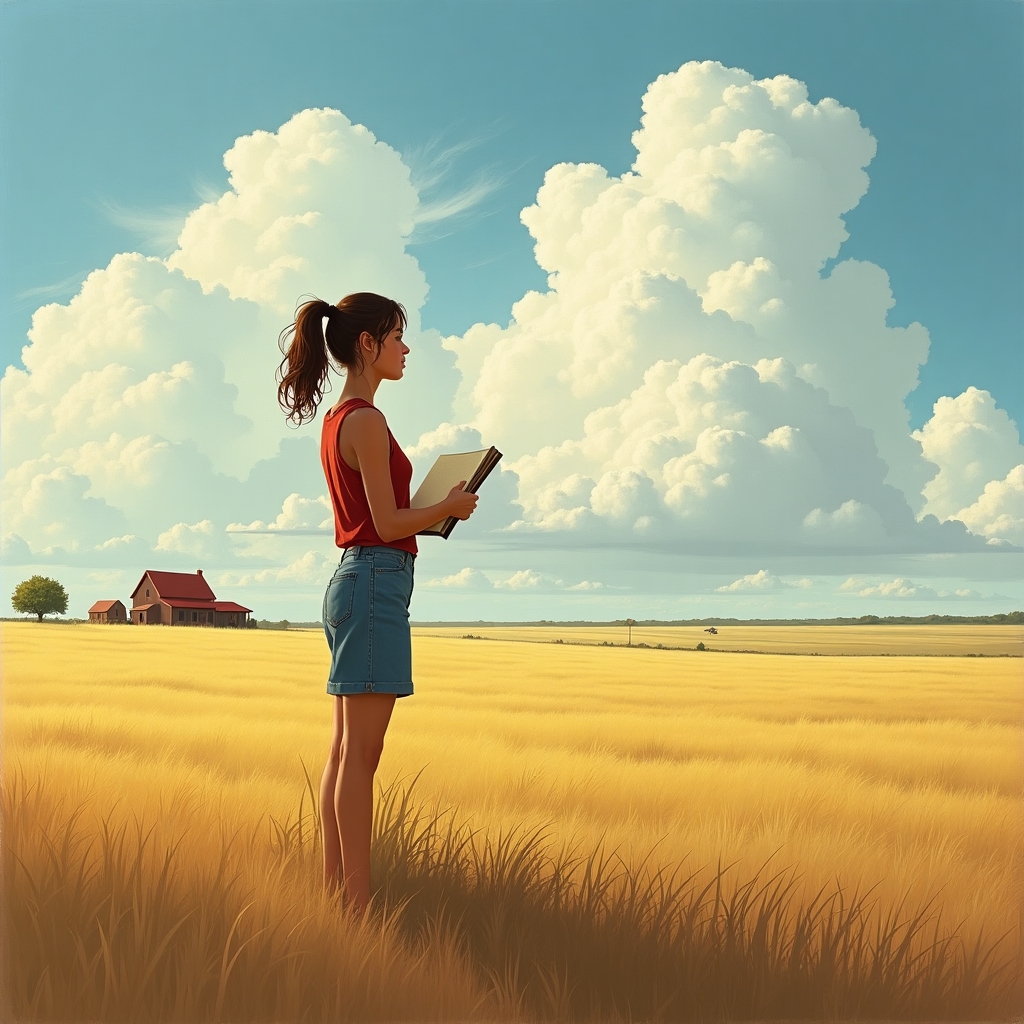
In the small, sunburnt town of Claymore, where the earth cracked open like ancient scrolls under the summer sun, lived a young woman named Elara. Her life unfolded between the silences of her family’s expectations and the whispers of her own desires. The sky above was as vast and indifferent as her mind was turbulent, filled with dreams that seemed always on the brink of suffocation by the weight of tradition.
Elara’s family owned one of the oldest farms in the region, passed down through generations. Each dawn, the horizon would blush with the toils of her father’s labor, and each dusk, her mother would weave stories of ancestral perseverance at the dinner table. Their legacy was one of resilience and relentless devotion to the land, a story they expected Elara to continue.
From a young age, Elara learned to navigate languages of love and duty that her family spoke fluently. The fields were her playground and her prison, its boundaries marked by her family’s hopes. Her hands knew the feel of soil intimately, but her heart beat for the painted horizons she found in art books hidden under her bed. To her, a brush was as familiar as a plow, yet far more liberating.
It was her grandmother, a woman with eyes as deep as the ocean and a silent strength, who first noticed Elara’s restlessness. One evening, as the two of them sat in the kitchen, elbows touching over cups of chamomile, her grandmother turned to her. “You remind me of the willow tree, dear,” she said, her voice a soft lullaby. “Strong, but with a longing to sway with the winds.”
Elara smiled, though her heart clenched. Her grandmother saw her, truly saw her, but the world outside that kitchen? It was a different story. At family gatherings, the talk was always of crops, markets, and the future of the farm, a future that everyone expected Elara to embrace.
As the years rolled by, Elara became adept at masking her inner turmoil. She dutifully helped on the farm, painted in secret and lived in a kind of tentative peace with herself. Yet every sketch clutched in her hands felt like a stolen moment, a betrayal to her lineage.
The town knew her as the girl with steady hands and silent dreams. In the marketplace, where bright vegetables lay like jewels, she would sometimes pause, catching the eye of a local artist who once had whispered, “You have the eyes of someone who sees beyond.” Such words were rare gifts; they planted seeds of courage in Elara’s heart.
It was a quiet Sunday, the town resting in its weekly respite when Elara’s turning point unfurled. She was in the fields, the sun casting amber hues on the rolling acres, the breeze a gentle caress. Her family was indoors, planning the next harvest’s strategy. Elara was alone, the earth’s heartbeat thrumming under her feet. Absently, she traced patterns in the dirt, her fingers sketching the outlines of a dreamscape she often visited in her mind.
Up above, clouds moved languidly, transforming into canvases of possibility. Elara felt a tug in her chest, a whisper louder than the summer winds. Suddenly, everything aligned in a moment of clarity—a realization that love for her family and loyalty to herself were not mutually exclusive. She could honor her roots while reaching for the skies.
With a sudden surge of resolve, Elara stood up, her shadow elongating across the field like a bridge between past and future. She picked up her sketchbook, filled with images of dreams and memories, and walked to the farmhouse.
Inside, her family gathered around the table, papers and plans spread out like maps. Elara paused, the threshold a line she was about to cross. The room quieted as she approached, her heart a steady drumbeat in her chest.
“I need to show you something,” she said, her voice a mirror reflecting both resolution and vulnerability. As she laid her sketches before them, the room held its breath. Silence stretched, pregnant with possibility.
Her father, a man of few words, scanned the drawings with meticulous care, his brow furrowing, then his eyes softening. Her mother, with tears glistening, reached out to touch Elara’s hand.
Her grandmother, always the willow, nodded gently, her look one of understanding. “The world needs people who dream,” she whispered, echoing the sentiment that had lived quietly within Elara all along.
The tension that had quietly threaded through Elara’s life slowly unwound, leaving in its wake a tapestry of serenity. She saw now that the path forward was not one of choosing, but of weaving herself into the fabric of her heritage with her own thread of creativity.
The house was filled with a new kind of conversation that day, one that spoke of generational stories intertwined with individual dreams. Elara’s art became a bridge, mending the silent rift between expectation and self-expression, a testament to the power of courage whispered, rather than screamed.
And in the quiet of the evening, as the sun dipped below the horizon, Elara stood with her family, gazing at the land that was both history and canvas, ready to embrace the tomorrow of her own making.