




Amara stood in the quiet of her room, the walls painted a soft lavender, and the curtains fluttering gently in the breeze of the early morning. Outside, the city of Jaipur awoke with its usual symphony of honking scooters and the call of street vendors setting up their stalls. But inside Amara’s mind, there was a cacophony of expectations and desires that threatened to drown her own voice.
Her mother, Meena, had always been clear about the path Amara was expected to take. A successful medical practice, a suitable husband from a respectable family, and the continuation of their age-old traditions were not simply preferences but the unspoken laws of their household. Yet, Amara’s heart yearned for something different; she could feel it with every beat that seemed to pulse with a rhythm distinct from that of her family.
Every evening, during the quiet moments when the day cooled down and the sky turned a deep indigo, Amara would lose herself in her art. Hidden away in a secret sketchbook, she painted vivid landscapes of places she had never been, dreamed up stories she had never heard, and crafted worlds where choice and freedom were intertwined, and obligation didn’t tether the soul.
The tension was subtle, an undercurrent running through daily life, manifesting in the smallest of gestures. When she sat at the dinner table and listened to her father, Rajesh, recount tales of his ancestors and their noble pursuits in medicine, she nodded dutifully, though her mind often wandered to the gallery exhibitions she had begun attending in secret. Each nod felt like a tiny betrayal to herself, yet a necessary salve to the unspoken expectations that bound her.
The garden was her refuge, a small slice of paradise in their sprawling home. It was here, amidst the blooming marigolds and swaying jasmine, that Amara often found herself lost in thought. She’d sit on the old wooden bench, running her fingers over its weathered surface, feeling the grain beneath her fingertips as she pondered her path.
It was a place for quiet contemplation, where she could almost hear the whispers of the generations before her, echoing in the rustle of leaves. Yet, it was also where she felt the strongest sense of herself, as if each bloom and breeze carried with it a reminder of her individuality.
One afternoon, as the monsoon clouds gathered ominously in the sky, Amara found herself in the garden once more. The air was thick with anticipation, both of the impending rain and the unspoken confrontation brewing within her. Her mother’s voice echoed in her mind, a litany of hopes and dreams that didn’t quite match her own.
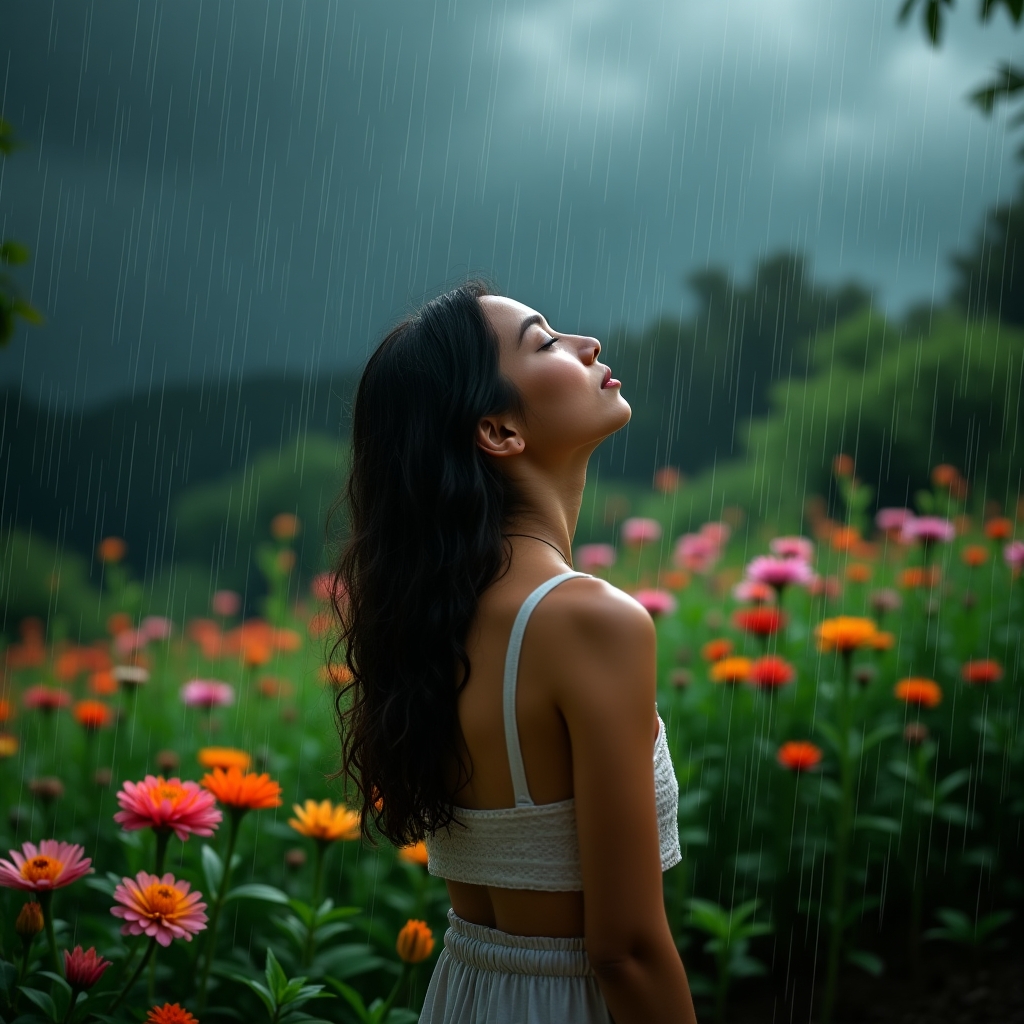
Her musings were interrupted by the soft patter of raindrops, first gentle, then insistent, as if urging her to confront her truth. Amara closed her eyes, feeling the cool drops on her skin, the scent of earth rising to greet the rain. It was in this moment, amidst the storm, that clarity struck.
She envisioned herself standing in the gallery, her paintings, vibrant and raw, lining the walls. The image was at once terrifying and exhilarating. For the first time, she allowed herself to truly see it, to acknowledge the pull of her passion and the possibility of a life unbound by the constraints placed upon her.
The realization was quiet, yet profound. Amara understood in that moment that her dreams were not a departure from her family, but an extension of the stories they had woven through generations — tales of courage, resilience, and adaptation. As the rain poured down around her, Amara felt the tension within dissolve, replaced by a serene resolve.
The next morning, over breakfast, Amara spoke in a quiet voice that carried the weight of her newfound clarity. She shared her vision, her desire to pursue art, each word a step away from the expected, yet a step towards her truth. Her parents listened, their initial surprise giving way to a contemplative silence, the air thick with unspoken emotions.
In the days that followed, conversations became more open, filled with a genuine effort to understand. There were no instant resolutions, no dramatic turns, but a slow weaving of understanding, a bridge between generations built on respect and love.
Amara’s journey taught her that courage wasn’t always loud. Sometimes, it whispered in the quiet moments of introspection, in the gentle acceptance of one’s truth amidst the storm of expectations.
Her story became a testament to the power of quiet resilience and the transformative potential of empathy, as her family slowly began to see the harmony in her choices, and the beauty in embracing new traditions while honoring the old.