


In the heart of a city that never slept, nestled between towering skyscrapers and the constant buzz of urban life, lay a small neighborhood that seemed forgotten by time. In one of its narrow streets, lined with brownstones and tiny gardens that fought for sunlight, lived Maya. At twenty-three, she was caught between the life she envisioned for herself and the legacy her family expected her to uphold.
Maya’s family, originally from a small village in the foothills of the Himalayas, had immigrated to this bustling city decades ago. They carried with them the weight of generations—traditions, hopes, and unspoken rules that had to be revered. Her parents had struggled to build a life from scratch, and they set high expectations for Maya, the first in their family to graduate from college.
Each evening after work, Maya sat at the small wooden table in her apartment, the aroma of jasmine tea filling the air, enveloped by the soft glow of a lone lamp. Here, she reviewed applications for PhD programs in art history, her true passion. But whenever she considered sending them, a heavy silence would descend, a reminder of her parents’ dreams. They envisioned her as a doctor, a stable and honorable profession.
The tension between her dreams and her parents’ expectations was almost palpable. It was woven into her daily life, a quiet presence that shadowed her every decision. Conversations at home were laden with subtle suggestions, maternal sighs, and paternal nods towards medical journals left casually on the kitchen counter.
Maya loved her parents deeply. Their sacrifices, their unwavering support through her studies, and their stories of resilience filled her with gratitude. Yet, within her, an artist’s spirit yearned to explore, to express, to break free from the clinical constraints of her family’s vision.
The internal conflict gnawed at her. On one side was loyalty to her family, a sense of duty towards their sacrifices. On the other, her own burgeoning identity, a whisper of autonomy she was too afraid to amplify. The struggle was not loud or explosive; it was a silent echo, reverberating within the chambers of her heart.
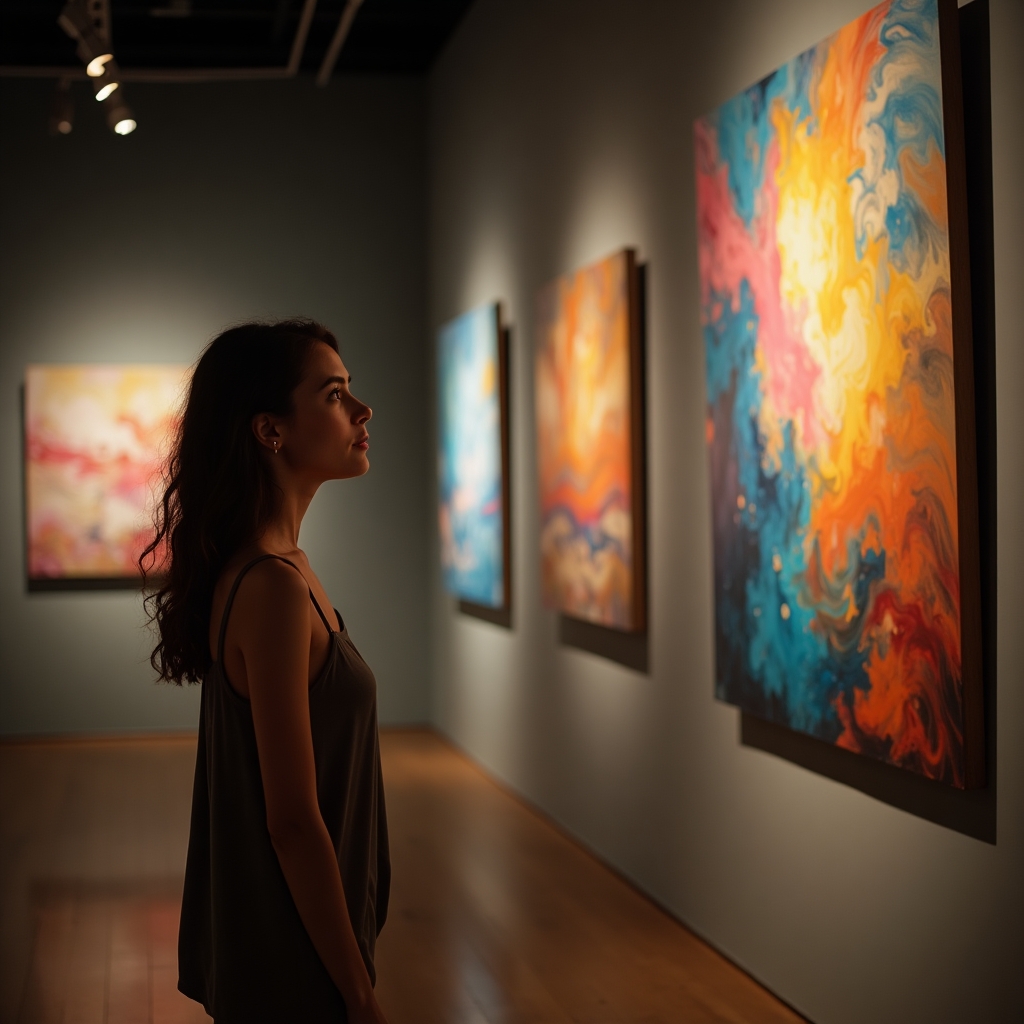
One evening, as the city was bathed in twilight and the sky turned the color of melancholy, Maya found herself at an art gallery opening. Her friend, Alex, had invited her, insisting it would lift her spirits. The gallery, a renovated warehouse, was filled with eclectic pieces, each telling a story more vibrant than the next.
Maya wandered through the exhibits, her fingers trailing softly against the cool, polished surfaces of sculptures. She paused in front of a painting that caught her breath—a cascade of colors, chaotic yet harmonious. It was as if the artist had poured their entire being into the canvas, without reservation or fear.
It was then she felt it—the emotional clarity she had been seeking. Standing before this explosion of expression, she understood the power of living one’s truth. Her heart swelled with a newfound courage, a gentle but firm resolve. She realized that honoring her own path was the greatest tribute she could pay to her parents’ sacrifices. They had taught her to be strong and resilient, tools she could use to carve her destiny.
That night, back in her apartment, Maya sat at her table once more. With steady hands, she completed the art history applications, each click of the keyboard a step closer to her truth. She knew conversations with her parents awaited, and they would not be easy. But for the first time, the silence within her was not of despair but of quiet determination.
Maya’s journey was not about denying her heritage but about integrating it into her own narrative. She envisioned a bridge between her past and her future, where both could coexist without one overshadowing the other.
Thus, Maya embarked on a path of emotional courage, one that embraced her cultural roots while allowing her true self to flourish. It was not a path free of challenges, but it was hers, and for that, she was grateful.