


The café on Elmsworth Street was an eclectic jumble of mismatched furniture and eccentric patrons, tucked discreetly between an antique bookstore and a sea of brownstones. It was a haven for the neighborhood’s array of artists, writers, and wistful dreamers, a place where time seemed to pause just long enough for old memories to catch up.
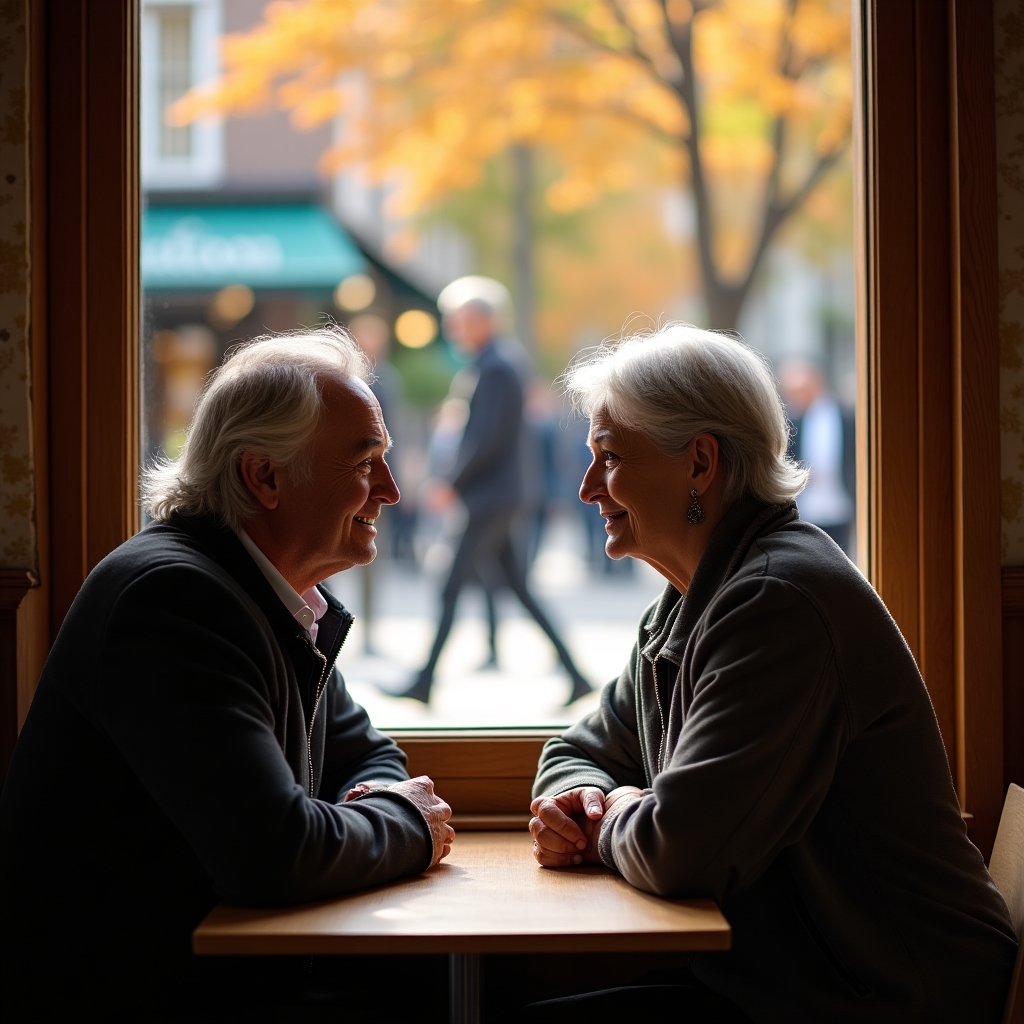
Julia sat at a corner table, nursing a cup of herbal tea and absently flipping through a softcover novel. The afternoon light spilled through the large window beside her, casting patterns across her face, and intermittently highlighting the strands of gray woven into her once-dark hair. The years had etched their stories upon her, in the subtle lines around her eyes and the wisdom in her gaze.
As she turned another page, the little bell above the door jingled. She barely noticed at first, absorbed in a world of fictional lives, until a presence loomed at the edge of her consciousness. She glanced up and her breath caught. Standing before her, in a threadbare jacket and with eyes as deep as a hundred unspoken words, was Henry.
They had not seen each other in nearly three decades. Time had sculpted him into a figure both familiar and foreign. They had been the best of friends once, bound not by romance but by the fierce loyalty of shared dreams and restless hearts. Life, however, had a way of pulling the threads of even the tightest tapestry apart.
There was a moment of silence so profound that it seemed to deepen the café’s ambient hum into a gentle echo. Henry shifted his weight, awkwardness flickering across his features, but his gaze held hers. “Julia,” he said simply, his voice carrying the gentle rasp of forgotten familiarity.
“Henry,” she replied, her tone softening the single word into a quiet acknowledgment of all that lay between them.
He gestured awkwardly to the empty chair opposite her. “May I?”
She nodded, closing her book and pushing it aside. It was a gesture of hospitality, a hesitant olive branch extended across the divide of years.
They sat together, not speaking for a while, allowing the fragments of their shared history to filter through the silence like sunlight through the café windows. Julia studied him from the corner of her eye, the lines of his face telling a story of trials, of distances traveled both physically and metaphorically.
“You look well,” Henry ventured, his voice a cautious blend of truth and diplomacy.
“Life has been kind in some ways,” she replied, a small smile curving her lips. “And you?”
He chuckled softly, a sound that was both weary and warm. “Surviving.”
There it was—the bittersweet symphony of nostalgia and grief, of lives lived apart. Neither of them rushed to fill the distance with superficial words; they knew it would take more than pleasantries to bridge the chasm.
“I often wondered,” he began, his eyes fixed on the tea swirling in his cup. “About where life took you after… everything.”
She nodded, understanding his hesitation. “I thought of you too. More often than I admitted, even to myself.”
Their parting had been sudden, precipitated by the chaos of youthful ambitions and misunderstood intentions. The hurt had been sharp and lingering, but time, with its persistent grace, had softened the edges.
“Do you remember the old tree by the lake?” Julia asked, her expression softening with the weight of recollection.
Henry’s eyes lit up with the memory. “Of course. We used to spend hours there, dreaming up futures that were larger than life itself.”
They both laughed softly, the sound laced with nostalgia that neither diminished nor glorified their past. It simply was—a constant, like the tree that still stood by the lake.
“I went back there once,” Julia admitted. “A few years ago. It wasn’t the same without you.”
There was a pause, rich with unspoken emotions. “I’m sorry,” Henry said at last, his voice laced with genuine regret. “For leaving the way I did. For not reaching out sooner.”
Julia met his gaze, seeing in his eyes the same vulnerability she had known so many years ago. “I forgave you a long time ago, Henry. I think, perhaps, I needed to forgive myself more.”
The words hung between them, delicate yet solid, a testament to the quiet power of time’s healing hand. It was a moment of reconciliation, not loud or showy, but profound in its simplicity.
The afternoon slipped away almost unnoticed, the shadows lengthening across the café’s warm interior. Their conversation flowed easily now, punctuated by laughter and moments of comfortable silence. They spoke not only of the past but of the present and the possibilities that the future might yet hold.
As they rose to leave, Julia glanced out at the street beyond the window. The world was much the same, and yet, in a way, everything had changed. She turned back to Henry, a gentle smile playing on her lips.
“I’m glad you walked in today,” she said softly, her words carrying the weight of genuine warmth.
Henry nodded, his expression reflecting a kind of peace. “So am I.”
They stepped out into the fading light of the afternoon, the silence between them now filled with the promise of renewed connection. The past remained with them, but it was no longer a specter—it was a foundation upon which new memories might be built. And as they walked, side by side, the echoes of their silence slowly transformed into the gentle harmony of a friendship reclaimed.