


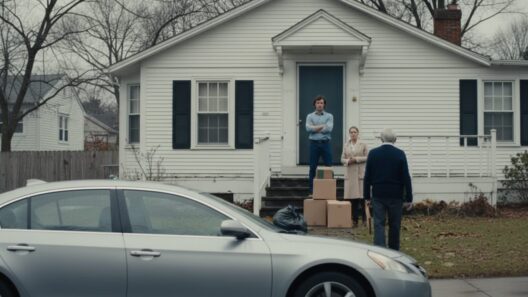

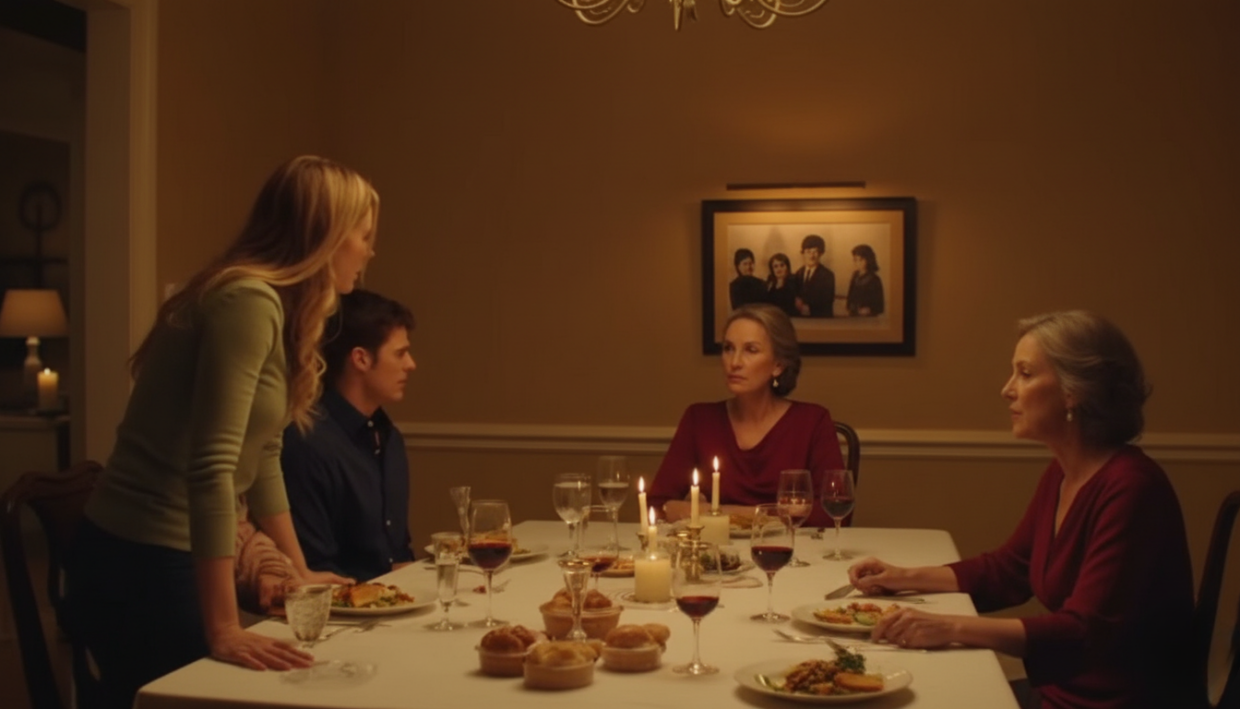
She stood up at Sunday dinner and accused her mother-in-law of stealing her jewelry — in front of the whole family. Everyone believed her instantly… But an hour later, the police knocked, and the bracelet turned up somewhere no one expected.
The Tanner family dinners were legendary for two things: Margaret’s pot roast and somebody crying before dessert.
This Sunday was no different. Except the crying would come later. And so would the handcuffs.
Margaret set the last dish on the table and smoothed her apron. Forty years of Sunday dinners. Forty years of this house, this table, these people. She looked around — her son David, his wife Courtney, her daughter Lisa, Lisa’s husband Paul — and felt, for one quiet moment, something like peace.
Then Courtney walked in from the hallway and it evaporated.
“Where is it?”
Courtney’s voice cut through the room before she’d even reached her chair.
Margaret looked up. “Where is what, sweetheart?”
“Don’t.” Courtney’s eyes were hard, jaw set. She pointed. “My grandmother’s bracelet. White gold, sapphires. I left it on the shelf in the guest bathroom last week. Now it’s gone.”
David frowned. “Court, are you sure you—”
“I know where I left it, David.” She pulled out her chair and sat with the energy of someone who had already decided what happened. “I’ve looked everywhere. Three times.”
Margaret kept her voice even. “I haven’t been in the guest bathroom since Thursday. I was cleaning in there, and I—”
“Cleaning.” Courtney repeated the word like it was a confession. Like it answered everything.
Silence dropped over the table.
Lisa glanced at Paul. Paul studied his water glass. David looked at his mother, then at his wife, then back at his mother.
Margaret felt the shift in the room before anyone said another word. That particular kind of silence — the one where people had already made up their minds.
“Courtney,” Margaret said quietly, “I did not take your bracelet.”
“It was my grandmother’s. She died two years ago.” Courtney’s voice climbed. “That bracelet is all I have left of her. It was there Thursday. Now it isn’t.”
“I understand how important—”
“Do you?” Courtney stood up fully. “Because you were the only person in this house Thursday. Full access. And now it’s gone.”
The words landed like stones dropped through still water.
Lisa spoke carefully. “Mom, maybe you just moved it while you were cleaning? Put it somewhere safe and forgot?”
Margaret looked at her daughter. Even Lisa.
“I did not touch it,” she said. “I would never.”
“Then where is it?” Courtney spread her hands. “It didn’t walk out on its own.”
“I don’t know. But it wasn’t me.”
“Who else? Who else was in this house?”
Silence.
Margaret thought through Thursday. Music on, windows open. She’d dusted the guest bathroom, wiped the counter, replaced the hand towels. No bracelet that she’d seen. But she hadn’t been looking for one either.
And she had been alone.
Or so she’d thought.
“I want to call the police,” Courtney said.
David stood. “Court—”
“If she’s innocent, she has nothing to hide.” Courtney looked directly at Margaret. “So let’s call them.”
Margaret met her daughter-in-law’s gaze. Something cold moved through her — not fear, exactly. Something worse. The understanding that in this room, right now, she was already guilty. That these people she had fed and loved every Sunday for forty years were looking at her the way you look at someone who has done something unforgivable.
“Call them,” Margaret said. “Go ahead.”
Courtney took out her phone.
David sat back down. Lisa reached for her wine. Paul studied the water glass with renewed commitment.
The pot roast went cold.
Nobody ate.
Forty minutes passed. The conversation that limped through dinner was worse than silence — forced talk about David’s job, a movie Lisa had seen, nobody acknowledging the phone on the table or the two women on opposite ends of it who could barely be in the same room.
Margaret ate nothing.
The knock came at 7:14 PM.
Two officers. A man and a woman. David answered the door.
“We received a call about a theft,” the male officer said. “Mrs. Tanner?”
Margaret stepped forward from the kitchen doorway. “That’s me.”
Courtney moved past her. “I called. It’s my bracelet — white gold, sapphires, antique setting. It was in the guest bathroom and now it’s gone.” She gestured toward Margaret without looking at her. “She was the only person in the house when it went missing.”
The female officer looked at Margaret. “Ma’am, do you have any objection to us taking a look around?”
“None at all,” Margaret said. “Start wherever you like.”
The officers moved through the house. Guest bathroom. Hallway closets. The living room shelves. The guest bedroom.
Margaret followed at a distance, arms crossed. Courtney trailed the officers, narrating in a low voice. David stood in the hallway looking like a man who deeply wished he were somewhere in another time zone.
“Nothing in the bathroom,” the male officer reported.
“Could it have rolled behind something?” his partner asked.
“I checked. Under the cabinet, behind the toilet. It’s not there.”
“Any other recent visitors to the home?”
“No,” Courtney said. “Just her.”
She still didn’t use Margaret’s name.
The female officer turned back to Margaret. “Mrs. Tanner, do you mind if we—”
“Check my room, my purse, my coat pockets. Whatever you need,” Margaret said. “I have nothing to hide and I want you to find it.”
They moved toward the master bedroom. Margaret stepped aside.
And then the male officer slowed.
He’d paused in the doorway of the small study off the hallway — David’s room when he visited, with the old desktop computer, the armchair, the bookshelf. A low-traffic room. Easy to overlook.
“What’s this?” he asked.
“My husband’s old study,” Margaret said. “My son uses it sometimes when he’s here.”
The officer stepped inside. His partner followed.
On the desk, half-tucked beneath a jacket draped over the back of the chair — David’s jacket, the one he’d worn in today — something caught the ceiling light.
A glint of white gold.
Sapphires.
The room went absolutely still.
The female officer lifted the jacket carefully. The bracelet was fully exposed now — coiled on the desk surface like it had been set down and forgotten.
She turned to face the hallway.
Courtney’s face had gone the color of old chalk.
David made a sound that wasn’t quite a word.
“Is this the item?” the officer asked.
Courtney stared at it. “Yes,” she said. Her voice had dropped to almost nothing. “That’s it. That’s the bracelet.”
“It was under this jacket.” The officer held the jacket up. “Sir, is this yours?”
Everyone turned to David.
David looked at the jacket. Then at the bracelet. Then at his wife.
“I—” He stopped. “I don’t know how that got there.”
“It’s your jacket,” Courtney said. Barely audible.
“I know it’s my jacket.” He ran a hand through his hair. “I was here last week — Wednesday — I stopped by to use the computer while my office internet was down. I must have — maybe it fell off the bathroom shelf somehow and I picked it up without thinking, set it down in here, and then put my jacket on top of it without even seeing it—”
“You were in the house last week,” the male officer said. It wasn’t quite a question.
“Wednesday afternoon. I have a key. I didn’t think to mention it because I wasn’t there long.”
Margaret hadn’t known he’d come by.
He had a key. He’d used it. He’d never mentioned it.
She stood very still and didn’t say a word.
“So you had access to the guest bathroom,” the officer said.
“I wasn’t in the guest bathroom. I came straight to the study. I didn’t go near her stuff.”
“And yet the bracelet is under your jacket.”
David’s voice was rising. “I’m telling you it was an accident. I didn’t steal it. It must have fallen somehow and I picked it up on autopilot, I didn’t even look at what it was—”
The male officer continued writing.
Courtney hadn’t moved.
“I accused her,” she said softly. To no one in particular. To the room. To herself. “In front of everyone. I stood up at the dinner table and I accused her.”
Lisa had gone very quiet in the corner.
Paul had, at long last, stopped looking at his water glass.
Now he was looking at the floor.
Margaret walked past all of them. Back into the kitchen. She heard the low murmur of the officers’ voices behind her, David’s explanation climbing in pitch, Courtney’s silence louder than anything else in the house.
She stood at the kitchen counter and looked at the cold pot roast.
Four minutes later, Courtney appeared in the kitchen doorway.
She looked smaller than she had at dinner. The certainty was gone. She stood with her arms wrapped around herself, like she was holding something fragile together from the inside.
“Margaret.”
Her voice cracked on the second syllable.
Margaret didn’t turn around.
“I need to—” Courtney stopped. Swallowed. “I don’t know how to—”
“I know,” Margaret said.
“I was so sure. I was so, so sure it was—”
“I know you were.”
“That doesn’t make it right.” Courtney’s voice broke fully. “I said those things. In front of your whole family. I pointed at you like you were a criminal.”
Margaret turned around.
Courtney’s eyes were red. Her face was stripped of everything — the anger, the certainty, the righteous indignation that had carried her through dinner. What was left underneath was just a young woman standing in a kitchen having done something that couldn’t be undone.
“You don’t get to just apologize and have it be fixed,” Margaret said. “That’s not how this works.”
“I know.”
“I have been sitting at this table with this family for thirty years. Thirty years of trying. Of putting food out. Of making room.” Her voice was steady. “And the moment something went missing, you didn’t hesitate. Not for one second.”
“I was wrong.”
“Yes. You were.”
Courtney wiped her face. “Is there anything I can—”
“Not tonight.” Margaret picked up the pot roast dish and carried it to the sink. “Tonight I need everyone to go home. We can talk another time. But right now I need my house back.”
The officers wrapped up their questions in the hallway. No charges were filed — the bracelet had been recovered, no evidence of deliberate theft, accidental displacement of property. The male officer said something quiet to David near the door. David nodded, staring at the floor the way people do when they are absorbing the consequences of a very particular kind of carelessness.
Lisa hugged Margaret on the way out. Tight, without words.
Paul said, “Good night, Margaret,” and actually meant it.
David paused at the door. He looked like he’d aged five years in two hours.
“Mom, I’m sorry I didn’t say more at dinner. I should have—”
“Lock up when you leave,” Margaret said. “You still have your key.”
The door swung shut behind him.
Courtney was the last one out.
She stopped on the porch and looked back. Margaret stood in the open doorway, one hand on the frame, the porch light catching the silver in her hair.
“I’m sorry,” Courtney said. “I know it’s not enough.”
“No,” Margaret said. “It isn’t. But you came back into my kitchen and said it to my face instead of just texting David an emoji. So it’s something.”
She closed the door.
She walked back to the kitchen. Sat down at the table. Looked at the six place settings — good plates, linen napkins, candles burned to stubs.
She picked up her fork.
She ate her pot roast alone, in the quiet of her own house, with the quiet dignity of a woman who had been publicly accused of theft, had sat with the humiliation of it, and had not bent.
Three weeks later, Courtney rang the bell.
Not David’s key. Not a text asking if it was okay. She rang the bell, hands at her sides, and waited.
Margaret answered the door.
“I’d like to talk,” Courtney said. “If you’ll let me.”
Margaret looked at her for a long moment.
Then she stepped back and opened the door wider.
“Coffee?” she said.
“Yes. Please.”
They sat at the kitchen table — the same table, the same chairs — and Courtney talked.
About her grandmother. About the bracelet and what it had meant for two years of grief. About how the fear of losing it had turned into fury, and how the fury had needed somewhere to land, and how Margaret had been the easiest target.
“I’ve been looking for reasons not to trust you,” Courtney said, very quietly. “Since before David and I got married. I don’t know exactly when it started. Maybe because he loves you so much and I was afraid there wasn’t enough room.”
Margaret wrapped both hands around her mug.
“There’s always room,” she said.
“I know that now.” Courtney looked at her directly. “I threw it away. I humiliated you in front of your family. I called the police on you.” She paused. “And you’re still sitting here.”
“I’m sitting here because David loves you,” Margaret said. “And because you came without him. That means something.”
Courtney nodded slowly.
“I’m going to earn this back,” she said. “I can’t just ask for forgiveness. I know that. I have to show you.”
“Yes,” Margaret said. “You do.”
It wasn’t a hug. It wasn’t tears and instant healing and everything restored. It was two women sitting across a table with a hard and honest truth between them, and the slow, tentative, unsentimental beginning of something that might — given enough time and enough work — eventually become trust.
The bracelet was on Courtney’s wrist that day.
She hadn’t taken it off since the night they found it under David’s jacket.
Margaret noticed.
She didn’t say anything.
But she refilled Courtney’s coffee without being asked.
And in Margaret Tanner’s house, that was always how things started.