




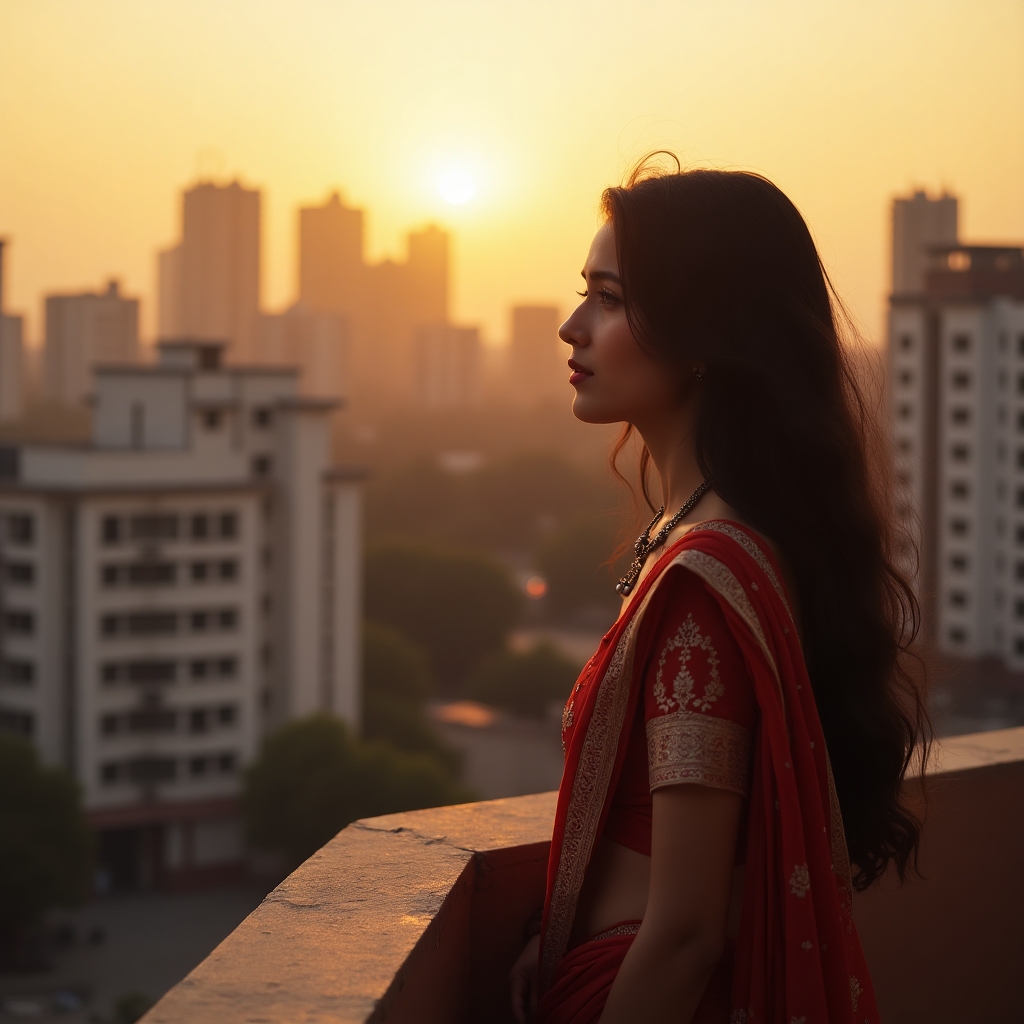
In the gentle embrace of the morning light, Maya sat by the window of her room, her gaze lingering on the slowly awakening cityscape of San Francisco. The fog hung low, a thin veil that mirrored the cloudiness in her mind. Here she was, on the precipice of adulthood, her heart tugged in directions that felt as contrasting as the streets below—modern yet steeped in history.
Maya was the only daughter of the Shah family, who had emigrated from India before she was born. As such, her life had been a delicate dance between two worlds. Her parents held tightly to their traditions, hoping to preserve within her the essence of a culture rich with history and expectation. Every weekend was a mosaic of cultural gatherings, vibrant with the colors and sounds of the homeland, while weekdays were a symphony of Western influences resonating within her schooling and friendships.
The expectations were explicit: Maya was to excel in her studies, uphold family values, and eventually marry someone of her own culture. Yet, as she navigated her way through her final year at Stanford University, Maya found herself increasingly drawn to ideas and people that lay outside the boundaries of her parents’ wishes. Her psychology degree opened her mind to new perspectives, and her heart began to beat to the rhythm of her own desires.
It was at a seminar on mental health awareness that Maya first met Alex—a fellow student with a passion for understanding the human mind. They began collaborating on a project, their conversations flowing effortlessly from academic topics to shared interests, and eventually to the more personal corners of their lives. Alex was everything Maya’s parents would not have chosen. But as their friendship deepened, Maya felt a growing ease she couldn’t ignore—here was someone who saw her as she truly was.
Each evening, Maya found herself torn between the path she was expected to follow and the one her heart whispered of. Her parents, loving yet firm, spoke often of duty and legacy. “You are our only hope,” her mother would say, a loving reminder wrapped in the weight of responsibility. Maya smiled in response, her heart heavy with unspoken thoughts.
The turning point came quietly, a moment not marked by battles or confrontations, but by a quiet clarity. It was a Sunday afternoon. The Shah family sat together, the aroma of spices wafting through their home, conversations peaking and ebbing like the tides. Her father, ever the sage, began speaking of an upcoming cultural festival and casually mentioned a family friend’s son who would be perfect for Maya.
Maya’s heart thudded. She excused herself, stepping out onto the small balcony. The air was crisp, the sun painting the city in golden hues. She stood there, staring at the skyline, her mind a cacophony of thoughts—a future mapped out versus the uncharted path she longed to explore.
The realization came as the wind whispered across her cheeks: she was living in the spaces between—between who she was expected to be and who she truly was. The emotional clarity cascaded over her like the waves beneath the Golden Gate Bridge. She understood now that her journey was not about choosing one world over the other, but about weaving them into a tapestry of her own making.
Reentering the apartment, she felt a renewed sense of calm. Her parents noted the change, her mother sensing the shift as mothers often do.
“Maya, is everything okay?” her mother asked, her tone gentle.
Maya nodded, her voice soft yet firm, “Yes, Mamma. I just need to find my own way to make you proud.” Her words hung in the air, a tender but firm declaration of her truth.
It was not a rejection but an invitation—for them to see her as the bridge between two cultures, not a battleground. Her parents exchanged a glance that spoke volumes, an understanding that their daughter was stepping onto her own path.
Over the following weeks, the conversations between Maya and her parents slowly transformed. They began to ask more about her interests, her studies, and her aspirations. It was not an easy journey, but it was one of mutual learning and respect.
In her quiet moments, Maya would return to her balcony, staring out at the ever-present skyline. She was not a renegade, nor was she a rebel. She was simply Maya, finding her way, one step at a time, with a heart that held room for both the world she had been born into and the one she was creating.
The city remained the same, yet everything felt different. It was a new dawn, both outside and within, and Maya was finally ready to embrace it.