

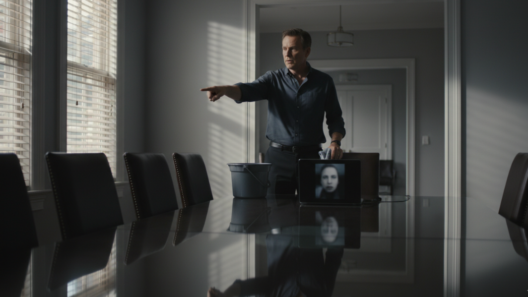

He smashed a glass at a janitor’s feet and screamed “Clean it up in five seconds!”… But the old man just smiled — because his son had been building a federal case against him for two years.
The conference room on the forty-second floor had floor-to-ceiling windows. On a clear day you could see three counties. On this particular Tuesday morning, all anyone could see was Raymond Holt.
He stood at the head of the table in a charcoal suit that cost more than most people’s monthly rent. His tie was a deep burgundy. His cufflinks were monogrammed. Everything about Raymond Holt said I matter and you don’t, and he had spent forty-seven years of his life making absolutely sure everyone in any room understood that hierarchy within the first sixty seconds.
The conference room was empty except for two people.
Raymond and the janitor.
The janitor’s name was Walter Briggs. He was sixty-three years old, with a wide, steady back and hands that had seen real work — the kind of work you don’t forget even when your body asks you to. He wore gray coveralls with the building’s logo stitched on the left chest. He moved slowly, methodically, pushing a mop across the marble floor near the far end of the room. He hadn’t looked up when Raymond walked in.
That was the first mistake, in Raymond’s opinion.
“Hey.” Raymond didn’t say excuse me or sir or even you there. Just: “Hey.”
Walter kept mopping. Not out of disrespect. He’d simply learned over many years that when men like Raymond said hey, they didn’t actually want a response yet. They wanted an audience. They’d get to what they wanted eventually. Walter had been mopping floors in this building for eleven months. He’d learned to read the rhythms.
“I’m talking to you.” Raymond’s voice sharpened. He set his leather portfolio on the conference table with a sharp slap of sound.
Walter looked up then. Calm. Brown eyes, deep-set, no urgency in them. “Morning,” he said.
Raymond stared at him for a moment as though the word morning was somehow offensive. He walked three steps closer, hands loose at his sides.
“You’ve been in here for twenty minutes,” Raymond said. “I can see the log. Twenty minutes on a floor this size.” He spread one arm wide, gesturing at the room like he was presenting evidence to a jury. “What exactly are you doing?”
“Doing it right,” Walter said simply. He went back to the mop.
Something flickered behind Raymond’s eyes. It wasn’t quite anger yet — it was the thing that comes just before anger, the place where a certain kind of man makes a choice. Raymond Holt always made the wrong choice in that moment.
“Right.” Raymond let out a short, humorless laugh. He walked around the table slowly, circling. “Do you think,” he said, his voice dropping to that particular register — performative, theatrical, the voice of a man who has rehearsed cruelty — “that because you fought in the war, you are allowed to work slowly? Is that it? A little thank you for your service and now the rules don’t apply to you?”
Walter stopped mopping.
He didn’t turn around immediately. He stood still, both hands on the mop handle, and took one slow breath through his nose.
“You think I don’t see the pin on your collar?” Raymond continued, moving closer. “Very touching. Real American hero. But this is my building — my floor — and I pay for efficiency, not sentiment.”
Walter turned then. He turned slowly and looked at Raymond Holt with an expression that Raymond couldn’t immediately read, and that gap in his ability to read it unsettled him more than he would ever admit.
“I’ll teach you,” Raymond said, “to work faster.”
He reached across the nearest section of the conference table and picked up a glass — one of the water glasses left from yesterday’s meeting, still half-full — and without breaking eye contact, he dropped it deliberately onto the marble floor.
It didn’t shatter cleanly. It exploded. Water and glass fragments skittered across ten feet of floor in every direction, some pieces spinning under the table, some catching the morning light from the windows and sparkling there for a moment, almost beautiful.

“Start cleaning that up,” Raymond said. “Five seconds. Let’s see if a war hero can move when he needs to.”
Walter Briggs looked down at the broken glass.
He looked at the water spreading slowly across the marble.
He looked back up at Raymond Holt.
And then — and this was the thing Raymond would replay for the rest of his life — Walter smiled. Not a nervous smile. Not a bitter smile. Not the smile of a man swallowing humiliation. It was the smile of a man who has been waiting patiently at a bus stop and just seen his bus come around the corner, right on schedule.
“You want to talk about what’s hidden and what’s not?” Walter said. His voice was quiet, unhurried. “Mr. Holt.”
Raymond blinked. “Excuse me?”
“The shell companies.” Walter set the mop against the wall, carefully, and crossed his arms over his chest. “Meridian Capital LLC. The three offshore accounts registered in the Caymans. The wire transfers that got rerouted through that real estate holding company in Delaware.” He paused. “The investor funds you’ve been redirecting for six years.”
The color left Raymond’s face the way water drains from a tub — fast, then all at once.
“What did you just—” Raymond’s voice went strange. High and thin. It didn’t sound like his voice anymore. “Who are you?”
“Walter Briggs,” the old man said. “I push a mop. That’s what I do here.” He uncrossed his arms and reached into the breast pocket of his coveralls. He pulled out a phone, turned it around, and held it so Raymond could see the screen.
It was a text message thread. The name at the top read: Daniel.
Raymond couldn’t read all of it from where he was standing. He stepped forward without thinking — drawn forward the way people are always drawn toward the thing they fear most — and he read the most recent message, time-stamped forty-seven minutes ago.
He’s in the building. 42nd floor. Conference room. Should be a good morning.
Beneath it, his son’s reply — though Raymond didn’t know it was his son yet:
Tell him we said good morning. We’ll handle the rest.
“My boy Daniel,” Walter said, tucking the phone away, “has been a Special Agent with the FBI’s financial crimes division for nine years. He’s good at his job. Takes after his mother for the patience.” Walter bent down, slowly, with the careful deliberateness of a man whose knees remember worse terrain than marble floors, and he picked up one of the larger pieces of broken glass from the floor. He set it on the edge of the conference table. “He’s been building your case for twenty-six months. Every shell company. Every wire. Every conversation you had on a phone or email that you thought was clean.” He straightened up and looked Raymond in the eye. “You think all your schemes are safely hidden, Mr. Holt. You’re wrong.”
Raymond’s mouth opened. Nothing came out.
His hand moved to his jacket — instinct, reaching for his phone — and then he stopped himself because he suddenly understood that every action he took in the next thirty seconds would be on record somewhere, would be seen by someone, and that the floor he was standing on was not actually his floor, and had not been his floor for quite some time now.
“You—” Raymond’s voice cracked. “You’re a janitor.”
“I am,” Walter agreed pleasantly. “Was a Marine first. Then a warehouse supervisor for twenty-two years. Then my hip went. Then my wife got sick and the medical bills got heavy and I needed steady work with benefits, so.” He gestured at his coveralls. “Here I am. Doing it right.” He picked up his mop again. “Slowly.”
The door opened.
Three people walked in. Two were in suits — dark, professional, unremarkable. The third wore a sport coat and carried a federal badge on a lanyard, and he had his father’s eyes. Deep-set. Brown. No urgency in them.
He was thirty-four years old. He was tall. He looked at Raymond Holt the way someone looks at a crossword puzzle they’ve already solved — already done, just committing the answers to paper.
“Mr. Holt,” said Special Agent Daniel Briggs, “I’m going to need you to sit down.”
Raymond didn’t sit. His legs decided the question for him — they simply went, suddenly, as though the cables had been cut, and he grabbed the back of the nearest conference chair and held it, and he stood there holding it the way a man grabs a railing when the floor tilts.
“The glass,” Raymond said stupidly, looking at the mess on the floor, and then he didn’t know why he’d said it.
“We’ll take care of it,” Daniel said. He produced a folded document from inside his sport coat. “Raymond Holt, I have a warrant for your arrest on fourteen counts of wire fraud, six counts of securities fraud, and three counts of money laundering. You have the right to remain silent.” He kept walking slowly toward him, unhurried, professional, reciting the words with the calm precision of a man who has done this many times and finds no sport in it, only work.
Walter watched from the side of the room. He’d gone back to mopping — working around the broken glass carefully, giving the agents space. He didn’t watch his son the way a proud father watches from the bleachers. He watched the way he’d always watched the things he cared about most — quietly, steadily, with both hands on the work in front of him.
Raymond was cuffed at the conference table where he had closed twelve rounds of fraudulent financing.
The warrant listed six years of crimes. The evidence file, Daniel had told his supervisor, was four thousand pages and growing. Forensic accountants had been working on it for a year and a half. Nineteen investors had been defrauded of a combined forty-one million dollars — retirees, small business owners, a teacher’s pension fund, a children’s hospital endowment. People who had trusted a man in a good suit with monogrammed cufflinks.
Raymond said nothing. His lawyer had told him, once, in a theoretical conversation he now wished had been more specific: If they ever actually come for you, say nothing. So Raymond said nothing, and watched his own hands in the cuffs, and thought about the glass he’d smashed on the floor, and felt the particular vertigo of a man who has spent his life believing the rules were designed with an exception for him.
The two agents in suits walked him out.
Daniel Briggs stayed behind for a moment. He crossed the room to where his father was mopping near the windows. The morning light came through big and warm and turned the whole floor gold.
“You didn’t have to be here for this,” Daniel said quietly.
“I know,” Walter said. He kept mopping. “I wanted to.”
“The glass thing.” Daniel looked at the fragments still on the floor. “I heard it from the hallway.”
“He wanted to see me move fast,” Walter said. He glanced sideways at his son, and the smile came back — the same one. The bus-around-the-corner smile. “I moved at exactly the speed I felt like moving.”
Daniel looked at his father for a moment.
“Your hip okay?” he asked.
“It’s fine.”
“You sure? You bent down pretty—”
“Daniel.” Walter stopped mopping and looked at his son directly. “I’m fine. I’m a Marine.”
“You’re sixty-three.”
“Marines don’t have an expiration date.” Walter went back to the mop. “Go do your paperwork. Let me finish my floor.”
Daniel laughed — a real laugh, short and involuntary, the kind that escapes before you have time to decide whether to let it out. He squeezed his father’s shoulder once, and then he walked out, badge swinging on the lanyard, leaving his father alone in the big conference room with the morning light and the broken glass and forty-two floors of city spread out below the windows.
Walter Briggs finished the floor.
He swept up every fragment of the broken glass — carefully, thoroughly, the way he did everything. He got the water. He got the small chips near the table legs, the ones most people would’ve missed. He did it slowly, in his own time, with the methodical dignity of a man who has never confused the importance of work with the importance of appearing to rush.
When he was done, the marble floor was clean.
He collected his supplies, set the cart back in order, and headed for the door.
He paused at the threshold and looked back at the room — at the long conference table, at the empty chair at the head of it, at the city beyond the glass.
Then he pushed his cart into the hallway, and the door swung shut behind him, and the conference room on the forty-second floor was quiet and clean and completely empty for the first time in six years.
Three months later, Raymond Holt was convicted on eleven of the fourteen counts of wire fraud and all six counts of securities fraud. The sentencing guidelines put him at a minimum of twelve years. His attorneys were pursuing an appeal. The court-appointed asset receiver had identified approximately thirty-eight million dollars in recoverable funds. The children’s hospital endowment was made whole first, per the judge’s order, before any other restitution disbursement.
The building management company offered Walter Briggs a promotion to facilities supervisor two weeks after the arrest. He turned it down.
He said he liked the floor he was on.