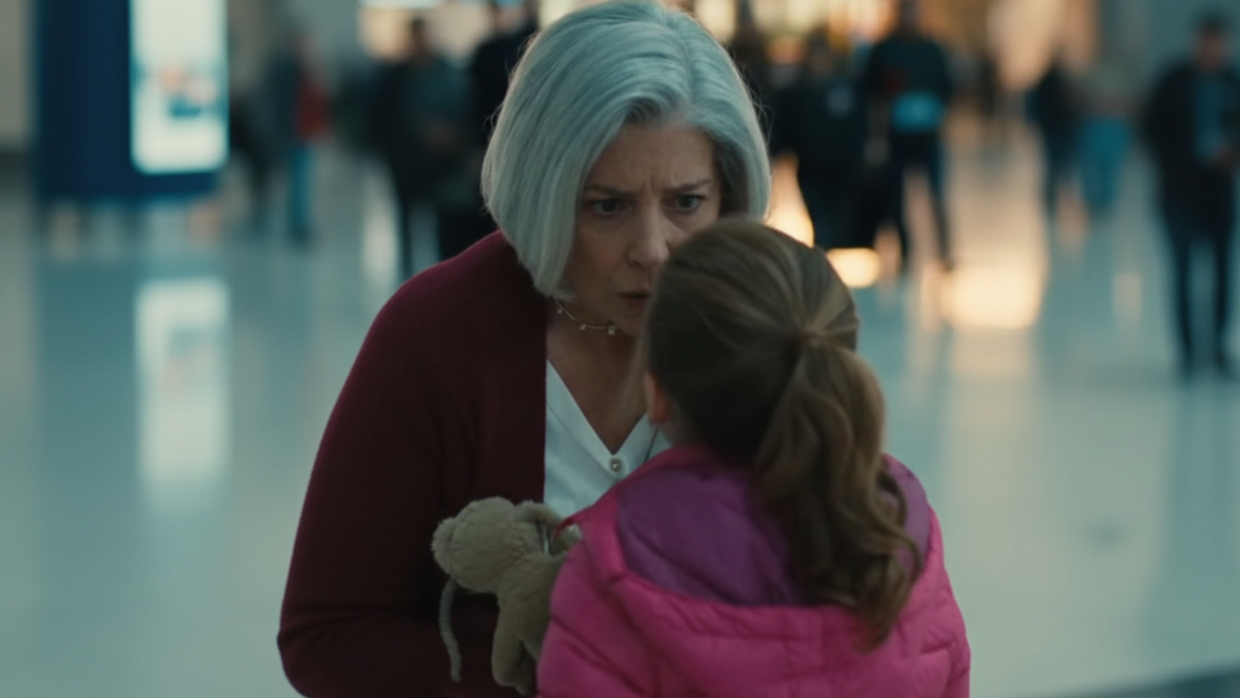
Her granddaughter whispered “He’s gone. We need to leave NOW” at the airport… But the stuffed rabbit she clutched held evidence that would bring down an entire criminal empire.
Helena adjusted her reading glasses as seven-year-old Betany ran toward her at O’Hare International. The child’s face was wrong. Too pale. Eyes too wide.
“Grandma.” Betany grabbed her hand, squeezing hard. “He’s gone. We need to leave now.”
Helena’s heart stopped. “What? Sweetheart, where’s your daddy?”
“He said to give you this.” Betany thrust her stuffed rabbit into Helena’s arms. “He said don’t let anyone take Mr. Hoppy. Ever.”
Helena’s phone buzzed. Unknown number. She answered.
“Mom, listen carefully.” Robert’s voice was tight, breathless. “They’re coming for Betany. Get her out of Chicago. Don’t go home. Don’t use credit cards. There’s a flash drive in the rabbit’s left ear. Guard it with your life.”
“Robert, what—”
“I found something at work. Money laundering. Weapons deals. Cartels. I copied everything. They know. Three men just walked into my office. Mom, I love—”
The line went dead.
Helena looked at her granddaughter. The child who still believed in fairy tales. The child who was now clutching her hand like it was the only solid thing in the world.
“We’re going on an adventure, sweetheart.” Helena’s voice didn’t shake. Thirty years of teaching high school had taught her how to fake calm. “A surprise trip.”
They walked quickly toward the exit. Helena’s mind raced through decades of Chicago history lessons. Safe places. Hidden routes. People who owed her favors.
A man in a black suit appeared near baggage claim. He scanned the crowd, then locked eyes with Helena. He reached for his phone.
“Betany, honey, we’re going to play a game.” Helena pulled her granddaughter toward the bathroom. “We’re going to pretend we’re spies.”
Inside the restroom, Helena dumped her purse contents, grabbed cash and her phone, stuffed them in her coat pockets. She pulled off Betany’s bright pink jacket, turned it inside-out to reveal plain gray lining.
“Are we hiding from bad guys?” Betany whispered.
“The very best spies always have a plan.” Helena kissed her forehead. “And Grandma has lots of plans.”
They exited through the family restroom, moved against the crowd flow, took the escalator down to ground transportation. Helena flagged a taxi driven by a woman in a hijab.
“Navy Pier,” Helena said, then leaned forward. “But I’ll pay you five hundred cash to lose anyone following us and take us to Greektown instead.”
The driver’s eyes met hers in the rearview mirror. “Someone after you?”
“Someone after my granddaughter.”
The driver’s expression hardened. “I have daughters. Hold tight.”
The taxi wove through traffic with precision that suggested military training. Helena watched the rear window. A black SUV tried to keep pace but got trapped at a red light.
Twenty minutes later, they stood on a Greektown side street. Helena counted out bills with shaking hands.
“My cousin runs a shipping company,” the driver said quietly. “If you need to disappear, really disappear, I can make a call.”
“I need to stay mobile.” Helena pulled out a pen, wrote a phone number on a napkin. “But if you hear that something happened to me, call this number. Tell them about the rabbit.”
The driver nodded. “Go with God, grandmother.”
Helena led Betany into a small café she remembered from years ago. The owner, Marco, had been her student in 1992. He looked up from the register, recognition dawning.
“Mrs. Phillips? I haven’t seen you in—”
“Marco, I need help. No questions. Please.”
His expression shifted. “Back room. Now.”
They huddled in a cramped office that smelled of oregano and old receipts. Helena examined the stuffed rabbit, found the flash drive exactly where Robert said. She turned it over in her hands. This tiny thing had destroyed her son’s life. Maybe ended it.
“I need a computer,” she said. “Just for two minutes.”
Marco provided a laptop. Helena plugged in the drive. Files appeared. Spreadsheets. Wire transfer records. Photographs of men in expensive suits meeting in parking garages. Audio files labeled with dates and times.
She clicked one audio file.
Robert’s voice: “So you’re telling me Global Meridian knowingly processed 340 million for the Sinaloa Cartel?”
Another voice, older, smoky: “We provide financial services. What clients do with their money isn’t our concern.”
“These ‘clients’ are buying assault rifles and smuggling them into Mexico. People are dying.”
“Your concern is touching. Also stupid. You have a daughter, yes? Seven years old? Pretty little thing.”
Helena’s hands clenched. They’d threatened Betany. Her grandbaby.
She ejected the drive, handed back the laptop. “Marco, I need you to forget I was here.”
“Already forgotten.” He pressed a wad of cash into her hand. “But take this. And Mrs. Phillips? You taught me that history is about people who refused to stay quiet. I’m proud of you.”
Helena’s eyes burned. “Thank you.”
They moved through Chicago like ghosts. A trucker Helena had tutored twenty years ago drove them seventy miles north. A librarian friend provided fake IDs and a burner phone. Each person asked no questions, gave everything they could.
By midnight, they’d reached a motel outside Milwaukee. Helena paid cash, registered as Mary Johnson and granddaughter. She double-locked the door, wedged a chair under the handle, finally let herself breathe.
Betany sat on the bed, still clutching Mr. Hoppy. “Grandma, is Daddy okay?”
Helena sat beside her, pulled her close. “I don’t know, sweetheart. But your daddy is very brave. And very smart. He did something important.”
“He told the truth about bad people?”
“Yes, baby. He told the truth.”
“My teacher says telling the truth is always right. Even when it’s scary.”
Helena kissed her hair. “Your teacher is absolutely right.”
The burner phone rang. Helena’s heart hammered. Unknown number.
“Hello?”
“Mrs. Phillips?” A woman’s voice. Familiar somehow. “This is Diane Castellano. I need you to listen very carefully.”
Diane. Robert’s girlfriend from college. The one who disappeared in 2004 without explanation.
“How did you—”
“I work for an agency that doesn’t officially exist. Robert sent an encrypted message to a dead drop we established years ago. He’s alive. Barely. He’s in protective custody, but there are moles in the FBI. We can’t trust traditional channels.”
“What do you need from me?”
“The evidence. Robert said you have it. We need to get it—and you and Betany—across the Canadian border. Tonight.”
“How do I know you’re really helping?”
“December 2003. Robert proposed to me at Lincoln Park Zoo, in front of the penguin exhibit. I said no because I’d just been recruited by the CIA. I’ve regretted it every day for twenty-two years. I’m not losing him again.”
Only Robert would have told her that story.
“Where do we go?”
Diane gave coordinates, a time, instructions that sounded like a spy novel. Helena memorized every word.
Two hours later, a dark sedan waited in a shopping center parking lot. Diane emerged from the driver’s side. She looked older than Helena remembered, harder, but her eyes softened when she saw Betany.
“She looks just like Robert did at that age.”
“He has pictures of you,” Betany said suddenly. “In a box under his bed. He looks at them when he’s sad.”
Diane’s composure cracked. Just for a second. “Get in. We have a three-hour window.”
They drove through the night. Diane explained in clipped sentences: Robert had contacted her directly after realizing his company was flagged. She’d activated an old extraction protocol. Her agency wanted the evidence but also wanted Robert and his family protected. Some people in government wanted the opposite.
“Global Meridian has connections everywhere,” Diane said. “Senators. Judges. Police chiefs. This goes deeper than one company.”
“How deep?” Helena asked.
“Deep enough that we’re driving to Canada instead of the nearest FBI office.”
They crossed the border at a rural checkpoint manned by Canadian intelligence. No stamps, no records, no evidence they’d ever been there.
The safe house sat outside Montreal, disguised as a hunting cabin. Robert waited inside, his face bruised, left arm in a sling.
“Mom.” His voice broke. “Betany.”
Betany flew into his arms. He winced but held her tight, tears streaming. Helena joined them, the three of them clinging together while Diane watched from the doorway.
“The FBI raided Global Meridian two hours ago,” Diane reported. “Arrested fourteen executives. Seized servers. Your evidence made that happen, Robert. You did it.”
“At what cost?” Robert gestured to his family. “My mom’s seventy. Betany should be in second grade, not running from assassins.”
“Sixty-eight,” Helena corrected. “And I taught American history for thirty years. I know what happens when good people stay silent.”
Diane pulled out a tablet, showed them news footage. Federal agents swarming a downtown Chicago high-rise. Executives in handcuffs. Headlines screaming about the largest financial fraud bust in a decade.
“You exposed a network responsible for thousands of deaths,” Diane said quietly. “Weapons that killed families in Mexico, drugs that destroyed communities in the US. You stopped that.”
“For how long?” Robert asked bitterly.
“Long enough.” Diane’s jaw set. “The evidence triggered a DOJ task force. They’re dismantling the entire operation. Following money trails to cartels, corrupt officials, arms dealers. It’s going to take years, but it’s happening.”
Helena studied the woman her son had loved. “What happens to us now?”
“Witness protection would normally be the protocol, but there are leaks. Instead, I’m offering something better. My agency has a program. Relocated identities in allied countries. You’d go to New Zealand. New names, new lives, financial support for two years minimum.”
“Forever?” Betany’s small voice.
“Maybe not forever,” Diane said gently. “When the prosecutions are complete, when the threats are neutralized, you could potentially come back. Or you could choose to stay. It’s a good life there.”
Robert looked at Helena. “Mom, you shouldn’t have to—”
“Choose?” Helena cut him off. “There’s no choice. You’re my son. She’s my granddaughter. Wherever you go, I go.”
“You’d leave your house? Your friends? Your whole life?”
Helena thought of the taxi driver who’d protected them without hesitation. Marco, who’d risked his business. The trucker and the librarian and all the people who’d helped because she’d once helped them.
“I’m not leaving my life behind,” she said slowly. “I’m carrying it forward. Everything I taught you about courage, about standing up to injustice—this is what that means. This is what it looks like.”
Diane’s phone buzzed. She glanced down, expression darkening. “We have a problem. Two hitmen just crossed into Canada. They’re eight hours behind us, but they’re coming.”
Robert stood, swaying slightly. “Then we leave now.”
“You can barely walk,” Helena protested.
“Then you’ll help me.” He gripped her shoulder. “Mom, you’ve spent three days keeping Betany safe. Let me help finish this.”
Diane was already moving, grabbing bags, wiping down surfaces. “There’s a cargo plane leaving from a private airstrip in ninety minutes. We’re on it.”
They piled into the sedan. Diane drove like she was racing death itself—which, Helena supposed, she was.
The airstrip was barely more than a dirt road with a hangar. A small jet waited, engines already running.
As they boarded, Helena turned back one last time. Canada. America somewhere beyond the horizon. The life she’d known for sixty-eight years.
“Grandma?” Betany tugged her hand. “Are you sad?”
Helena knelt down, looked into those serious brown eyes. “No, sweetheart. I’m not sad. I’m grateful.”
“For what?”
“For you. For your daddy’s courage. For getting to be brave when it matters.”
Betany considered this. Then she pressed Mr. Hoppy into Helena’s arms. “You can hold him. He makes people brave.”
Helena laughed, surprised by joy in the middle of terror. “Thank you, baby.”
The plane lifted into the pre-dawn sky. Below, the world became smaller. Cities turned to toys. Borders became invisible lines.
Diane sat beside Robert, their hands intertwined. Twenty-two years of regret being written over with second chances.
Helena closed her eyes, Betany sleeping against her shoulder, the stuffed rabbit clutched tight.
Six months later, Helena stood in a kitchen in Auckland, watching Betany chase sheep in a nearby field. Robert worked as a consultant under a new name. Diane visited monthly, working on the ongoing prosecutions.
The news kept getting better. More arrests. More networks dismantled. Global Meridian’s CEO sentenced to forty years. Senators implicated. Money recovered.
Helena’s old students found her somehow—teachers always do. Encrypted emails. Photos of their families. Thank you notes for lessons that had meant more than they’d realized.
She started teaching again. New Zealand history this time. But she wove in the same lessons: courage matters. Truth matters. Standing up when everyone else sits down matters.
“Mrs. Phillips?” A student raised her hand. “Why do you always say that even ordinary people can be extraordinary?”
Helena smiled, thinking of taxi drivers and café owners and truckers who’d risked everything for strangers.
“Because I’ve seen it,” she said. “I’ve lived it.”
Betany attended a local school, made friends, learned to love rugby. She kept Mr. Hoppy on her bed but stopped sleeping with him. The evidence had been extracted, secured, used to dismantle an empire. The rabbit was just a rabbit again.
Robert healed. Slowly. Some scars ran deeper than broken ribs. But Diane was patient, and Helena watched her son remember how to smile.
Two years became three. Then four. The threats diminished. Prosecutions concluded.
One morning, Helena received an encrypted call. “Mrs. Phillips, this is Special Agent Morrison, DOJ. I’m calling to inform you that all principal defendants in the Global Meridian case have been convicted. The criminal networks have been dissolved. Our assessment is that the threat level to you and your family is now minimal.”
“We can go home?” Helena asked.
“You can. If you want to.”
Helena looked out the window. Betany was laughing in the field. Robert was teaching her to kick a rugby ball. Diane had just pulled up in her car, waving.
“Agent Morrison, thank you for the information. But I think we’re already home.”
She hung up, walked outside into the New Zealand sunshine.
Robert jogged over, out of breath. “Mom? Was that—”
“We’re free,” Helena said. “Really free. We can stay. We can go. We can choose.”
They stood together, three generations who’d survived by refusing to break.
“What do you want to do?” Robert asked.
Helena watched Betany cartwheel across the grass, wild and safe and happy.
“I want to keep choosing this,” she said. “Every single day.”
They’d fled Chicago with nothing but a stuffed rabbit and each other. They’d lost addresses but found purpose. Left behind houses but built a home.
And when Betany asked, years later, why they’d stayed in New Zealand even after the danger passed, Helena told her the truth:
“We learned that home isn’t a place. It’s the people you’d cross the world to protect. And sweetheart, I’d cross a thousand worlds for you.”
Justice had been served. The criminals faced consequences. The weapons stopped flowing. Lives were saved.
But for Helena, the real victory was simpler: her family was whole, her granddaughter was safe, and every morning she woke up grateful for second chances.
Sometimes the most extraordinary thing an ordinary person can do is refuse to let fear win.
Helena refused. And that made all the difference.