


On Sunday mornings, the sun crept languidly into their bedroom, casting a gentle glow over the soft linens and the crumpled books on the nightstand. Helena lay beside Oliver, wrapped in the quiet comfort of their shared routine, yet a dissonance had begun to disturb the melody of their lives.
It started with a curious shift—barely perceptible. Oliver, once animated in recounting his day, had become reticent, his stories fragmented like shattered glass. Helena noticed when she asked him about his weekend plans with friends. “Oh, just the usual,” he’d said, a vague wave of his hand closing the conversation.
Unusual. Mundane.
Helena’s mind was a labyrinth of whispers and echoes, her imagination plucking at every anomaly with a silent urgency. Their conversations, once buoyant, now felt like dialogues with shadows. She began observing the art of his absence. During breakfast, his eyes lingered on his phone with a secretive intensity, and she’d catch his smile—a smile not meant for her—at some faraway joke. He was there, but not.
“Who was that on the phone?” she asked once, trying to sound nonchalant.
He shrugged, “Just an old friend from college.”
Yet, his eyes flicked away too quickly, and her heart skipped not with love but with foreboding.
It wasn’t precisely a lie, but more an evasion, a stone skipping over a lake, touching the truth fleetingly before vanishing into the depths.
Helena’s suspicions, once a quiet murmur in her mind, now demanded an audience, loud and insistent. She found herself curating evidence like a mystery novel detective. The mismatch of emotions, the missed beats in their rhythm, the unspoken chasm between their realities.
One evening, they watched a movie in silence, her head resting on his shoulder. It was a romantic drama, the kind they both loved, but his laughter felt hollow, echoing in the spaces where genuine joy should reside. She glanced up at him, and his eyes were glazed, lost somewhere she couldn’t follow.
“Did you like it?” she asked afterwards, her voice a tremor.
“Yeah, it was good,” he replied, his tone flat, eyes avoiding hers. He stood up, his hand brushing hers, yet the warmth felt absent, as if his touch were a ghost.
The unease settled into Helena’s bones. She had to know; the knowing was better than this silent unraveling.
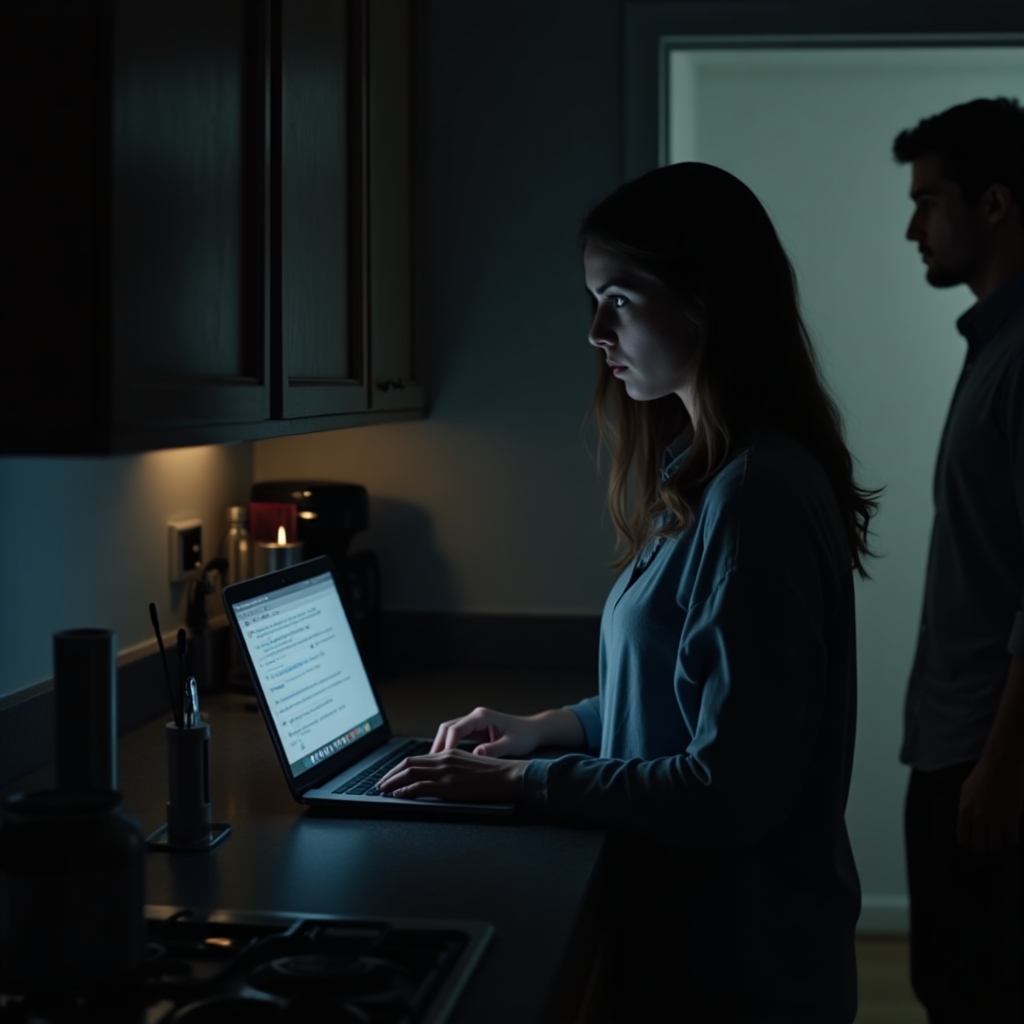
One day, as if summoned by her own uncertainty, an opportunity presented itself. Oliver had left his laptop open on the kitchen table, the screen aglow with a conversation thread. Helena hesitated, moral boundaries whispering for her to retreat, but the fear of ignorance propelled her forward.
The words were stark, undeniable.
A message exchange with an old college friend, yes, but the words shared—intimate, laced with shared secrets and future plans—were not those of mere friendship. It was a mismatched reality, a truth hidden beneath layers of emotional silence.
She was paralyzed, staring at the screen, her world shifting. The gaps in his stories, the shadows in his smiles, all leading to this moment. Her heart pounded, each beat a question: Why? Was it worth it? How long?
Oliver entered, seeing her posture, understanding without needing to ask. The silence erupted between them, a tangible force.
“Helena,” he began, his voice a cracked whisper, “I didn’t mean for it to be this way.”
His confession was a key, unlocking a flood of explanations, apologies, truths wrapped in regret. It was not betrayal in the conventional sense, but an emotional exodus, his heart venturing where it had no right.
They talked through the night, words spilled amid tears and halting breaths. It was a confrontation, not of anger, but of sorrow and understanding.
In the end, there was no simple resolution, no neat ends tied in bows. They sat in the dawn light, shadows stretching long across the room, and made a choice. A choice to rebuild, to understand each fissure and fill the cracks with shared strength.
Their journey was not over, but the knowing—ah, the knowing—was a balm, a painful yet necessary liberation.