




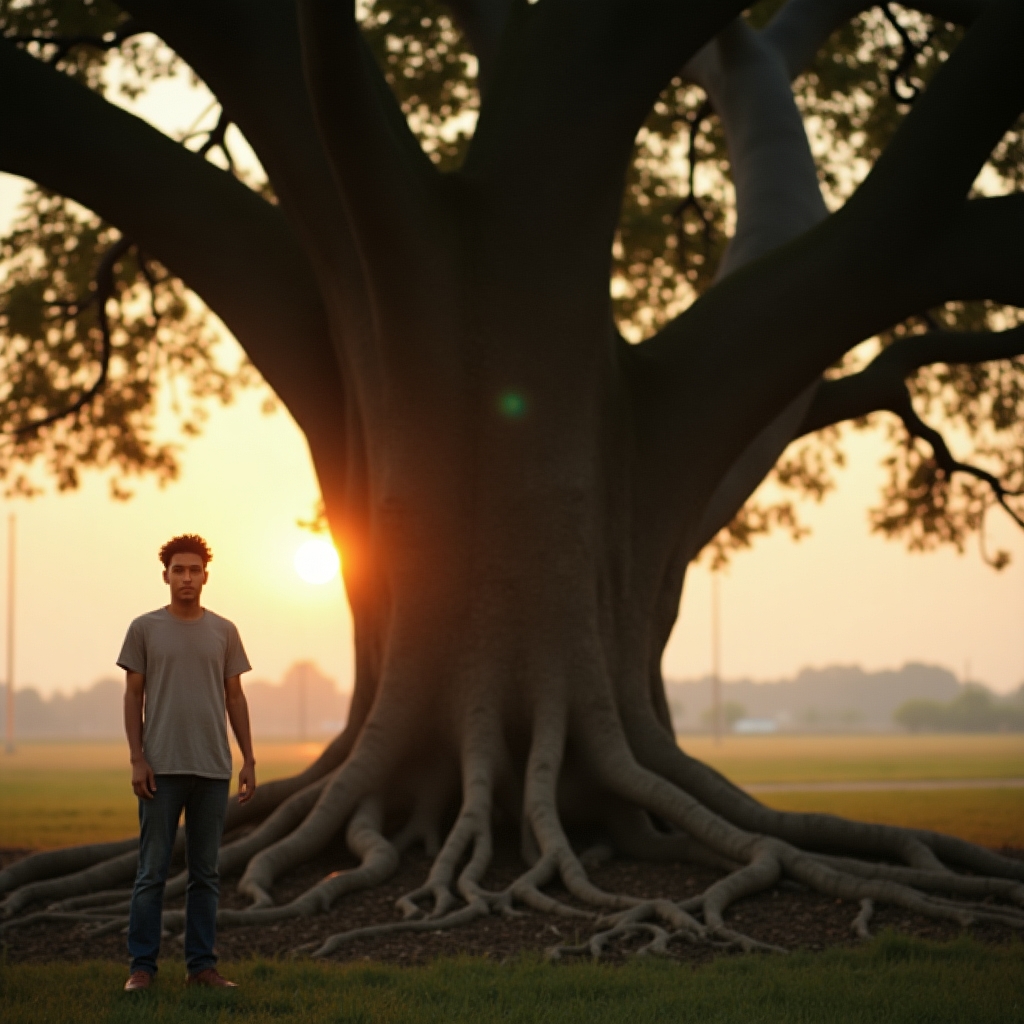
Aarav Mehta stood beneath the venerable banyan tree at the edge of his family’s ancestral property in a small village in Gujarat. The tree was ancient, with thick roots that sprawled across the earth like old, gnarled fingers. It was here that Aarav often found himself when the weight of expectations felt insurmountable.
He was the youngest of three siblings, and the only son. His sisters were married, fulfilling their roles within the family framework, but Aarav’s path was more convoluted. Ever since he was a child, he had been told that he would carry the family name forward, take over the responsibilities of the family textile business, and prioritize the collective over the individual. Yet, within him burned a quiet passion for painting — a passion that was neither understood nor encouraged by his pragmatic parents.
In his family, decisions were often made communally, and personal desires were subsumed under a broader shared identity. Aarav, however, found himself pulled in a different direction. The family’s expectations pressed on him like the heavy humidity that hung in the air before a monsoon storm.
Despite these expectations, Aarav managed to attend art school secretly, using the pretext of business studies in the city. He spent his nights sketching under the dim light of a single bulb in his rented room, his heart straddling two worlds. One was the world of colors and canvases, where he lost himself in creative expression; the other was the world of duty and tradition, where a son’s honor was measured by his conformity and sacrifice.
Each visit home was a dance. He would nod along with his father’s business plans, feign interest, and help in the shop during the day, all the while feeling a growing distance from his own essence. His mother’s soft yet firm reminders about the ‘right’ path would echo in his ears long after he had left the house.
It wasn’t that Aarav didn’t love his family. He did, deeply. He admired his father’s work ethic, his mother’s devotion to their traditions, and the way his family had stayed rooted in their culture through generations. But love, as Aarav knew, was complicated. It was not a single beam of light but a spectrum that could sometimes blur into confusion, especially when it meant sacrificing who you were meant to be.
One evening, the tension within him came to a quiet boil. Aarav was back in his room in the city, painting a sunset over a field of wildflowers. Each brushstroke was a small rebellion against the life that awaited him. In the middle of his work, his phone buzzed — a reminder from his father about an upcoming meeting with a potential business partner.
He stared at the message, feeling the tug of obligation tighten, knotting his stomach. This quiet rebellion had gone on for too long, and he knew a decision had to be made. But how could he choose between his family and himself without losing either?
The night was long and sleepless, and as dawn’s rosy hue began to bleed into the sky, Aarav found himself beneath the banyan tree once again. He closed his eyes, listening to the rustle of leaves above, feeling an inexplicable kinship with the tree — a living testament to resilience and rootedness.
It was here that the moment of clarity came to him, as naturally and silently as the sun emerging from behind the clouds. He realized that he didn’t have to choose one over the other. His love for art and his love for his family could coexist if he was brave enough to let them.
With newfound resolve, Aarav decided to speak his truth. It wouldn’t be easy, and not everyone might understand, but it was a necessity for his soul. He would continue with the family business commitments while pursuing his art, seeking a balance that could allow both his heart and heritage to flourish.
Later, when he finally stood before his family, his voice was steady, even if his heart raced. He spoke of his passion for painting, of how it wasn’t just a hobby but a piece of him. He saw the surprise in his father’s eyes, the concern in his mother’s furrowed brow. But he also saw something else — a glimmer of understanding, a recognition of his earnestness.
It wouldn’t be a perfect or immediate resolution, but it was a start. Aarav knew he had to prove himself, not just as a businessman but as an artist, and in doing so, perhaps he could bring a new dimension to the family legacy — one that honored both tradition and individuality.
Walking away from that conversation, Aarav felt lighter. The banyan tree seemed to nod in agreement as the breeze rustled through its leaves, a witness to his quiet yet profound transformation.