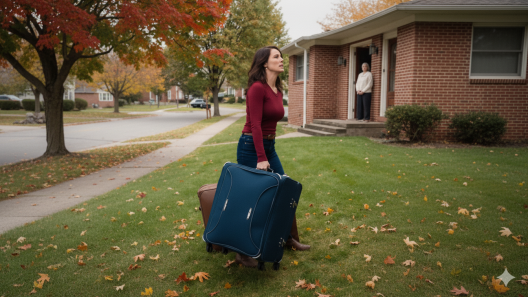
A grieving billionaire lined up five women and told his nine-year-old son to pick a new mom… But the boy pointed at the cleaner.
Gabriel was nine years old, and his eyes had already learned how to carry grief.
Two years had passed since his mother died. The doctors used words like “unexpected complications” and “rare progression.” To Gabriel, those words meant nothing. What he understood was simpler and more brutal: one morning she was there, and by evening she wasn’t. And the world hadn’t bothered to stop for even a single day.
The mansion kept standing. The marble floors kept gleaming. The crystal chandeliers kept catching sunlight. But warmth — real warmth — had packed up and left with her.
His father, Ricardo Santoro, was not a cruel man.
He was simply a man who had built his entire life around a single belief: every problem had a solution, and every solution required speed. Hesitation, in his world, was the enemy. In thirty years of business, he had learned that the men who paused too long lost everything. The men who moved quickly won.
So when Mariana died, Ricardo grieved in private for exactly one month.
Then he returned to the office.
He told himself this was strength. He told himself this was the responsible thing. He told himself his son needed stability, routine, structure — not a father weeping in hallways.
But children don’t read strategy memos.
Gabriel stopped smiling somewhere around month three.
He stopped raising his hand in class around month five.
By month eight, his teachers were calling Ricardo’s personal line.
“Mr. Santoro, your son hasn’t spoken to another child in weeks.”
“He stares out the window during lessons.”
“We’re concerned.”
Ricardo’s answer was always the same, delivered in the same measured boardroom tone.
“He’ll adjust. Children are resilient.”
But Gabriel wasn’t adjusting.
He was disappearing. Slowly. Quietly. In the way that only very sad children disappear — still physically present, still breathing, still eating dinner at the long table — but somehow entirely unreachable.
The mansion, which had once echoed with Mariana’s laughter and her habit of playing music too loud on Saturday mornings, now felt like a building that had forgotten what it was built for.
One Tuesday afternoon, Ricardo came home early from a board meeting.
He found Gabriel alone in the garden, crouched beside the koi pond, dropping pebbles into the water one by one. Not playing. Not watching the fish. Just dropping. Counting. Dropping. Counting.
Ricardo stood at the window for a long time.
His son looked impossibly small against the immaculate grounds — a small figure in an oversized house that had been designed to impress, not to comfort.
Something tightened in Ricardo’s chest. Not guilt — he wasn’t ready to name it that yet. Something more like strategy activating.
He picked up his phone and called his assistant.
“I want to host a dinner tomorrow evening.”
“Of course, sir. How many guests?”
“Five.”
A pause.
“Five women.”
The following night, the Santoro mansion was dressed to perform.
White orchids on every surface. Candlelight softening the marble. The kind of careful staging that communicated wealth without screaming it. Six figures of effort designed to look effortless.
The women arrived one by one in cars that cost more than most people’s houses.
They were everything Ricardo had curated: beautiful, polished, educated, connected. Women from families that understood the grammar of wealth. Women who would look correct standing beside him at charity galas and board dinners. Women who would — he told himself — provide Gabriel with the maternal presence a growing boy required.
He had handled this the only way he knew how.
Like an acquisition.
Before the guests came through the front door, Ricardo found his son sitting on the staircase landing.
“Gabriel. Come downstairs.”
The boy stood slowly. His small sneakers made soft sounds on the marble as he descended, hands trailing along the banister.
Ricardo placed a hand on his shoulder — the firm, brief kind that communicates affection without requiring vulnerability.
“Tonight you will meet some guests.”
Gabriel looked up. “What guests?”
“Women. Good women. From good families.”
Gabriel’s eyes narrowed slightly. “Why?”
Ricardo breathed in slowly. “I think it’s time this house had a woman in it again.” He paused. “Someone to care for you properly. You may choose whoever feels right to you.”
The small stone Gabriel had been turning between his fingers dropped to the marble floor.
The sound of it hitting the tile rang out like something much louder.
“I don’t want another mother,” he said.
Ricardo’s jaw tightened. “Your mother is gone, Gabriel. Life has to continue.”
“I already have a mom.”
“Had.” The word came out harder than Ricardo intended. “We have to be realistic.”
“I don’t want to be realistic.”
“You need someone to look after you. Someone permanent.”
Gabriel stared at his father for a long moment. Then he looked down at the floor where the pebble had landed.
He didn’t answer.
Because some things, when you’re nine years old, are too large to put into words.
When the first car crunched up the gravel drive, Gabriel was gone.
He moved quietly — he had gotten very good at that — through the back corridor, past the kitchen, out the side door that led to the garden. The evening air was cold. He didn’t stop.
He ran along the edge of the hedge maze, past the fountain, all the way to the back of the property where a small wooden bridge arched over the narrow stream that fed the koi pond. He crawled beneath it.
This was his place.
Had been since he was five, when his mother had helped him build a “fort” out of old garden cushions under that very bridge. She’d brought a thermos of hot chocolate and two flashlights and told him this was their secret headquarters.
“What are we protecting?” he’d asked.
She had smiled. “Each other.”
He pulled his knees to his chest and pressed his back against the cold stone.
And then he cried.
Not the quiet kind. The kind that comes from the deepest, most private part of you — the kind you only let out when you’re completely certain no one can hear.
From the kitchen window, Elena saw him run.
She had worked in the Santoro mansion for two months. Thirty years old. Hired as part of the housekeeping staff — cleaning, laundry, the ordinary invisible labor that kept a place like this functioning. She was not Gabriel’s nanny. She was not his tutor. She was not paid to care about him specifically.
But she had started bringing him cookies three weeks in — not because anyone asked her to, but because she’d noticed that on school days he came home and went straight to his room without stopping for a snack, and she remembered being small and hungry and no one noticing.
She had started sitting with him during thunderstorms because one night in October she’d heard him crying in the hallway outside the kitchen at two in the morning, and she’d opened the door, and he’d looked so startled — so braced for someone to send him back to bed — that she’d simply sat down on the floor beside him and said, “I don’t like thunder either.”
They had sat there together until it passed.
She didn’t tell anyone.
He didn’t tell anyone.
It became their arrangement.
Now, watching him disappear into the dark garden while luxury cars pulled around the front of the house, Elena felt something familiar tighten in her stomach.
Diane, the head housekeeper, appeared at her shoulder. “Leave it,” she said quietly. “The master has guests. Important ones. Don’t interfere.”
Elena nodded.
She waited exactly thirty seconds after Diane left the room.
Then she took off her apron, set it on the counter, and walked out into the dark garden.
She found him exactly where she expected.
Under the bridge. Knees to chest. Shoulders shaking.
She crouched down.
“Gabriel.”
He looked up. His face was a wreck — red eyes, wet cheeks, lip trembling.
Then he threw his arms around her and held on like she was the only solid thing in the world.
“They want me to pick a new mom,” he sobbed into her shoulder. “Like picking from a catalog. Like she was just—” He couldn’t finish.
“Hey.” Elena wrapped her arms around him. “Hey. Listen to me. No one is replacing anyone.”
“He said I could choose. Like it was a shopping trip.”
“Your father is—” She stopped. Chose her words carefully. “He doesn’t always know how to say the right thing. But that doesn’t mean he doesn’t love you.”
“Those women don’t love me.” Gabriel pulled back and looked at her. His eyes were fierce through the tears. “They don’t even know me. They look at the house. They look at the cars. I can tell. I can always tell.”
Elena didn’t answer immediately.
Because she had seen the women arriving through the kitchen window.
And she suspected he was right.
“Your mom would know what to do,” he whispered.
“Yeah,” Elena said softly. “She would.”
Gabriel leaned back against the stone wall. “She told me something before she went to the hospital the last time.” His voice was very small. “She said if anything ever happened to her, I should trust the person who stays. The one who doesn’t want anything from us.” He looked at Elena. “She said those people are rare but you always find them if you look.”
Elena felt something move in her chest that she didn’t have a name for.
“She sounds like she was very wise.”
“She was the smartest person I ever met,” Gabriel said. “Dad thinks smart means making money. Mom thought smart meant understanding people.”
A long silence stretched between them.
Somewhere across the garden, the french doors of the dining room opened, and warm light and the sound of polished laughter spilled out.
“Gabriel!”
Ricardo’s voice cut across the lawn.
The boy stiffened.
Ricardo walked across the grass, and behind him — because apparently subtlety was not on the evening’s agenda — came all five women. Dresses immaculate. Smiles curated. Five pairs of eyes sweeping the grounds with the practiced assessment of people who had been taught from birth to calculate the value of a room before deciding how much to want it.
When Ricardo saw Elena crouched under the bridge beside his son, something in his expression closed.
“What is going on here?”
“Elena was with me,” Gabriel said immediately, stepping slightly in front of her. Nine years old, defending a grown woman. “She works here.”
“I know where she works.” Ricardo’s voice was precise and cold. “Elena, please return inside.”
“Dad—”
“Gabriel.” The single word landed like a gavel. “Come and greet our guests. Now.”
Gabriel wiped his face with the back of his hand. He straightened his spine — something Elena had watched him practice without knowing he was practicing it, this performance of composure he’d been learning from watching his father.
He stepped forward.
The five women watched him approach with the careful attentiveness of people who needed to seem warm.
One smiled brilliantly. “He’s adorable.”
Another murmured to her companion.
“Bit dramatic, isn’t it? Running off like that.”
A third laughed lightly. “Oh, children.”
Gabriel heard all of it.
Elena watched him hear it.
She watched the flicker cross his face — the recognition of being discussed rather than addressed, of being a feature in a space rather than a person in it.
Ricardo crossed his arms.
“Gabriel. I told you — you may choose anyone you like. These women are all wonderful. Any of them would make an excellent—”
“I know who I choose,” Gabriel said.
His voice was quieter than Ricardo expected. Steadier.
The five women adjusted their expressions into their most appealing configurations.
One stepped forward warmly. “I would love to be your mother, sweetheart. We could do so much together.”
“I love children,” said another, placing a hand over her heart. “It would be an absolute joy.”
“And this property,” murmured a third, gazing past Gabriel toward the illuminated mansion. “It’s stunning. You must feel so lucky growing up here.”
Gabriel turned.
He pointed.
Not at any of the five women.
At Elena.
The garden went quiet in the way that gardens do when the humans inside them suddenly stop performing.
One of the women laughed — a short, startled sound. “Is he joking?”
Another looked at Ricardo with open amusement. “The housekeeper?”
A third turned to her neighbor. “I didn’t realize this was a comedy evening.”
Ricardo’s face had gone through three expressions in approximately two seconds. Confusion. Embarrassment. Something approaching anger.
“Gabriel.” His voice was very controlled. “This is not the time for—”
“I’m not joking.” Gabriel’s voice didn’t waver. “I choose Elena.”
“You don’t understand what you’re—”
“Mom told me.” The words landed like something dropped from a great height. “Before she died. She told me to trust the person who stays.” He turned and looked directly at his father. “Who stayed, Dad? When I couldn’t sleep? Who brought me food? Who sat with me when it thundered? Who let me talk about Mom without changing the subject?”
Ricardo said nothing.
“It wasn’t any of them.” Gabriel gestured toward the five women without hostility — simply with the devastating clarity of a child who hasn’t yet learned to be diplomatic when the truth is obvious. “They don’t know me. They looked at the house before they looked at me. I noticed.” He paused. “Elena always looks at me first.”
Silence.
One of the women — the one who had called him dramatic — opened her mouth.
“Ricardo, this is absurd. You cannot be seriously—”
Ricardo raised one hand.
One hand. That was all it took.
She stopped.
“Everyone go inside,” Ricardo said quietly.
“But surely—”
“Inside.”
The five women exchanged glances. The carefully maintained warmth evaporated. What replaced it was considerably more honest — irritation, pride wounded in the particular way that comes from being publicly outranked by someone who wasn’t even supposed to be a competitor.
They went inside.
The garden settled.
Three people remained in the cold evening air.
Ricardo. Gabriel. Elena.
Elena stood very still, her hands clasped in front of her, her expression the practiced neutral of someone who has spent years learning to take up as little space as possible in rooms that don’t belong to them.
Ricardo looked at her for a long moment.
“You’ve been comforting him,” he said. “Every night?”
“Not every night,” she said carefully. “When he needed it.”
“How long?”
“About six weeks after I started. When I realized no one else was—” She stopped herself. “I apologize if I overstepped. It wasn’t my place.”
“It was exactly your place.” Gabriel looked up at his father. “It was someone’s place. Someone needed to do it.”
Ricardo looked at his son.
Then he did something Elena had not seen him do in the two months she’d worked there.
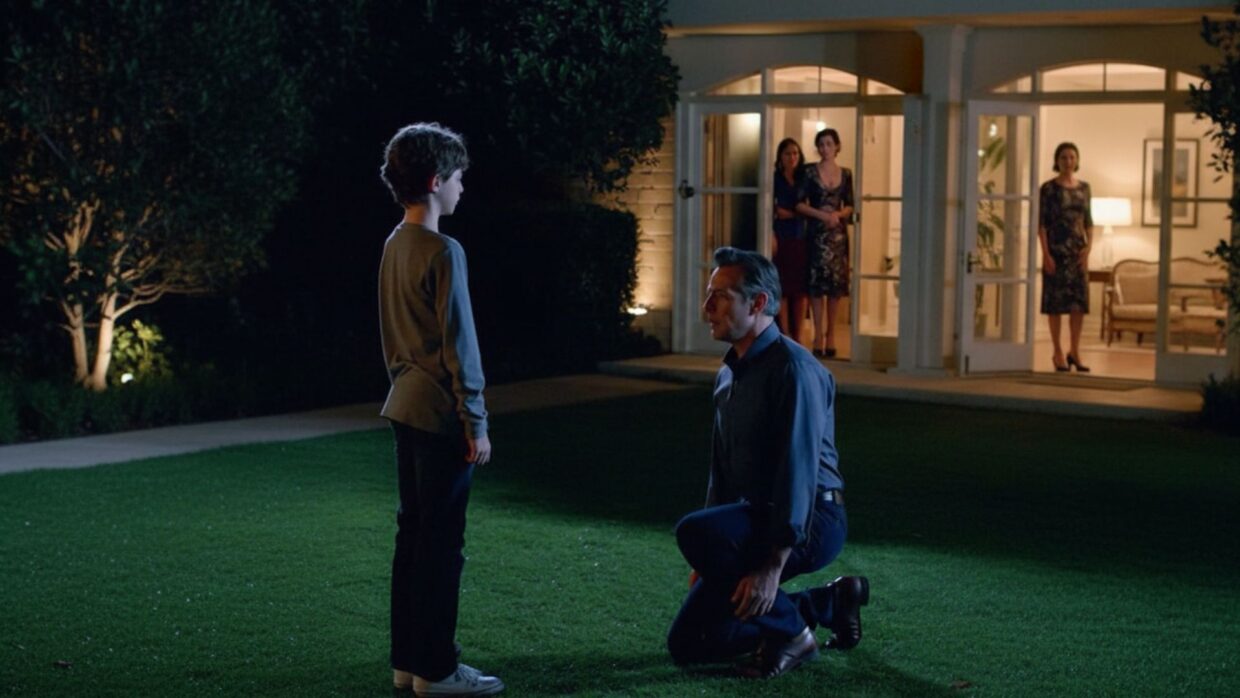
He knelt down.
Not the ceremonial crouch of an adult humoring a child. All the way down, one knee on the cold grass, until he was level with Gabriel’s eyes.
“I owe you an apology,” he said.
Gabriel blinked. “For what?”
“For thinking that moving forward fast was the same as taking care of you.” Ricardo swallowed. “I was wrong. I thought keeping this house running and keeping your life structured and not breaking down in front of you was protecting you.” He stopped. “But I forgot that what you actually needed was someone to sit with you.”
“Yeah,” Gabriel said. “That’s kind of what I needed.”
“I’m sorry.”
The boy looked at his father for a long time.
Then he said, very quietly: “Are you going to stop working so much?”
Ricardo exhaled. “I’m going to try.”
“Promise?”
“I promise I’ll try harder than I have been. That’s the honest version.”
Gabriel considered this with the seriousness of someone evaluating a contract. Then he nodded. “Okay.”
Elena tried to excuse herself.
“I should really go inside and—”
“Wait.” Ricardo stood. He looked at her directly for what was, Elena realized, possibly the first time since she’d been hired. Before, when he spoke to her, he’d been speaking past her — toward the task, toward the result. Now he was actually seeing her.
“My son trusts you,” Ricardo said. “He apparently trusts you more than anyone else in this house.”
“He’s a very good judge of character,” Elena said carefully.
“Apparently better than me.” A pause. “What he said — about his mother. She told him that?”
“That’s what he told me, yes.”
Ricardo was quiet for a moment. “That sounds like something Mariana would have said.” His voice changed on her name — softened in a way that nothing else had managed to soften it.
He looked at Gabriel.
“How often were you talking to her about your mother?”
“All the time,” Gabriel said simply. “Elena doesn’t change the subject.”
Ricardo looked at the ground briefly. Then back up.
“I want to change that. I want to be the person you talk to.” He glanced at Elena. “But I’d like her to stay.”
Gabriel looked at Elena. “Stay like… still work here?”
“Stay like become a permanent part of this household,” Ricardo said. “An official part. With a proper title and proper compensation and—” he paused, and for the first time that evening something almost self-aware moved through his expression “—with an actual contract this time, not just tacit permission to sit on kitchen floors during thunderstorms.”
Elena stared at him.
“Mr. Santoro, I’m not sure I—”
“You kept my son present,” Ricardo said quietly. “For two months, you kept him from disappearing completely. I didn’t even realize he was disappearing.” He stopped. “I owe you considerably more than a new job title. But it’s a start.”
Gabriel looked between them.
Then he reached up and took Elena’s hand on one side.
And after a moment — a beat of hesitation, the kind that costs something — he reached up and took his father’s hand on the other.
He looked at the two adults he was connecting.
“Okay,” he said. “But nobody’s replacing Mom. That’s the rule.”
“That’s the rule,” Ricardo agreed.
“No one’s replacing anyone,” Elena said. “Some people just add to what’s already there.”
Gabriel considered this.
Then he said, with the absolute pragmatism of a nine-year-old who has been grieving for two years and is very tired:
“Can we go inside now? It’s cold.”
The dinner that was supposed to change everything was cancelled.
The orchids were cleared. The candles were blown out. The five women left in the same luxury cars they’d arrived in, most of them on their phones before they’d cleared the driveway — already recalibrating, already deciding which part of this evening to be offended by and which part to use as a story at the next dinner party.
That night, Gabriel went to bed at his normal time.
Elena sat in the chair by his window, like she had on the nights when sleep wouldn’t come, and read from the book they’d been working through for three weeks — an old adventure story about a boy who sailed alone across an impossible ocean and found a civilization that had been waiting for him the whole time.
Ricardo stood in the hallway outside the door.
He stood there for a while.
Listening to Elena read.
Listening to Gabriel laugh at a joke that landed midway through chapter seven.
Listening to the small, unplanned sounds of a child who is temporarily, genuinely at ease.
He thought about Mariana. About the year before she got sick — how she used to tease him about working too much, about confusing productivity with presence. “You can run fifty meetings,” she’d told him once, not unkindly, “and still miss everything important.” He’d laughed it off. He’d told her she was being dramatic.
He hadn’t laughed since she died.
He reached into his jacket pocket and pulled out his phone. Opened his calendar. Looked at the next six weeks — the meetings, the calls, the travel, the layered architecture of a life built almost entirely out of obligations.
He started moving things.
Not all of them. Not overnight. But some of them.
Enough to clear three mornings a week.
Enough to be home for dinner.
Enough to be the person who was there.
He put the phone back in his pocket.
Through the door, he heard Gabriel say: “Elena, what happens when you love someone who’s gone? Does it get smaller?”
A pause.
“No,” Elena said softly. “It gets quieter. But it doesn’t get smaller. It just learns to live alongside everything else.”
A silence.
“That’s what Mom would have said,” Gabriel told her.
“Then she was right,” Elena answered.
Ricardo pressed his hand flat against the wall.
He stood there until the chapter finished and Gabriel’s voice finally went quiet.
Then he went downstairs.
Made two cups of tea — the kind Mariana had always kept in the back cabinet, chamomile with honey, the one he’d never touched since she died.
He set them on the kitchen table.
And he waited for Elena to come down.
She found him sitting at the kitchen table with the two cups.
She stopped in the doorway.
“Sit down,” he said. “Please.”
She sat.
He pushed one cup toward her.
“I want to hear about him,” Ricardo said. “Everything I’ve missed. The thunderstorms. The cookies. The conversations about Mariana. Everything.” He paused. “I want to understand who my son became while I was gone.”
Elena wrapped both hands around the warm mug.
“You weren’t really gone,” she said. “You were just looking the wrong direction.”
“Same result.”
“Different fix.” She met his eyes. “You can’t catch up on what you missed. But you can be present starting now. That’s all he actually needs from you.”
Ricardo was quiet for a moment.
“You’re very direct for someone who was just trying not to overstep.”
“I’ve been overstepping for six weeks,” Elena said. “Might as well commit.”
Something moved at the corner of Ricardo’s mouth. Not quite a smile. The ghost of the precursor to one.
“Tell me,” he said. “Everything.”
Elena took a breath.
And talked until the tea went cold.
Three months later, the mansion felt different.
Not renovated. Not redecorated. The marble was the same. The chandeliers were the same.
But Gabriel’s sneakers were at the bottom of the main staircase now — abandoned there every afternoon when he came home, a small act of disorder that Ricardo had stopped asking him to correct.
There was a second chair at Ricardo’s desk in the study, pulled up close, for the evenings when Gabriel wanted to do homework in the same room as his father.
There was a worn paperback on the kitchen table — the adventure book, chapter nineteen now — ready for whichever evening it was needed.
Elena had a room of her own in the house. A real one, with a real key and a nameplate on the door that said her name — not her job title.
One Sunday morning, Gabriel found both adults in the kitchen. Ricardo was making scrambled eggs with the focused incompetence of someone who had never learned to cook because he’d never needed to. Elena was standing beside him, explaining — with patient precision — exactly what he was doing wrong.
Gabriel sat down at the counter and watched them argue about butter.
Then he reached into the cabinet behind him and pulled out the chamomile tea.
Made three cups.
Without being asked.
Set them on the table.
Ricardo and Elena both stopped their argument and looked at the cups.
Then at Gabriel.
He shrugged with elaborate nine-year-old nonchalance.
“Mom always said tea makes fights shorter,” he said. “Don’t read into it.”
Then he went back to his homework.
Ricardo looked at Elena.
Elena looked at Ricardo.
Neither of them said anything.
But the kitchen — for the first time in two years — was exactly the kind of loud and warm and slightly chaotic that a home was supposed to be.
And in the afternoon light coming through the big windows, casting long gold stripes across the marble floor, the mansion didn’t look like a showcase anymore.
It looked like where a family lived.
Some people spend their whole lives searching for the right candidates.
Interviewing. Curating. Selecting.
Not realizing that the person they were looking for had already arrived —
had already been sitting quietly in their kitchen,
pouring tea and reading bedtime stories
and doing the invisible, irreplaceable work
of simply staying.
The best things in life don’t apply for the position.
They just show up.
And wait to be seen.