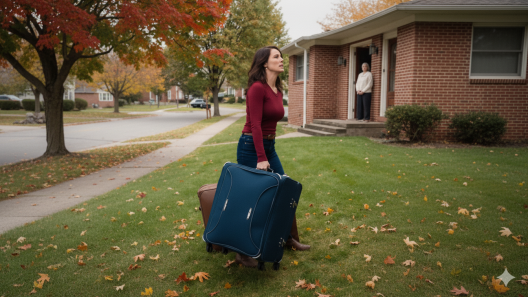
He paid his cleaning lady $5,000 to stand beside him at his elite Manhattan gala… But when he grabbed the mic and said her name, every billionaire in the room went completely silent.
I wasn’t supposed to matter.
That was the unspoken rule of the job. Show up. Clean. Disappear. Don’t leave a trace of yourself in the rooms where powerful people lived.
I had followed that rule for almost two years inside Julian Blackwood’s penthouse on the Upper East Side.
Two years of learning his silences. Two years of watching a man worth three billion dollars stand alone at floor-to-ceiling windows at six in the morning, his coffee going cold in his hand, staring at a city that owed him everything and somehow still couldn’t give him what he needed.
I wasn’t supposed to notice that.
But I did.
My name is Erin Calloway. I grew up in Yonkers in a two-bedroom apartment with my mother and younger brother. I paid my way through community college cleaning office buildings overnight. When the service agency placed me in the Blackwood penthouse, I told myself it was temporary. A stepping stone.
Two years later, I was still there.
And I had stopped pretending I didn’t know why.
The afternoon it changed, I was in the service corridor on the forty-second floor, restocking the supply cart. The corridor smelled like industrial cleaner and recycled air. It was the part of the building that reminded you of what the building actually was — a machine dressed in marble.
I heard footsteps that didn’t belong there.
Julian Blackwood never used the service corridor.
I turned around and he was standing six feet away, holding a black envelope.
“Erin,” he said. Just that. My name, in his voice, like he had been rehearsing something else and abandoned it at the last second.
“Mr. Blackwood.” I straightened. Set down the cleaning spray. “Is something wrong with the east bathroom again? I can check the grout seal if—”
“No.” He stepped closer. Not crowding. Just closing the absurd distance between a man in a three-thousand-dollar suit and a woman in gray work clothes. “I need to ask you something. And I want you to know you can say no.”
That sentence alone was strange. Men like Julian Blackwood did not typically build exit ramps into their requests.
He held out the envelope.
I opened it.
The check inside had my name on it. The amount had five zeros before the decimal point.
“Five thousand dollars,” I said out loud, because the number didn’t feel real unless I heard it.
“I’d like you to accompany me tonight,” he said. “To the Blackwood Foundation gala.”
I looked up at him. I searched his face for the thing I expected to find — amusement, condescension, some version of a rich man testing the hired help for his own entertainment.
There was none of that.
His expression was careful. Deliberate. Like a man who had thought about this moment and was now standing inside it, slightly unsure of the ground.
“I clean your bathrooms,” I said quietly. “I scrub your tile and fold your towels and I am very good at my job, but I don’t belong in your world, Mr. Blackwood. I think you know that.”
“I do know that,” he said. “That’s exactly why I’m asking you.”
Silence stretched between us.
“That’s not an explanation,” I said.
“No,” he agreed. “It’s not. But I’m hoping you’ll trust me enough to come anyway.”
I stood there in the service corridor holding a check for five thousand dollars and looking at a man who had every resource in the world at his disposal and had still walked down a back hallway to ask me personally.
That meant something.
I just wasn’t sure what yet.
“What time?” I said.
His stylist arrived at four. Her name was Claudette and she had the efficient, surgical kindness of someone who had dressed nervous women before and knew exactly how to make you feel like yourself on a larger scale rather than a costume you were borrowing.
The dress was midnight blue. Floor-length. Simple enough not to feel theatrical, structured enough to carry a room.
When I looked in the mirror I felt the strange vertigo of looking at a version of yourself that you had never been introduced to.
“Well,” Claudette said, standing behind me, “that’s what I thought.”
“What?”

She smiled. “That you’d wear it better than the dress.”
Julian was waiting in the main foyer when I came out.
He was in a black tuxedo, his dark hair brushed back, his posture exactly the way it always was — composed, contained, like a man who had long ago decided that stillness was safer than expression.
When he saw me, the stillness broke. Just for a second. Just enough.
“You’re—” He stopped. Looked at me the way people look at things they don’t have words for. Then he smiled — a real one, smaller and less polished than the public ones I had seen in photographs. “You’re yourself,” he said finally. “Exactly yourself.”
“Is that good?” I asked.
“It’s everything,” he said.
We walked to the elevator without touching. But his hand was close to mine. Close enough that I could feel the heat of it, the deliberate nearness, the careful restraint of a man who was asking permission even from the air between us.
I didn’t move away.
The gala was held at the Meridian Club in Midtown — a ballroom under a glass dome with the Manhattan skyline visible in every direction, the city spread out like a circuit board pulsing with light.
The moment we stepped through the entrance, I felt the shift in the room.
Not hostile. Worse than hostile. Curious.
Glances traveled from Julian to me, from me to Julian, searching for the story, searching for the category. I watched people do the math — who she is, what she is, why she’s here — and come up empty.
Julian stepped slightly closer. Not possessively. Just present.
“You’re safe,” he said under his breath. “With me.”
“I know,” I said. And I was surprised to realize I meant it.
He moved through the room with me at his side, introducing me to board members and foundation directors and senators with the same calm, straightforward tone he used for everything.
“This is Erin Calloway. She’s important to me.”
Not: she works for me.
Not: she’s a friend.
Important to me.
I watched the faces cycle through confusion, reassessment, forced pleasantry. I kept my posture level. My voice steady. I had spent two years being invisible in rooms full of powerful people. I knew their rhythms. I knew what they needed to believe about themselves.
And I no longer felt obligated to give it to them.
Then Robert Kane appeared.
I recognized him from the charity circuit photographs that occasionally appeared in the penthouse’s subscription magazines — a man of about fifty-five with silver hair, a jaw built for television, and the kind of smile that had been professionally maintained for thirty years. The smile of a man who had never once said what he actually meant.
“Julian.” He clasped Julian’s shoulder. “Wonderful turnout. Foundation’s looking strong.” Then his eyes moved to me with the practiced casualness of a predator pretending to browse. “And who is this?”
“Erin Calloway,” Julian said. “Erin, Robert Kane. Former foundation board member.”
“Charmed.” Kane took my hand. Held it a beat longer than necessary. “Calloway. Are you in finance? I don’t believe I know the family.”
“Maintenance services,” I said pleasantly. “I manage Mr. Blackwood’s residential upkeep.”
I watched Kane recalibrate. The smile stayed exactly in place — the mark of a professional — but something behind his eyes sharpened. Reassessed the target.
“Well,” he said, “isn’t that refreshing. Julian’s always been an unconventional man.” He said unconventional like a compliment that was actually a dissection.
“Thank you,” I said. “He is. It’s one of his better qualities.”
Julian made a sound beside me. Not quite a laugh. Close.
Kane’s smile tightened almost imperceptibly. He excused himself with the grace of a man retreating to regroup, and Julian turned toward me.
“You didn’t need to—”
“I wanted to,” I said.
He looked at me for a moment. Something passed through his expression that I didn’t have a name for yet.
“I know,” he said softly.
The lights dimmed at nine.
Julian leaned toward me. His voice was low, close.
“Erin. I need you to trust me. For the next few minutes.”
“You keep asking me to trust you,” I said.
“Because it keeps mattering,” he replied.
He squeezed my hand once — briefly, firmly — and walked toward the stage.
The room settled into that particular silence that money commands effortlessly. The silence of people who are accustomed to having the volume of the world adjusted to their preference.
Julian stood at the podium. He looked out at the room. And then he looked at me.
“I started this foundation twelve years ago,” he began, “because I believed in the idea of impact. Real impact. Not symbolic gesture. Not reputation management. Actual change in actual people’s lives.”
The room nodded. The room knew this story. The room had heard it at every gala for twelve years.
“I’ve given a lot of money,” Julian continued. “I’ve written a lot of checks. I’ve sat across from a lot of people who wanted something from me and given them what they asked for and felt exactly nothing afterward. Not pride. Not connection. Nothing.”
The nodding slowed.
“The woman I’ve chosen to stand beside me tonight is not a board member. She’s not a donor. She doesn’t own property in the Hamptons or a seat on any exchange.” He paused. “She cleans my apartment. She has for nearly two years. And in that time, she has been the most honest person in my life without ever once trying to be.”
The silence in the room changed quality entirely.
“Her name is Erin Calloway. And I want the people in this room to understand something: the work that she does — the work that women like her do, every single day, in the buildings where we live and work and pretend the world runs on our intelligence alone — is the infrastructure of everything we claim to have built. And she deserves to stand in this room not because I brought her here, but because this room has never deserved someone like her.”
He stepped back from the podium.
The applause began slowly, then found its footing.
I stood very still in the middle of the room, and I felt the precise moment when the heat behind my eyes became something I was going to have to control.
That was when Victoria Ashworth walked in.
I had heard her name. Everyone in Julian’s circle had. She was his former fiancée — two years ago, a three-month engagement that ended without public explanation. She was thirty-eight, flawlessly presented, the kind of beautiful that announced itself without effort, and she walked through the room with the proprietary ease of a woman who still considered certain territories hers.
She moved directly to me.
“You must be Erin,” she said. Her voice was warm. Her eyes were not.
“I am,” I said.
“Julian’s little project.” She sipped her champagne. “He does this occasionally, you know. Finds someone… outside his world. Gets overwhelmed by the novelty.” She tilted her head. “It never lasts past the first morning after the fairy tale. He gets bored. They go back to where they came from. No harm done.”
I looked at her.
I thought about the service corridor. About the check. About a man standing at a window at six in the morning with cold coffee, looking at a city that owed him everything.
“How long were you engaged to him?” I asked.
She blinked. “Three months.”
“Two years cleaning someone’s home,” I said. “You learn things about a person that three months of dinners don’t. You learn how they treat people when no one’s watching. You learn what they actually value.” I held her gaze. “Julian Blackwood is not bored with me, Ms. Ashworth. He’s the least bored he’s ever been in his life. And I think you already know that.”
Victoria opened her mouth.
“Also,” I added, “I’ve been managing the household accounts for eight months. I noticed the foundation billing discrepancies in March. I flagged them to his CFO last week. You might want to speak to your attorney before the board meeting on Friday.”
Her face went very still.
“That’s a serious accusation,” she said quietly.
“I know,” I replied. “I was careful to make sure the documentation was thorough before I filed it.”
Victoria Ashworth set down her champagne glass with the precise, deliberate control of a woman who wanted very badly to throw it and wasn’t going to.
She walked away.
Julian appeared at my side thirty seconds later. “What did she say to you?”
“Nothing worth repeating,” I said.
He studied my face. “Erin.”
“She tried to minimize what tonight is,” I said. “I corrected her.”
“And the look on her face?”
I thought about it. “Informed,” I said.
Julian exhaled. “The CFO called me twenty minutes ago. He said the documentation you submitted is—”
“I know what it is,” I said. “I’m meticulous. You knew that when you hired me.”
He looked at me for a long moment. “You’ve been protecting me.”
“I’ve been doing my job,” I said. “The job just got more interesting.”
He smiled. And this time there was nothing small or contained about it. It broke open across his face like something that had been waiting a very long time for permission.
We left before midnight.
Not to escape. But because neither of us needed anything from what was left of the evening.
In the car, heading uptown through the lit grid of the city, Julian reached over and took my hand. Not a question this time. A statement.
I let him.
“I want to ask you something,” he said.
“You’ve been asking me things all day,” I said.
“This is the last one.” He looked at me directly. “I want to renegotiate your employment.”
I raised an eyebrow.
“I want to bring you on as a full-time household and foundation operations manager. Competitive salary, benefits, a contract that reflects what you actually do.” He paused. “And I want to be honest that my reasons are not entirely professional.”
“I know,” I said.
“And?”
I looked at him — this man who had walked into a service corridor with an envelope and a question and the rarest thing any powerful person had ever offered me: a choice.
“I want something first,” I said.
“Anything.”
“I want a different title. Not operations manager.” I watched his face. “Something accurate.”
“What would you prefer?”
I thought about it. The apartment. The windows. The cold coffee. The silence I had learned the shape of before I ever knew I was learning to love the person inside it.
“Necessary,” I said.
Julian Blackwood — the man from the magazine covers, the headlines, the ballroom stage — looked at me in the backseat of a car moving through Manhattan at midnight, and laughed. Really laughed. The kind that comes from somewhere below performance, below control.
“Accurate,” he said.
His hand stayed in mine.
Outside, the city moved. Unapologetic, alive, indifferent to the small private things that turn out to be the only things that matter.
Victoria Ashworth resigned from the Blackwood Foundation board the following Monday, three hours before the forensic accounting team presented its findings. The firm’s legal department handled the rest. Julian did not comment publicly.
He didn’t need to.
The story was never about her.
It was about a woman who had spent two years learning a man’s silences, and one night when she stopped letting the world define what she was allowed to be.
I didn’t go back to the supply cart.
I never needed to again.