A 24-year-old salon manager told the plainly-dressed woman she was “out of place” and needed to leave… But the signature on his paycheck told a very different story.
The salon was busy that Tuesday morning. Blow-dryers hummed, music played softly, and the smell of keratin hung in the warm air. Every stylist was booked. Every chair was full.
Nobody noticed the woman who walked in.
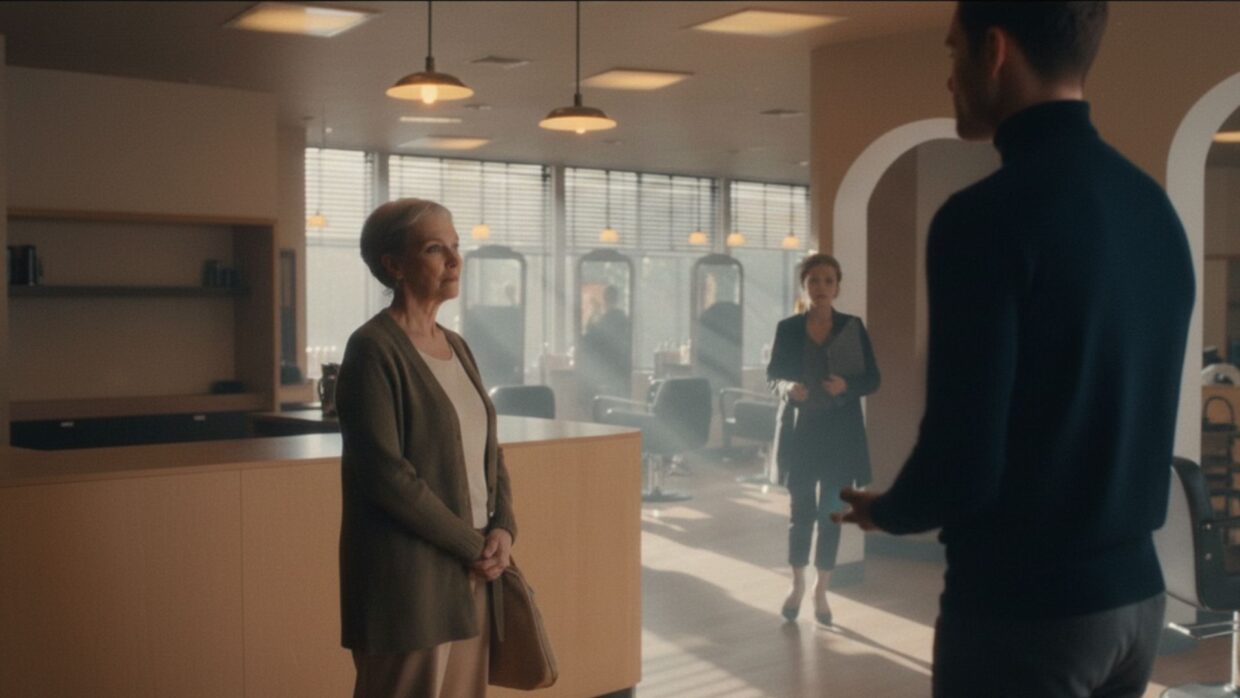
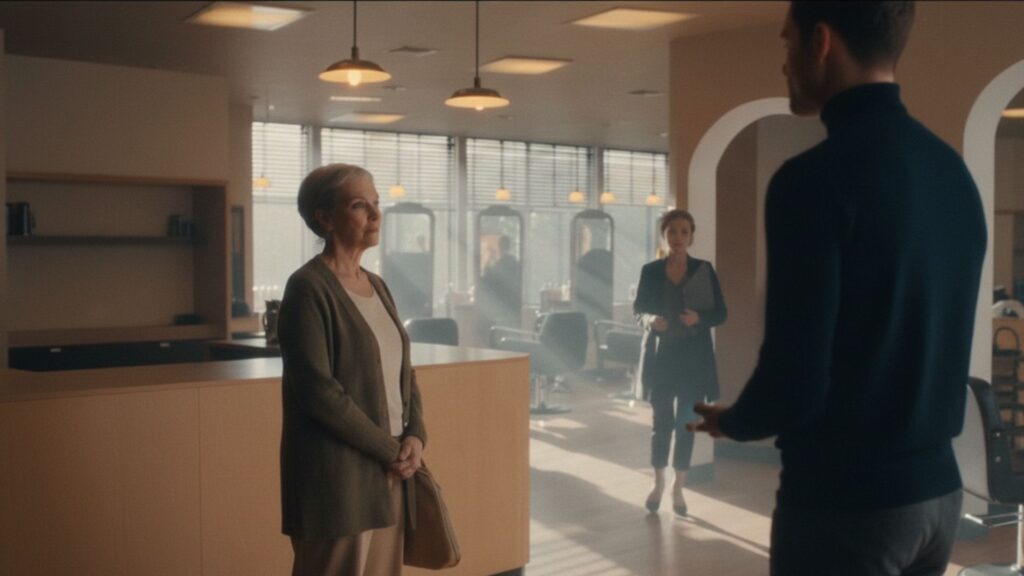
She was in her late fifties, wearing a plain beige cardigan, sensible flats, and no jewelry worth mentioning. Her silver-streaked hair was pulled back without fuss. She stood near the front desk, hands folded, watching the room with quiet, steady eyes.
That’s when Marcus spotted her.
He was twenty-four, recently promoted to salon manager, and very proud of it. He wore a fitted black turtleneck and kept his hair immaculately styled. He had a gift for reading a room — or so he believed.
He crossed the floor with practiced authority and stopped three feet from her.
“Excuse me,” he said, his voice smooth and carrying just enough volume for the nearby stylists to hear. “Can I help you?”
She smiled. “Just looking around, thank you.”
“Right.” He glanced at her shoes. At her cardigan. At the tote bag on her shoulder that had a grocery store logo on it. “This is a premium establishment. Our services start at two-fifty and go up from there.” He paused. “I want to make sure you’re… in the right place.”
She tilted her head slightly. “I think I am.”
“Ma’am.” His tone sharpened. “I’m going to have to ask you to step out. We have clients waiting, and I can’t have the lobby area — “
“Marcus.”
The voice came from behind him. It was Diane, the regional director, who had arrived for her monthly walkthrough. She stood frozen in the doorway to the back office, her face the color of paper.
“Diane,” he said, not turning yet. “I’m just handling a walk-in situation — “
“Stop talking.” She walked toward them fast. “Stop talking right now.”
He turned. Diane’s expression was something he had never seen on her before. It wasn’t anger. It was fear.
“Mrs. Calloway,” Diane said, and her voice dropped like she was in a church. “I am so sorry. I didn’t know you were coming today. We would have — I would have — “
“It’s all right, Diane.” The woman — Mrs. Calloway — waved a hand gently. “I prefer it this way. You see everything clearly when nobody knows who you are.”
Marcus felt the first cold ripple move through him. “I’m sorry — who is — “
“This,” Diane said, turning to face him with the kind of precision that meant careers ended in moments like this, “is Eleanor Calloway. She founded this company. Twenty-two years ago. She owns every single location in this chain. Including this one.” A pause. “Including your position.”
The blow-dryer closest to them shut off. Then another. The music kept playing but the human noise in the room had drained completely away. Every stylist, every shampoo tech, every client wrapped in a black cape — all of them were watching.
Marcus opened his mouth. Nothing came out.
Eleanor looked at him without cruelty. That was somehow worse than cruelty. “What’s your name?”
“Marcus,” he managed.
“Marcus.” She nodded once, as if filing it away. “How long have you been managing this location?”
“Seven — seven weeks.”
“Seven weeks.” She turned slowly and looked at the salon. At the clean stations, the fresh flowers on the reception desk, the framed prints on the wall that she had personally chosen in 2003. “I built this place so that every woman who walked through that door would feel like she belonged here. Every woman. Regardless of what she was wearing. Regardless of what she looked like.” She turned back to him. “That was the entire point.”
“Mrs. Calloway, I didn’t know — “
“You didn’t know who I was,” she said. “That’s correct. But you did know she was a person. And that should have been enough.”
He had no answer for that.
Diane stepped forward. “Marcus, go to the back office.”
“Diane — “
“Now.”
He went.
Eleanor spent the next two hours in the salon. She sat with clients. She talked to stylists by name — she had read every employee file in every location every quarter for twenty-two years. She remembered a woman named Priya who had transferred from the downtown location eight months ago, and asked how her daughter was doing. Priya burst into tears.
At the end of the visit, Eleanor stopped at the front desk. The receptionist — nineteen years old, three weeks on the job — was visibly terrified.
Eleanor put a hand on her arm. “You greeted me when I came in. You smiled. That’s exactly right.” She reached into the grocery store tote bag and pulled out a small notebook, wrote something, and tore the page out. “Give this to Diane.”
It was a recommendation that the receptionist be flagged for the management trainee program.
Marcus was terminated the following morning. Not by Diane. By HR, per a directive from the corporate office — from Eleanor’s own desk.
His termination letter cited a single violation: conduct unbecoming of Calloway brand standards, specifically the treatment of a guest in a manner inconsistent with the company’s founding values.
He appealed. The appeal was reviewed by the company’s ethics board.
Eleanor sat on the ethics board.
The appeal was denied in four minutes.
He packed his things on a Wednesday. The stylist nearest the door — a woman he had once told to “look more polished” — held it open for him without a word and let it close quietly behind him.
Back in her corner office forty miles away, Eleanor Calloway poured herself a cup of tea, opened the next location’s quarterly report, and got back to work.
She had nineteen other salons to visit that month.
She planned to dress exactly the same way for every single one.