A City Guard captain poured a beer on the wrong man’s head tonight — a janitor who hadn’t been a janitor for three years.
The bucket hit the floor with a wet slap.
Dirty water splashed across my boots, soaking the hem of my gray coveralls. The Underworld Bar went completely silent. Twenty people stopped breathing at the same moment.
Captain Rourke stood over the mess with a grin that told you everything about who he was — a man who’d never once been told no.
“On your knees, janitor,” he said. “Clean it up. With your tongue if you have to.”
I stood there. Mop in hand. Water dripping from my shirt.
“I said kneel,” Rourke repeated, louder. His six guards spread behind him in a loose arc, smirking like the outcome had already been decided.
I looked at him. Really looked at him. The shiny captain’s bars. The polished boots. The entitled set of his jaw.
“No,” I said.
Rourke’s face went red. “What did you just say to me?”
“I said no.” My voice stayed low. Level. “I’m not kneeling. And you’re going to regret coming in here tonight.”
One of his guards stepped forward. “You threatening a City Guard officer?”
“Just stating facts.”
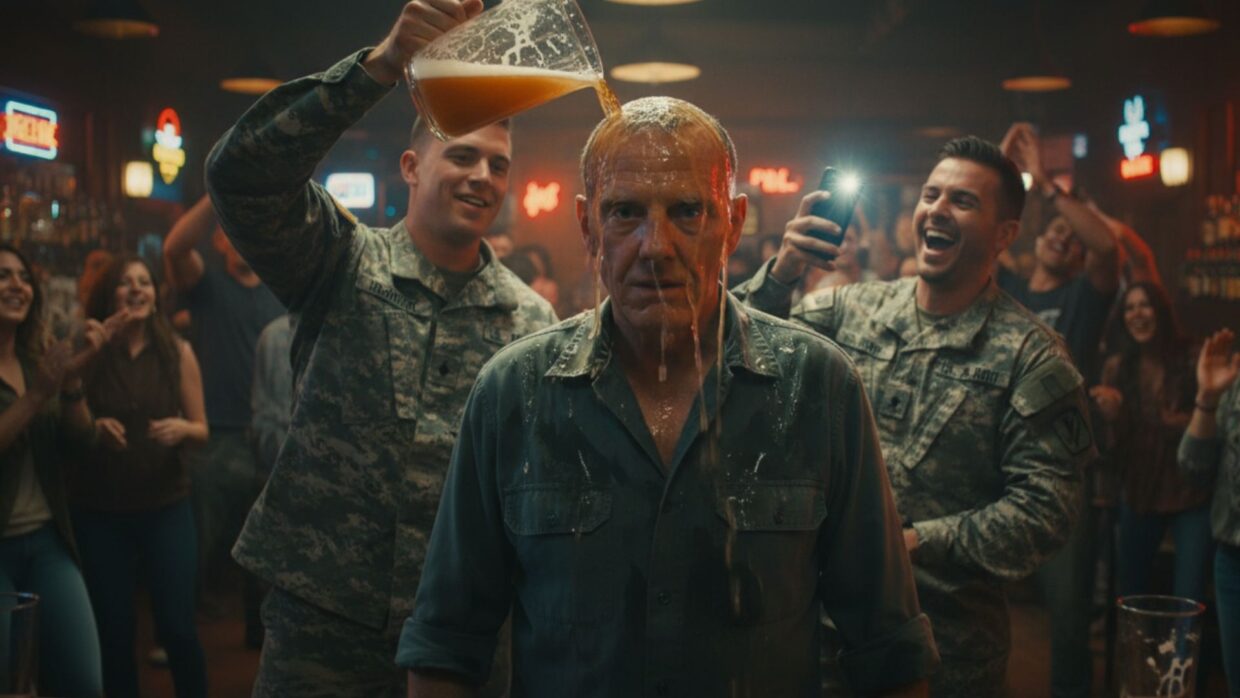
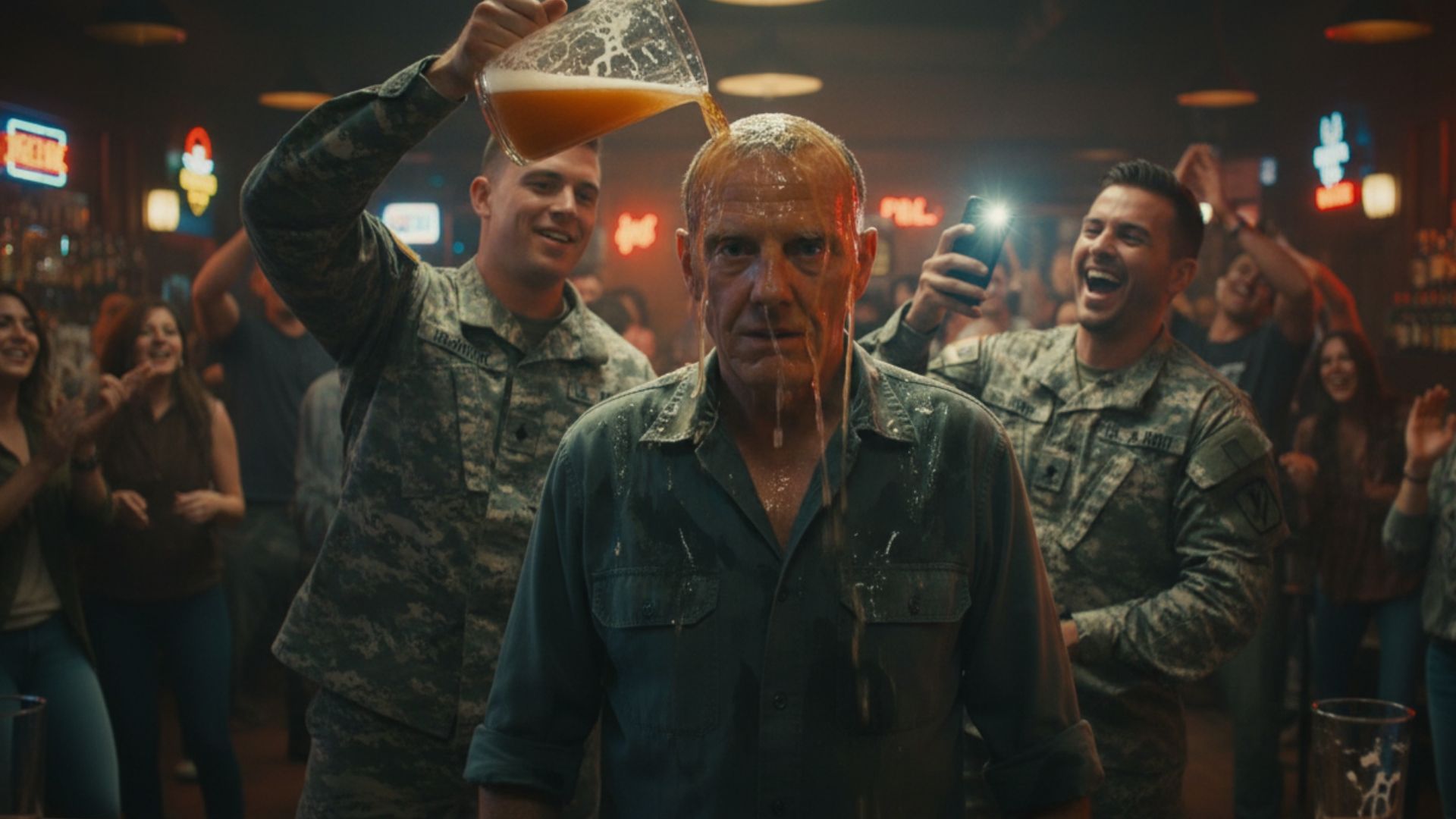
Rourke laughed — a hard, ugly bark that echoed off the ceiling. “You hear this guy? Tough janitor.” He snatched a beer from the nearest table and upended it over my head without hesitation.
Cold liquid ran down my face. Into my eyes. Someone in the crowd gasped.
“That’s what I thought,” Rourke said. “You’re nothing. Just another loser scrubbing toilets for minimum wage.”
I didn’t move.
I stood there with beer dripping off my chin, and I let him feel it. Let him savor it. Because men like Rourke only give themselves away when they think they’ve already won.
Then I wiped my eyes. Slowly. Deliberately.
“Leo,” I called to the bartender. “Call Vance.”
Leo went pale so fast it looked like someone had pulled a plug. “Sir… are you sure?”
“Call him. Now.”
Rourke frowned. “Who’s Vance? Your boss?” He laughed again, but there was something uncertain in it now. “Go ahead. Call him. I’ll shake him down too.”
Leo’s hands trembled as he pulled out his phone. He dialed. Three rings.
“This is Leo at the Underworld.” His voice cracked. “He says it’s time.” A pause. “Yes, sir. Commander Mason has activated Protocol Zero.”
The room changed.
Not dramatically. Not loudly. It changed the way a room changes when the temperature drops ten degrees and no one can explain why.
Rourke’s smirk went stiff. “Mason? As in… Marcus Mason?”
“That’s right,” I said.
I pulled off the wet coverall top. Underneath was a simple gray t-shirt, unremarkable, soaked through. But on the counter behind me sat something Rourke had walked right past when he came in. A small velvet box.
I opened it.
Inside, a medal. Ten stars arranged in a perfect circle on a black field. The highest military decoration issued by the nation. In the entire history of the Republic, it had been awarded exactly once.
“Oh God,” one of Rourke’s guards whispered. His voice had gone hollow. “That’s… that’s the Supreme Commander’s medal.”
“No way,” Rourke stammered. “You retired. You disappeared. You’re supposed to be dead.”
“I retired,” I confirmed. “I didn’t feel like being Supreme Commander anymore. Too much politics. Too many people like you finding their way into positions they don’t deserve.”
I held the medal up. Let the bar light catch the stars.
“But being a janitor?” I set it down gently. “That’s honest work. Nobody bothers you. Nobody asks questions. You clean up messes and go home.”
Rourke’s throat worked. “Then why are you—”
“Because you didn’t just disrespect a janitor.” I faced him fully now. “You’ve been running an extortion ring in District 9 for six months. Shaking down business owners. Threatening families. Using your badge to steal from people who can’t fight back.”
His hand moved toward his sidearm.
That was the wrong move.
I crossed the room in two steps. His gun was in my hand before the motion was halfway complete. Magazine out, chamber cleared, pieces tossed behind the bar in under three seconds.
Rourke stood there staring at his empty holster like he couldn’t understand what he was seeing.
“How did you—”
“Seventeen years of black ops training,” I said. “You really think I forgot?”
The helicopters arrived before he could answer.
Six of them, by the sound. The windows of the Underworld lit up white as tactical spotlights turned night into midday. The building shook. Glasses rattled on shelves. A bottle of whiskey toppled and shattered on the floor.
“That’s my security detail,” I said. “They get anxious when I invoke Protocol Zero.”
The bar doors blew inward. Shadow Ops soldiers poured through the gap, moving the way they train for years to move — silent, fast, purposeful. In eleven seconds, every one of Rourke’s guards was on the floor, zip-tied and disarmed. Not a shot fired. Not a word spoken.
Rourke stood alone in the center of the bar.
Shaking.
“You can’t do this,” he said, but the authority was gone from his voice. What was left sounded like a child. “I want General Kaine. He’s my superior officer. He’ll—”
“He’s on his way,” I said. I walked to the bar and sat down on a stool. “Leo. Two beers. Fresh ones.”
Leo set them down without a word.
“Drink,” I told Rourke.
He stared at the glass. “Is it—”
“It’s beer. The same beer you thought was good enough to pour on my head.” I met his eyes. “Drink it.”
He drank. Beer spilled down his chin. His hands were shaking too badly to hold the glass steady.
The front door opened again.
General Kaine came in flanked by two JAG lawyers, his white uniform immaculate, his expression set to righteous outrage before he’d even fully entered the room. Then he stopped. Took in the Shadow Ops soldiers. The zip-tied guards. The beer glasses on the bar.
Then he saw me.
“Mason,” he said carefully. “I was told there was a terrorist incident.”
“Pest control,” I said, spinning on my stool to face him.
Kaine straightened. He was a man accustomed to using his height as a weapon. “Rourke is a decorated officer. You have no jurisdiction here. You abandoned your post three years ago.”
“I left the post in your trust,” I said. “And I come back to find my city being shaken down for protection money by men in uniform.” I stood. The room contracted slightly. “Kaine. Did you authorize Rourke’s extortion operation in District 9?”
“I won’t be interrogated by a janitor.”
“Wrong answer.”
I moved fast. Kaine hit the floor hard, my boot on his chest before his bodyguards could process what was happening. Three Shadow Ops rifles pressed against their helmets. They went very still.
“Vance,” I said. “Play it.”
My second-in-command stepped forward with a compact audio device and keyed the playback. The bar’s ambient noise dropped to nothing. Everyone leaned in without meaning to.
The recording was from last week. Rourke’s voice, unmistakable: “The General needs his cut, Leo. Thirty percent. Or we burn this place down. Kaine doesn’t work for free.”
The silence after it was total.
Kaine’s jaw worked. “That’s manipulated. I’ll have your whole unit charged with—”
“It’s over,” I said quietly. “Protocol Zero authorizes command authority in cases of High Command corruption. This qualifies.” I looked down at him. “You built a machine that fed off the people you were sworn to protect. You put a uniform on greed and called it law enforcement.”
I looked over at Rourke.
He was crying.
Not silently. The kind of crying that shakes a man’s whole chest, the kind that comes out when the last wall comes down. He stood there in the center of the Underworld Bar, a man made entirely of his rank and his power, and I was about to take both.
“Strip them,” I said.
The sergeant closest to me hesitated. “Sir?”
“Strip them of their rank. Right now. Cut the patches off.”
Combat knives came out. Rourke screamed as his captain’s bars were sliced from his shoulders — not carefully, not ceremoniously, just cut away and dropped on the floor. Kaine thrashed and cursed, but with my boot still on his chest and a rifle at his head, he didn’t accomplish much. His general’s stars were torn loose, leaving ragged holes in the pristine white fabric.
“You are dishonorably discharged,” I said, letting the words sit in the room. “You’ll be transferred to Blackgate Penal Colony pending trial for treason, extortion, and abuse of office under wartime statute.”
I pinned the ten-star medal to my wet gray t-shirt.
It looked absurd. It looked like the most powerful thing in the room.
I turned to Rourke. He was barely standing, stripped of his insignia, his uniform torn at the shoulders, his face a wreck of snot and tears.
“You wanted me on my knees,” I said. “You wanted to feel powerful. You wanted a man who couldn’t fight back.”
I picked up the mop from the corner. Held it out to him.
His eyes went to the mop. Then to the medal. Then to the floor — the spilled beer, the dirty water, the mess he’d made when he walked in here tonight thinking he owned the room.
He took the mop.
He cleaned.
The Underworld Bar watched in silence as Captain Rourke, former City Guard officer, decorated and corrupt, mopped a linoleum floor in a torn uniform while his general lay handcuffed at his feet. There was no satisfaction in the room. No cheering. No cruelty.
Just a correction.
The universe lining itself back up.
Rourke wept while he mopped. He pushed gray water around the floor in wide arcs, cleaning around my boots, cleaning around Kaine, who stared at the ceiling with empty eyes. When every inch of the floor was dry, he stopped. Stood there holding the mop handle like it was the only solid thing left in the world.
I took it from him.
“You missed a spot,” I said. I wasn’t pointing anywhere. There was no spot. I just needed him to know that it was done when I said it was done.
I nodded to Vance. “Get them out of here.”
The Shadow Ops team moved the disgraced officers toward the door. Kaine walked under his own power, stiff and silent. Rourke had to be guided, still shaking, eyes on the floor. The bar doors closed behind them. Sirens faded. The helicopters pulled back and their lights went with them, and the Underworld Bar settled into a strange, heavy quiet.
I unpinned the medal. Placed it back in the velvet box. Snapped it shut.
“Leo,” I said.
“Yes, Commander?”
“I’m still on the clock. Didn’t finish my shift.”
I walked to the utility closet. Grabbed a fresh bucket. Filled it with water and bleach — the sharp, clean smell that most people hated and I’d come to associate with things being made right. I carried it back out and dipped the mop in.
“Mr. Mason.” Leo came around the bar, eyes wet. “You don’t have to do that. You’re the Supreme Commander. The city—”
“The city is fine,” I said, wringing out the mop. “The city has a lot of good people in it who deserve better than what they had tonight. And that’s worth something.”
I pushed the mop across the floor where Kaine had been lying.
“I’m the Supreme Commander when there’s a war, Leo. Right now there’s no war. Just a dirty floor.”
Nobody left.
I expected them to. I expected people to drain out into the night once the drama was over, but they didn’t. They stayed in their seats and at their bar stools and they watched me mop. Quietly. Drinking their beers with both hands around the glasses like they needed something to hold on to.
I worked for an hour. Mopped the main floor. Wiped down the bar. Stacked the chairs that had gotten knocked over in the chaos. When the Underworld was as clean as I’d found it, I put the equipment away, pulled on my jacket, and walked to the door.
Vance was outside beside a black armored vehicle, hands clasped behind his back.
“Orders, sir?” he asked.
I looked back through the bar window at the people inside. The bartender who’d been paying extortion fees for six months. The regulars who’d been afraid to walk home at night. The woman in the corner who’d stopped crying somewhere around the time Kaine hit the floor.
“Keep the perimeter secure until morning,” I said. “But keep it invisible. I don’t want these people scared.”
“And you, sir? Back to headquarters?”
I shook my head. Looked down the empty street toward the small studio apartment three blocks away, the one with the bad radiator and the view of the fire escape.
“Going home. I’m back here at six. Tomorrow’s delivery day.”
Vance smiled — one of his rare ones, the kind that changed his whole face. “Understood, sir. Welcome back.”
I walked into the night.
The city felt different now. Heavier. I was carrying it again, whether I’d asked to or not, and I knew that once you accepted that weight it didn’t really leave you. You just learned to walk with it.
I touched the velvet box through my jacket pocket.
Rourke had poured beer on a janitor. He’d done it in front of twenty witnesses because he was certain it was safe. Certain that nothing a man in gray coveralls could do would reach him where he stood, up in the elevated country of rank and authority.
He forgot the first rule.
Be careful what you step on.
It might look like dirt. It might look like nothing. But some things that look like nothing have been waiting — quietly, patiently, without complaint — for exactly the right moment to remind the world what they are.
I was the biggest landmine in the city.
And tonight, finally, someone had stepped on me.