A wealthy grandmother thought she buried her secret 40 years ago — until a barefoot little girl showed up with proof she couldn’t deny.
The park was the kind of place where rich people came to feel peaceful.
Manicured hedges. Wrought-iron benches. A fountain that cost more than most people’s cars.
Eleanor Whitmore sat on her usual bench, back straight, posture perfect. She was seventy-three and looked every bit the part of a woman who had never missed a salon appointment. Her white silk blouse was pressed. Her pearls sat just so.
And on her wrist — a golden bracelet, thick and gleaming, catching the late afternoon sun like a signal fire.
She turned a page in her book. Sipped her sparkling water. Breathed in the jasmine.
Then a shadow fell across her lap.
Eleanor looked up.
A girl stood in front of her. Seven, maybe eight. Thin as a rail. Her clothes were faded — a T-shirt two sizes too big, shorts with frayed hems, sneakers held together with duct tape.
But her eyes. Lord, her eyes.
They were sharp. Clear. Unwavering. The kind of eyes that had seen too much too young.
“Excuse me,” the girl said.
Eleanor blinked. “Can I help you, sweetheart?”
The girl didn’t smile. She stared at Eleanor’s wrist.
“My mom used to wear a bracelet just like that.”
Eleanor’s fingers went cold. She set the book down slowly.
“That’s a common design, dear,” she said. “Lots of bracelets look alike.”
“No,” the girl said. “Not like that one. That one has a crescent moon on the clasp. My mom’s had the same one.”
Eleanor’s hand moved instinctively, covering the bracelet.
“Who are you?” she whispered.
“My name’s Lily.”
“Lily what?”
“Lily Anne Reeves.”
The last name hit Eleanor like a truck. She gripped the edge of the bench so hard her knuckles went white.
Reeves. That was the name. The name she hadn’t said out loud in forty years.
“Where’s your mother?” Eleanor’s voice came out tight. Controlled. But barely.
Lily opened her hand. In her small, dirt-smudged palm sat a bracelet. Golden, like Eleanor’s. But this one was cracked. Tarnished. The clasp was broken, the chain frayed.
“She told me to find you,” Lily said.
Eleanor stared at the broken bracelet. Her throat closed.
“That’s impossible.”
“She said you’d say that.”
“Your mother — she doesn’t know me.”
Lily tilted her head. “She said you were her mother.”
The world stopped.
Eleanor felt the bench sway beneath her, though it hadn’t moved. The fountain kept running. Birds kept singing. But inside Eleanor’s chest, something cracked open that she had spent four decades sealing shut.
“That’s not — I don’t have a daughter,” Eleanor said.
But her voice broke on the last word.
Lily didn’t flinch. “She said you’d say that too.”
Behind them, a man stopped on the gravel path. Mid-forties. Dark jacket, no tie. He had a manila folder tucked under one arm and the look of someone who’d been watching for a while.
Eleanor didn’t notice him. She couldn’t take her eyes off the broken bracelet.
“My daughter,” she whispered. “My daughter died.”
“No,” Lily said softly. “She didn’t.”
Eleanor’s breath caught. “What?”
“She grew up. She got married. She had me.” Lily paused. “And she spent her whole life wondering why you gave her away.”
Eleanor pressed a hand to her mouth. Tears spilled before she could stop them.
“I didn’t give her away. I — I had no choice.”
“That’s not what she says.”
“You don’t understand. I was young, I was —”
“She says you chose the money.”
Eleanor flinched like she’d been slapped.
Because it was true.
It had been 1984.
Eleanor was thirty-one. Beautiful. Ambitious. Married to Richard Whitmore III, heir to a textile fortune, and living in a twelve-room colonial in Greenwich, Connecticut.
She had everything. The house. The name. The social calendar.
And she had a secret.
Before Richard, there had been David Reeves. A carpenter from Bridgeport. Working hands, easy smile, not a dime to his name. Eleanor had loved him the way you love someone before you learn that love doesn’t pay for anything.
They had a daughter. Grace.
Eleanor was twenty-two when Grace was born. David was twenty-five. They lived in a one-bedroom apartment above a laundromat, and Eleanor told herself it was romantic.
It wasn’t.
When Grace was two, Eleanor met Richard at a charity gala she’d snuck into. He was everything David wasn’t — polished, connected, wealthy.
Richard proposed within six months.
But there was a condition. Richard’s mother, Vivian Whitmore, made it clear: “My son will not raise another man’s child. If you want this life, the girl stays behind.”
Eleanor told herself she’d come back for Grace. She told herself it was temporary. She told David she needed time.
She signed the papers. She left Grace with David. She married Richard.
And she never went back.
She sent money for the first year. Checks in plain envelopes. No return address.
Then the checks stopped.
Then the years piled up.
Then Eleanor told herself the story she needed to believe: that Grace was fine. That David was a good father. That it was better this way.
She told Richard she had no children from before.
She told their friends the same.
She told herself until she believed it.
And the golden bracelet — the one David had made for her with his own hands, one half for Eleanor, one half for Grace — became a prop. A piece of jewelry. Nothing more.
Until now.
“How did you find me?” Eleanor asked. Her voice was raw.
“Mom told me where to look,” Lily said. “She said you come to this park every Tuesday.”
Eleanor’s stomach dropped. “She’s been watching me?”
Lily shook her head. “She looked you up. It wasn’t hard. You’re on the board of three charities. Your picture’s on the internet.”
Eleanor closed her eyes. Of course. All those galas. All those photo ops. All that visibility she’d built to prove she was somebody.
It had led her daughter right to her.
“Where is she?” Eleanor asked. “Where’s Grace?”
Lily’s face changed. The tough-kid mask cracked, just slightly.
“She’s sick.”
Eleanor’s heart seized. “Sick how?”
“Cancer,” Lily said. The word came out flat, the way children say terrible things when they’ve had to say them too many times. “Stage four. They found it too late.”
Eleanor pressed both hands to her chest. “No.”
“She doesn’t have insurance. Dad’s been working doubles, but it’s not enough.”
“Your father —”
“Not my grandfather. My dad. Mom married a guy named Tom. He’s a mechanic.” Lily paused. “Grandpa David died eight years ago.”
Eleanor felt the ground tilt. David. Dead. Grace. Dying.
And Eleanor sitting in a park in a silk blouse with a bracelet she didn’t deserve.
“She doesn’t want your money,” Lily said, as if reading her mind.
“Then what does she want?”
Lily held up the broken bracelet again. “She wants you to see this. She wants you to know she kept it. Every single day. Even when she hated you.”
Eleanor reached for it. Lily pulled her hand back.
“She said not to give it to you,” Lily said. “She said to show it to you. There’s a difference.”
The man on the path stepped forward.
“Mrs. Whitmore?”
Eleanor startled. She hadn’t seen him approach.
“Who are you?”
“My name is Daniel Cope. I’m a patient advocate at Bridgeport General.” He opened the manila folder. “I’ve been working with Grace Reeves for the past three months. She asked me to accompany Lily today.”
Eleanor stood up. Her legs shook.
“She sent a stranger with my granddaughter?”
“She sent someone who could verify the facts, ma’am.” Daniel’s voice was calm. Professional. But his eyes were hard. “Grace wanted to make sure you couldn’t deny it.”
“Deny what?”
Daniel handed her the folder.
Inside: a birth certificate. Grace Marie Reeves. Mother: Eleanor Jane Porter. Father: David Allen Reeves. Date: March 12, 1982.
Beneath that: a photocopy of the bracelet, both halves, side by side. One pristine. One broken.
Beneath that: hospital records. Diagnosis. Treatment plans. Bills.
The total was staggering. Six figures. Climbing.
“She’s not asking for money,” Daniel said. “She told me to make that clear. She doesn’t want a dime from you.”
“Then why —”
“She wants an answer.” He paused. “She wants to know why.”
Eleanor sank back onto the bench. The folder sat in her lap like a verdict.
“I was young,” she said. “I was stupid.”
“She’s heard that before,” Lily said. “From other people. About other things. It doesn’t help.”
Eleanor looked at her granddaughter. Really looked.
The girl had Grace’s jaw. David’s eyes. Eleanor’s own stubborn posture.
“Can I see her?”
Lily looked at Daniel. Daniel looked at Eleanor.
“She’s at home,” Daniel said. “She has good days and bad days. Today’s a good day. But she was very specific about the terms.”
“Terms?”
“She doesn’t want a reunion, Mrs. Whitmore. Not yet. She wants accountability.”
The word hung in the air like a blade.
“She wants you to stand in front of her,” Daniel continued, “and tell her the truth. Not the version you tell yourself. The real truth. Why you left. Why you never came back. Why you let her grow up thinking her mother was dead.”
Eleanor’s mouth fell open. “She thinks I’m dead?”
“That’s what she was told,” Lily said quietly. “Grandpa David told her you died in a car accident when she was three. He thought it would hurt less than the truth.”
“And when did she find out?”
“After Grandpa died. She found the checks. The ones you sent. With the postmark from Greenwich.”
Eleanor covered her face with both hands.
David had lied to protect Grace. And Eleanor had let the lie stand by never showing up to contradict it.
“She tracked you down six years ago,” Daniel said. “She’s known where you are since then.”
“Six years?”
“She wasn’t ready. She is now.” He paused. “The cancer clarified things.”
Eleanor stood. Her legs felt like water, but she stood.
“Take me to her.”
“It’s not that simple —”
“Take me to her right now.”
Lily stepped closer. “She said you’d do this. She said you’d try to make it dramatic. She said you always did that — made everything about your feelings instead of hers.”
The words landed like stones.
Because they were true. Every word.
Eleanor had left Grace to protect Eleanor’s feelings. She’d stayed away to protect Eleanor’s comfort. She’d built a new life to protect Eleanor’s image.
Not once — not once — had she thought about what Grace felt.
“You’re right,” Eleanor whispered.
Lily blinked. She hadn’t expected that.
“You’re right,” Eleanor said again, louder. “I didn’t protect her. I protected myself. Every single time.”
She pulled the golden bracelet off her wrist. Her hand was shaking so badly she could barely work the clasp.
She held it out to Lily.
“Give this to your mother.”
Lily hesitated. “She said —”
“I know what she said. But this was never mine. It was always hers. I just kept it because I was too much of a coward to return it.”
Lily looked at the bracelet. Looked at Eleanor. Looked at Daniel.
Daniel gave a small nod.
Lily took the bracelet. She held both pieces now — the whole one and the broken one. One in each hand.
“She’s at 412 Maple Street,” Daniel said. “Apartment 3B. She’ll be awake until about seven.”
Eleanor checked her watch. It was four fifteen.
“I’ll call a car.”
“No,” Lily said. “She said if you come, you walk. It’s four blocks from the bus stop on Grant. She wants you to see the neighborhood.”
Eleanor looked down at her silk blouse. Her pearl earrings. Her Italian shoes.
“Fine,” she said.
The bus ride was twenty-two minutes. Eleanor hadn’t been on a city bus in forty years. She sat between a man in paint-spattered overalls and a teenager with headphones. Nobody recognized her. Nobody cared.
The neighborhood was exactly what she expected and nothing like she’d prepared for.
Cracked sidewalks. Chain-link fences. A bodega on the corner with bars on the windows. Kids on bicycles. An old man watering a brown lawn.
412 Maple was a three-story walk-up with peeling paint and a broken buzzer. Eleanor climbed the stairs. Each step felt heavier than the last.
She knocked on 3B.
The door opened.
And there she was.
Grace.
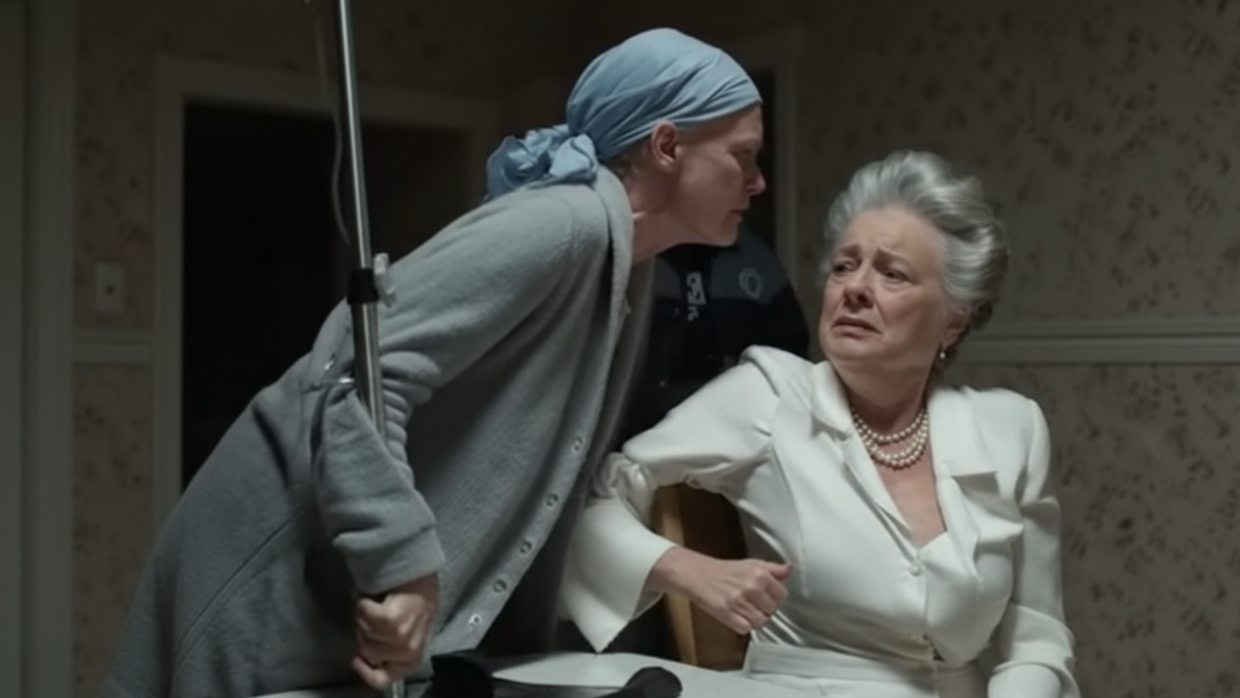
She was forty-two but looked older. Thin. A scarf covered her head where the chemo had taken her hair. Her skin was pale, almost translucent. An IV pole stood behind her, a tube running to her arm.
But her eyes — God, her eyes. They were Eleanor’s eyes. The same shade of green. The same sharp intelligence.
And right now, they were burning.
“So,” Grace said. “You came.”
“I came.”
“Lily said you cried.”
“I did.”
“Good.” Grace stepped aside. “Come in. Don’t touch anything.”
The apartment was small but clean. A worn couch. A kitchen table with three chairs. Children’s drawings on the fridge. Medical paperwork stacked on the counter.
A man stood by the window — mid-forties, broad shoulders, grease under his fingernails. Tom. He didn’t extend a hand. He didn’t smile. He just watched.
“Sit,” Grace said, pointing to a chair.
Eleanor sat.
Grace sat across from her. The kitchen table between them felt like an ocean.
“I’m not going to make this easy for you,” Grace said.
“I don’t expect you to.”
“Good. Because I’ve had forty years of hard, and you’ve had forty years of easy, and I think it’s time to balance the scales.”
Eleanor nodded.
“Why?” Grace asked.
One word. But it contained everything.
“His mother,” Eleanor said. “Vivian. She said Richard wouldn’t marry me if I had a child from another man.”
“So you chose him.”
“I chose the life he offered. Yes.”
“Say it without the euphemism.”
Eleanor swallowed. “I chose money over you.”
Grace’s jaw tightened. “Keep going.”
“I told myself I’d come back. I told myself I’d send for you once I was settled. But the longer I waited, the easier it got to pretend.”
“Pretend what?”
“That you didn’t exist.”
The room went silent. Tom’s fist clenched at his side. Lily, standing in the hallway, pressed her back against the wall.
“I know there’s nothing I can say that fixes this,” Eleanor said. “I know that. But I need you to hear me say it anyway: I was wrong. Completely, entirely, unforgivably wrong. And I have no excuse. Not one that matters.”
Grace leaned back. Her expression didn’t soften. But something in her eyes shifted — not forgiveness. Recognition.
“Vivian’s dead, isn’t she?” Grace asked.
“Seven years ago.”
“And Richard?”
“Ten.”
“So you’ve been alone.”
“Yes.”
“With your money and your charities and your park bench.”
“Yes.”
Grace reached into the pocket of her robe and pulled out a folded piece of paper. She slid it across the table.
Eleanor unfolded it.
It was a crayon drawing. Faded, creased, decades old. A little girl holding hands with a tall woman. Above them, in wobbly letters: ME AND MOMMY.
Eleanor’s vision blurred.
“I drew that when I was five,” Grace said. “Dad told me you died. So I drew you from memory. Except I didn’t have any memories. So I made you up.”
Eleanor couldn’t speak.
“I made you kind,” Grace continued. “I made you warm. I gave you a big smile and long hair and I told myself you loved me so much that God took you to heaven early because the angels needed you more.”
A sob escaped Eleanor’s throat.
“And then I found the checks,” Grace said. “And I realized you weren’t dead. You were just in Greenwich.”
She let that sit.
“You didn’t even use your real name on the envelopes,” Grace said. “You used a fake one. Like you were ashamed.”
“I was ashamed.”
“Of me?”
“Of myself.”
Grace studied her for a long moment. “I believe that. But it doesn’t change anything.”
“I know.”
“I don’t forgive you.”
“I know.”
“Maybe I will. Maybe I won’t. That’s not why I asked you here.”
Eleanor waited.
“Lily needs someone,” Grace said. Her voice cracked for the first time. “When I’m gone. Tom works seventy hours a week. His mother’s in a nursing home. My father’s dead.”
The air in the room changed.
“You’re the only family I have left,” Grace said. “And God help me, that makes me furious. But it’s the truth.”
Eleanor looked at Lily, standing in the hallway. The girl looked back with those sharp, ancient eyes.
“You want me to take care of her,” Eleanor said.
“I want you to do what you should have done forty years ago. I want you to show up. Not with money. Not with guilt. With time. With presence. With the thing you never gave me.”
Eleanor stood up from the table. She walked around it. She knelt in front of Grace — slowly, deliberately — and placed both hands on her daughter’s knees.
“I will,” she said. “Not because you’re asking. Because I owe you a debt I can never repay, and this is the only way I know to start.”
Grace looked down at her. Her lip trembled. She didn’t reach for Eleanor. She didn’t embrace her.
But she placed one hand — gently, barely — on top of Eleanor’s.
“Every Tuesday,” Grace said. “You come here. Not the park. Here. You bring Lily her homework snacks and you sit with me while I do my treatment.”
“Every Tuesday.”
“And when I’m gone, you don’t put her in a boarding school. You don’t hand her to a nanny. You raise her. Yourself.”
“Myself.”
“Swear it.”
“I swear it.”
Grace pulled her hand away. She straightened in her chair.
“Tom will draw up the paperwork. Legal guardianship. Daniel will witness.”
“Whatever you need.”
Grace looked at the two bracelets sitting on the table — the golden one and the broken one.
“Take them both,” she said. “Melt them down. Make one new one for Lily.”
Eleanor picked them up. In her hands, they weighed almost nothing. But the weight they carried was forty years heavy.
She turned to Lily.
The girl was crying. Silently. The way children cry when they’ve been brave for too long.
Eleanor knelt down. Eye level.
“I’m not going to promise I’ll be perfect,” she said. “I already proved I’m not. But I promise you this: I will be here. Every single day. No matter what.”
Lily wiped her face with the back of her hand.
“Mom said you’d say something like that.”
“Did she say whether to believe me?”
Lily looked at Grace. Grace gave the smallest nod.
“She said to give you one chance.”
Eleanor took a breath. “One chance is more than I deserve.”
That evening, Eleanor Whitmore rode the bus home. She sat in the same seat. Held the two bracelets in her lap.
The next morning, she called her attorney. She restructured her will. Everything — the house, the investments, the trust — went to Lily Anne Reeves.
She called her jeweler. Brought both bracelets. Explained what she wanted: one new bracelet, forged from the gold of both.
“Engrave the inside,” she said.
“What would you like it to say?”
Eleanor thought about every Tuesday she’d sat in that park. Every year she’d wasted. Every lie she’d told herself.
“It should say: I showed up.“
Three words. The only ones that mattered.