I never imagined that sweltering Tuesday in July would become a turning point in my life. The morning began like any other: I left the city clinic early after seeing the last patients of the morning shift.
The heat was stifling, the sky like a giant white sheet covering everyone’s heads. I drove along the old road connecting the capital with the towns in the south—a road I had traveled countless times.
I was driving at a steady pace when something made me slow down. A short distance from the bridge, near a lamppost, two figures sat huddled together, seemingly trying to shield each other from the scorching sun. An elderly woman in a faded floral dress sat beside an old man wearing a straw hat.
Around them were a few worn cloth bags and a small suitcase that looked like it had seen many years. The sight gripped my heart.
I pulled over and got out of the car. Dust rose with each step. As I got closer, I could see their faces clearly: the woman’s eyes were red and swollen, dried tear marks visible on her cheeks.
The man stared intently at the road, as if he could find answers in the scorching asphalt. I spoke softly, afraid of startling them.
“Good morning… are you both alright? Do you need any help?”
She slowly looked up. In her eyes, I saw something that shattered my heart: shame, pain, and a kind of resignation that no human being should have to endure.
It took her a few seconds to speak, and when she did, her voice was like a thousand pieces of broken glass. “My… my children left us here, doctor. They said they would come back… but it’s been two hours, and they’re still nowhere to be seen.”
I felt the air being sucked out of my lungs. How could that be?
The old man then spoke, his voice hoarse and heavy with endless sorrow. “Don’t worry… they’ll come back, or maybe not. Anyway… we’re just a burden to everyone.”
The word “burden” pierced me like a needle. A burden? Two people who had spent their whole lives raising and loving their children—and now they considered themselves a burden?
I knelt before them, taking the old woman’s hands in mine, feeling the roughness of time and the slight tremor of exhaustion. I looked them straight in the eyes.
“Listen to me. You two are not a burden to anyone. And I won’t leave you here. Right now, I’m going to take you to a safe place.”
He hesitated. I saw in his gaze the mark of someone who had been betrayed so many times that he no longer dared to believe in kindness.
But she squeezed my hand unexpectedly tightly, whispering as if praying. “Thank you… God bless you…”
I helped them stand up and gathered their few belongings. She clutched a cloth bag as if it were her most precious treasure. He carried his small suitcase very carefully.
I noticed a yellowed envelope in his shirt pocket. He pressed it against his chest with his arm as if afraid of losing it.
On the way to the local hospital, I tried to chat with them to ease their pain. They said their names were Beatriz and Ernesto.
They had been together for fifty-three years. She had been a primary school teacher in the town until her knees could no longer bear standing all day.
He worked in construction, building houses with his own hands until his back gave out. They had four children.
They had given them an education, taught them values, and given them all the love two hearts could give. But three of them had become, in their words, “a distorted mirror” of what they had sown.
Only their youngest daughter, Lucía—who lived abroad—kept regular contact. Lucía sent money whenever she could and called every week without fail.
Whenever Lucía was mentioned, their eyes lit up with a special light, a stark contrast to the deep sadness they carried.
Upon arriving at the hospital, the nurses immediately treated Beatriz for severe dehydration and dangerously high blood pressure. I sat next to Ernesto in the waiting room.
He was still clutching his suitcase and envelope to his chest. I gently asked, “Uncle Ernesto… could you tell me exactly what happened?”
He took a deep breath and recounted, his voice choked with emotion. “We’ve been living with our eldest son, Fernando, and his wife for two years now. At first, it seemed fine. Then, gradually, the reproaches began… that we were a nuisance, a burden, useless.”
“Every day was more humiliating. They treated us like old belongings taking up space.”
“This morning, Fernando said he would take us to see a beautiful hacienda—a place to live peacefully. We… were as happy as children. We thought they finally showed us some compassion.”
“We got in the car with a few things. The other two, Carlos and Patricia, followed in another car.”
His voice cracked. “Near the bridge, Fernando said he had to check the tires and told us to get out and wait. Before we could understand anything, both cars sped away.”
“We waited, believing they would return. One hour… then two hours… the sun burned our skin, Beatriz started crying. I comforted her… but inside, I was dying.”
“Doctor… how could the children I raised with so much effort do this?”
I felt a surge of burning anger. It wasn’t just abandonment. It was cruelty.
I promised him I would help them, that their children wouldn’t get away with it.
In the days that followed, every afternoon after work I would visit Beatriz and Ernesto. I brought home-cooked food, magazines, and most importantly: my presence.
They told me about their youth: how they met at a town festival, how they overcame difficulties to raise four children. Beatriz taught me how to knit, telling stories of how she used to mend her children’s clothes with scraps of fabric.
Ernesto talked about the early mornings at construction sites, the exhaustion that seeped into his bones. “But the sight of my children’s faces made it all disappear,” he said.
The more I listened, the more I loved them, and the more I hated what their children had done.
One afternoon, Beatriz dozed off after lunch, and Ernesto gestured for me to come closer. He took the faded yellow envelope and placed it on the small table beside the bed.
“Doctor Carmela…” he called my name for the first time. “You are a good person. I know I can trust you. What I have here is very important… but it’s not the time to show it to you yet.”
“I just want you to know it exists, and when the time comes, you’ll know what to do.”
My curiosity was burning, but I respected him. I nodded.
He smiled, a smile that was both relieved and sad, then put the envelope back into his coat pocket.
On Wednesday, the doctor discharged Beatriz. She was better, but needed rest and care. They couldn’t go back to live with any of their children, and their meager pensions were barely enough to get by.
Without hesitation, I invited them to my house. My house had an empty room since my mother passed away two years earlier.
And honestly, loneliness is sometimes heavier than I imagined. They initially refused, saying they would bother me too much.
I insisted until they agreed. It was one of the best decisions of my life.
With them in the house, everything seemed to come alive. Beatriz tended to the potted plants in the garden that I had neglected for so long.
Ernesto fixed the little things that kept breaking. Meals had that familiar “home” feel again.
The afternoons were filled with laughter, stories, and deep conversations. I felt like I was reunited with my parents—the ones I had lost too soon.
But the peace didn’t last. On the tenth day, Fernando appeared.
He arrived in a luxury car, wearing an expensive suit, looking anxious. He rang the doorbell repeatedly until I opened it.
“Hello, ma’am. I’m Fernando, son of Beatriz and Ernesto. I heard they were here, so I came to visit.”
I let him in. Beatriz turned pale at the sight of her son and clutched her husband’s hand. Ernesto stood stiff as a statue.
Fernando tried to sound remorseful. “Mom and Dad, I’m sorry. That day…it was just a misunderstanding. We got scared and drove off, thinking you’d hitched a ride. I searched everywhere for you…”
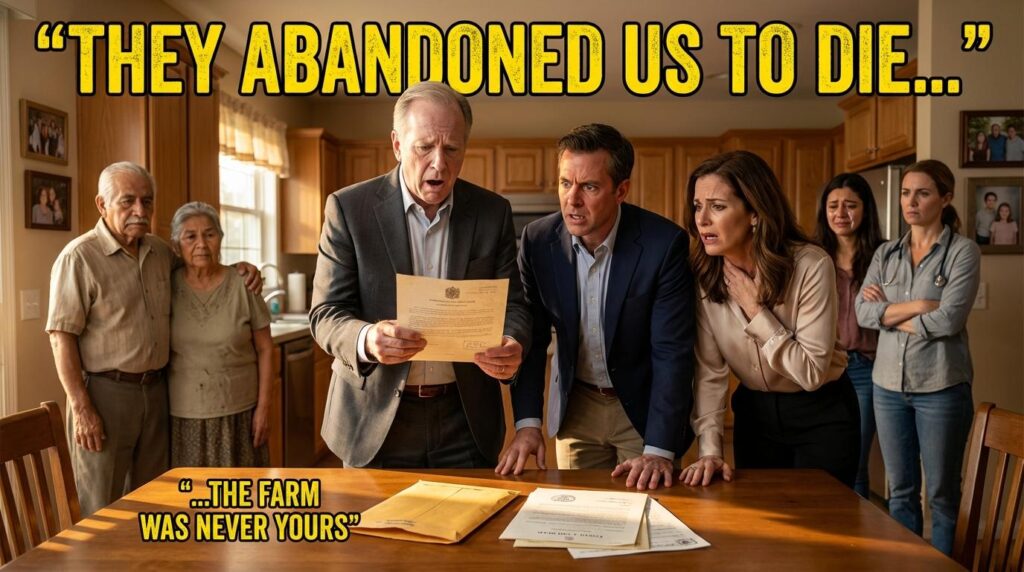
A blatant lie. No one believed him.
Beatriz wept silently. Ernesto looked at his son with pain and disappointment.
Finally, he said, his voice harsh. “You abandoned us on the road, knowing full well what you were doing. You left us exposed to the sun like trash. And now you come here to lie.”
Fernando immediately revealed his true colors. “Well, you two are old and can’t take care of yourselves. I’ve come to take you home. You’ll be better cared for there.”
I stepped forward immediately. “Mr. Fernando, your parents are perfectly fine here. And they won’t go anywhere unless they want to.”
He looked at me contemptuously. “Who are you to interfere in my family matters?”
I replied without hesitation. “I’m a doctor, and I know how to recognize abuse when I see it.”
Fernando slammed his hand on the table. “This isn’t over yet. I’ll be back with my siblings. Then we’ll see who’s right.”
When the door slammed shut, Beatriz burst into tears. Ernesto trembled with anger.
I understood the war had only just begun.
That evening, during the silent dinner, Ernesto suddenly said, “Dr. Carmela… it’s time you knew the truth.”
He placed a faded yellow envelope on the table. Beatriz nodded, her eyes welling up with tears.
“Open it,” Ernesto said.
My hands trembled as I opened the old paper. And what I read left me breathless.
It was a certificate of ownership for a plot of land—a thirty-hectare farm outside of town, fertile land with its own water supply, and a large adobe house. But what shocked me wasn’t the value.
It was the name of the sole owner: Lucía Hernández Morales.
Beatriz recounted, her voice breaking. Five years earlier, when Ernesto fell seriously ill, medical expenses drove them to the brink of bankruptcy.
They nearly lost the farm they had worked their whole lives to buy. Lucía—then a nurse in America—sent all her savings to pay off debts and save the land.
“But we saw greed in the eyes of our three remaining children,” Beatriz said. “We knew that when we died, the other three would scramble for the land, regardless of the consequences.”
“So, through a friend acting as a notary, we transferred everything to Lucía’s name. Lucía doesn’t know yet—we intended to tell her as a surprise when she returned.”
Ernesto continued. “The other three children believe the farm is still in our names. That’s why for years they maintained a ‘minimum sense of courtesy.’ But when they abandoned us, thinking we would die alone, they must have already begun calculating their ‘inheritance.'”
His voice was both stiff and tearful. “That’s why I’m keeping this paper. It’s proof that justice exists, and true love will be rewarded. Lucía deserves it—because she’s the only one who never abandoned us.”
I sat in silence for a long time. Then I asked, “Does Lucía know about the abandonment?”
Beatriz shook her head. “We don’t want her to worry… she has her life, her work…”
I looked at them and decided. “I’ll call Lucía tomorrow morning. She needs to know. And you two need her by your side.”
That night I barely slept. Three things kept swirling in my head: the cruelty of the greedy children, the heartbreaking kindness of the two elderly people, and Lucía’s enduring love from afar.
The next morning, we called. It was six o’clock in the evening in California.
Lucía answered in a warm voice. “Mom, Dad… is everyone alright?”
Beatriz tried to speak but her voice cracked. Ernesto told her everything.
There was a chilling silence on the other end of the line. Then Lucía burst into tears, her voice filled with anger and sorrow.
“I’m coming home right away. I’ll catch the earliest flight. Don’t go anywhere. Tell Dr. Carmela… I’ll be grateful to her for the rest of my life. I’ll be there in two days.”
When they hung up, Beatriz and Ernesto hugged each other and cried with relief. And I felt a warmth spread through my chest.
That broken family was beginning to have a chance to mend.
Two days later, I went to the airport to pick up Lucía. I recognized her immediately: her gentle eyes were like her mother’s, her forehead like her father’s.
She was about forty years old, simply dressed, her hair neatly tied back. Seeing me, she came forward and hugged me as if we had known each other for a long time.
“Thank you, Doctor Carmela… you saved my parents. I don’t know how to repay you.”
I replied sincerely. “You don’t need to repay me. They saved me too—even though they don’t know it yet.”
On the way home, Lucía recounted her life in America. Working double shifts at the hospital, sharing a small apartment with two other nurses, saving money to send back home.
“I never married, because my parents were always my priority,” she said. “I sacrificed my own happiness to care for the people who gave birth to me. And now I discover my siblings wanted to destroy what was left of our family.”
Back home, the reunion was unforgettable. Beatriz ran, her legs aching, and hugged her daughter tightly.
Ernesto wept uncontrollably, embracing both of them. They formed a circle of pure love, while I stood beside them, tears streaming down my face.
I knew everything I had done was worthwhile.
That afternoon, the “rest” of the family arrived: Fernando first with his wife, then Carlos with his wife, and finally Patricia alone, having divorced.
They brought expensive gifts and fake smiles. Seeing Lucía, they were stunned—they hadn’t expected her there.
Lucía looked at them with an unusually cold expression. “So you’re the ‘brave ones’ who abandoned your parents?”
Fernando stammered. “Lucía, it’s not what you think, it was a misunderstanding…”
Lucía interrupted. “A misunderstanding is forgetting to buy milk. Leaving elderly parents in the sun so they could die—that’s cruelty.”
Carlos sneered. “You’re always the spoiled child. What do you know about having to bear their burdens every day?”
Patricia added, her voice sharp. “Easy for you to judge from California while we had to deal with them constantly.”
Lucía’s eyes filled with fury. “Bear their burdens? They changed your diapers. They fed you. They paid for your education. And you call caring for them in their old age a burden?”
“I sent money every month from my salary as a nurse—money I could have used for my own life. I called every single week. I never complained. Because that’s what family does.”
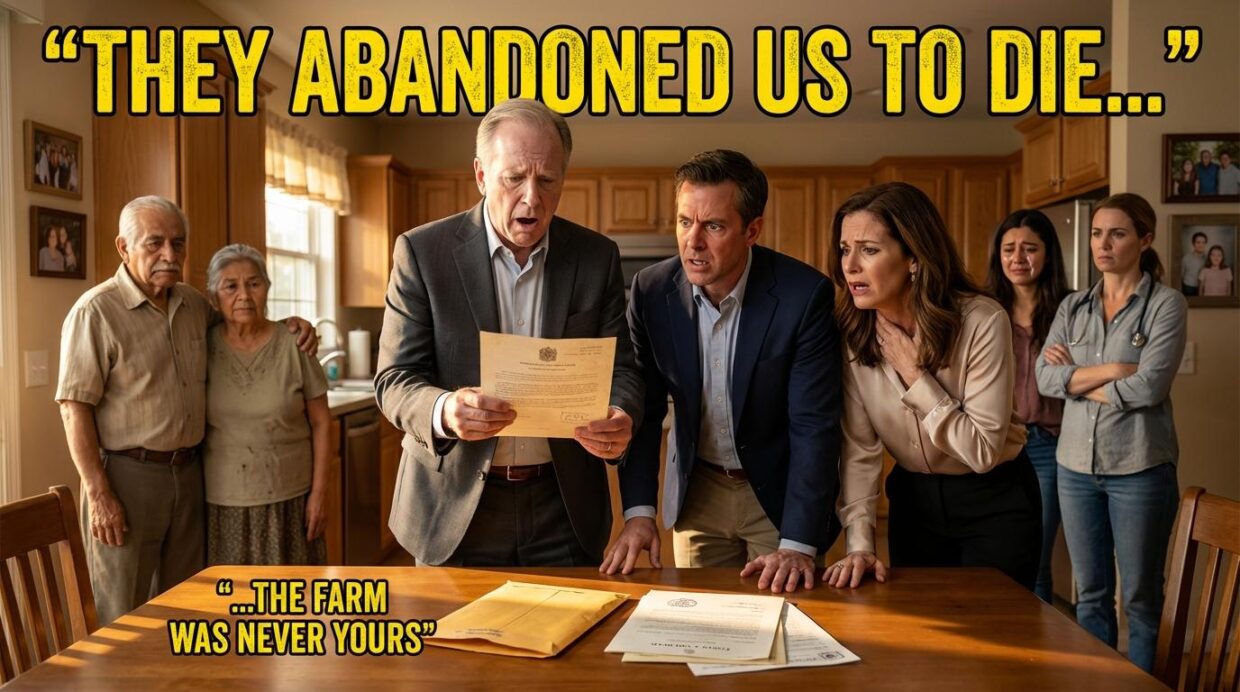
Fernando recovered his composure, trying a different tack. “Well, now that we’re all here, we should discuss their living arrangements. And… eventually… the farm. We need to make sure everything is divided fairly when the time comes.”
There it was. The real reason they’d come.
Ernesto stood up slowly, his face like carved stone. “Divided fairly? You want to talk about fairness?”
He walked to his room and returned with the yellow envelope. He placed it on the table in front of his three eldest children.
“Go ahead. Open it.”
Fernando grabbed it eagerly, pulling out the document. His face went from curious to confused to absolutely white.
“What… what is this?”
Carlos snatched it from his hands. “This can’t be legal. You can’t just give away our inheritance!”
Patricia’s voice was shrill. “The farm is worth hundreds of thousands! You gave it all to her?”
Lucía looked confused. “What are you talking about?”
Beatriz spoke, her voice steady now. “Five years ago, when your father was dying and we nearly lost everything, Lucía sent us every penny she had. Thirty thousand dollars she’d saved for years. She saved the farm.”
“We knew then that you three only cared about money. So we made sure the farm would go to the one child who loved us without expecting anything in return.”
Ernesto added. “The transfer was legal, notarized, and final. Lucía owns the land. You three own nothing.”
Fernando’s face twisted with rage. “You can’t do this! We’ll contest it in court!”
I stepped forward. “Actually, you won’t. Because I documented everything. The abandonment, the dehydration, the emotional abuse. I have hospital records, photographs, and my testimony as a physician.”
“If you try to fight this in court, I’ll make sure elder abuse charges are filed against all three of you. In this state, that’s a felony. You could face jail time and significant fines.”
The room fell silent. Carlos looked like he might be sick.
Patricia started crying—not tears of remorse, but tears of rage at losing money.
Fernando tried one last time. “Mom, Dad… we’re your children too. We made mistakes, but—”
“You’re right,” Ernesto said, his voice breaking. “You are our children. And that’s why this hurts so much. We gave you everything. And you gave us nothing but cruelty.”
“Lucía never asked for the farm. She doesn’t even know she owns it yet. But she deserves it—not because of money, but because she has a heart.”
Beatriz stood beside her husband. “You three need to leave now. And don’t come back unless you’re ready to apologize—truly apologize—for what you’ve done.”
Fernando tried to argue, but one look at my face reminded him of the legal consequences he was facing. The three siblings left in angry silence, their expensive gifts abandoned on the table.
When the door closed, Lucía finally spoke, her voice shaking. “The farm is mine?”
Ernesto smiled through his tears. “It always should have been yours, mija. You’re the only one who understood what family really means.”
Lucía broke down sobbing. “I don’t want the farm. I just want you both safe and loved.”
“You’ll have both,” Beatriz said, embracing her. “And when we’re gone—many years from now, God willing—you’ll have the land we worked our whole lives for. Because you earned it with your heart, not your greed.”
That night, we celebrated—a real family dinner. Lucía, Beatriz, Ernesto, and me.
We cooked together, laughed together, and for the first time in weeks, Beatriz and Ernesto looked truly at peace.
Over the next few months, things settled into a beautiful rhythm. Lucía found a nursing position at the local hospital and moved into my house too—we converted the garage into a small apartment for her.
Beatriz and Ernesto thrived with both their daughter and me around them. Their health improved dramatically. Love, it turns out, is better medicine than anything I learned in medical school.
Fernando, Carlos, and Patricia tried calling a few times. Beatriz and Ernesto refused to speak to them unless they admitted what they’d done and showed genuine remorse.
Eventually, Patricia called, crying real tears this time. “Mom… I’m so sorry. I was horrible. I don’t deserve your forgiveness, but… I’m asking for it anyway.”
It took time, but slowly, Patricia began rebuilding a relationship with her parents. She visited weekly, helped with chores, and never mentioned the farm again.
Fernando and Carlos never apologized. They sued for a portion of the estate, but the judge dismissed the case immediately after reviewing my evidence and testimony. The judge actually lectured them in open court about elder abuse.
Two years later, I sat in my garden watching Beatriz teach Lucía’s daughter—yes, Lucía had finally married a wonderful man she met at the hospital—how to knit.
Ernesto was in his workshop building a cradle for their second grandchild on the way.
And I realized that the day I stopped my car on that dusty road, I hadn’t just saved two people.
I’d found my family. The family I’d been missing since my own parents died.
Beatriz looked over at me and smiled. “Carmela, dear, come here. I want to teach you this stitch.”
I walked over and sat beside them, feeling the warm sun on my face.
Sometimes the family you choose is just as precious as the family you’re born into.
And sometimes, justice comes not from revenge, but from love winning in the end.
Fernando and Carlos never spoke to their parents again. They lost not just an inheritance, but something far more valuable—the love and respect of the people who gave them life.
Patricia eventually inherited a small portion when Beatriz and Ernesto passed many years later—not because of legal obligation, but because they forgave her genuine repentance.
But Lucía inherited everything else: the farm, the house, and most importantly, the knowledge that she had honored her parents when it mattered most.
And me? I inherited two parents who loved me like their own, a sister in Lucía, and the understanding that stopping to help a stranger can change your entire life.
The yellow envelope that Ernesto guarded so carefully now sits in a frame in Lucía’s home—a reminder that love and loyalty are always rewarded, even if it takes time.
And cruelty, no matter how carefully calculated, ultimately costs you everything that truly matters.