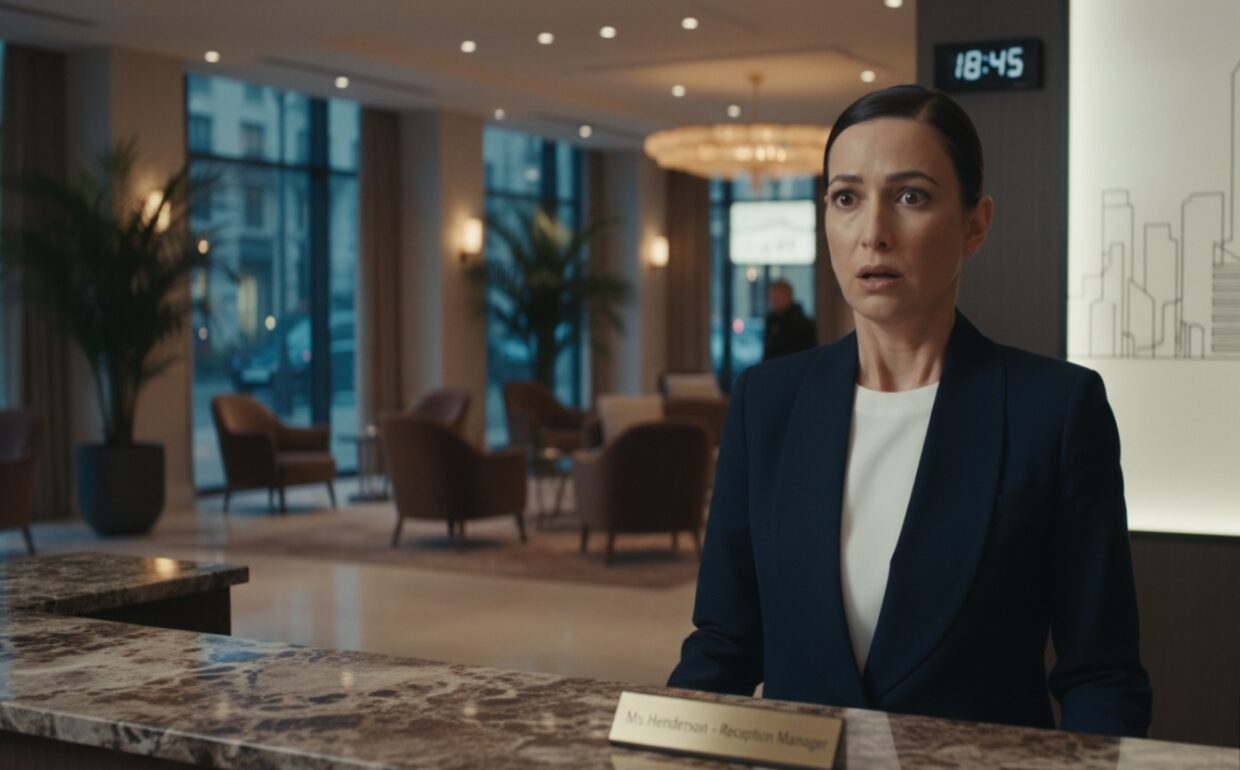
A receptionist mocked a “homeless man” at her luxury hotel desk—then watched him fire her entire management team.
Margaret Chen straightened her Hermès scarf and surveyed the marble lobby with satisfaction. Fifteen years at the Grand Luminere Hotel, and she’d perfected the art of spotting trouble.
The automatic doors hissed open. She tensed.
An elderly man shuffled in wearing a torn windbreaker, baggy jeans stained with what looked like coffee, and scuffed work boots. His white hair stuck up at odd angles. He carried a faded backpack.
Margaret’s manicured hand reached for the phone. “Security to reception. Code three.”
The man approached her desk slowly. Up close, she noticed his weathered hands, the deep creases around his eyes. He smiled. “Good afternoon. I’d like—”
“Sir, I’m going to stop you right there.” Margaret’s voice carried across the lobby. Several business travelers looked up from their phones. “This is a five-star establishment. We have standards.”
“I just need to—”
“Whatever you’re selling, we’re not interested.” She waved dismissively. “And if you’re looking for the shelter, that’s six blocks east.”
The man’s expression didn’t change. “I’m not selling anything. I’m a guest.”
Margaret laughed, a sharp sound that echoed off the vaulted ceiling. “A guest? Sir, our rooms start at four hundred dollars a night.”
“I’m aware.”
“Then you’re aware you don’t belong here.” She lowered her voice to a hiss. “Leave now, or I’ll have you removed. You’re making actual guests uncomfortable.”
A woman in a business suit nearby clutched her designer purse closer. Margaret noticed and felt vindicated.
“I’d like to speak with your manager,” the man said quietly.
“My manager is busy with important matters.” Margaret’s finger hovered over the security button again. “Last warning.”
The elevator across the lobby chimed. A tall man in an expensive suit stepped out, phone pressed to his ear. He ended his call and began crossing the marble floor.
Margaret’s eyes lit up. “Mr. Patterson!” She gestured urgently. “Sir, we have a situation.”
Regional Manager David Patterson was forty-two, ambitious, and ruthless about protecting the brand. He’d fired three staff members last month for minor infractions. Margaret had always admired his dedication.
Patterson approached, taking in the scene with cold efficiency. “What’s the problem?”
“This… person refuses to leave,” Margaret said. “I’ve asked him multiple times. Politely.”
Patterson’s gaze swept over the elderly man’s appearance. His lip curled. “Sir, you need to exit the premises immediately.”
“I’m trying to check in,” the man said. His voice remained calm, almost amused.
“Check in?” Patterson scoffed. “Do you have a reservation?”
“Under James Whitmore.”
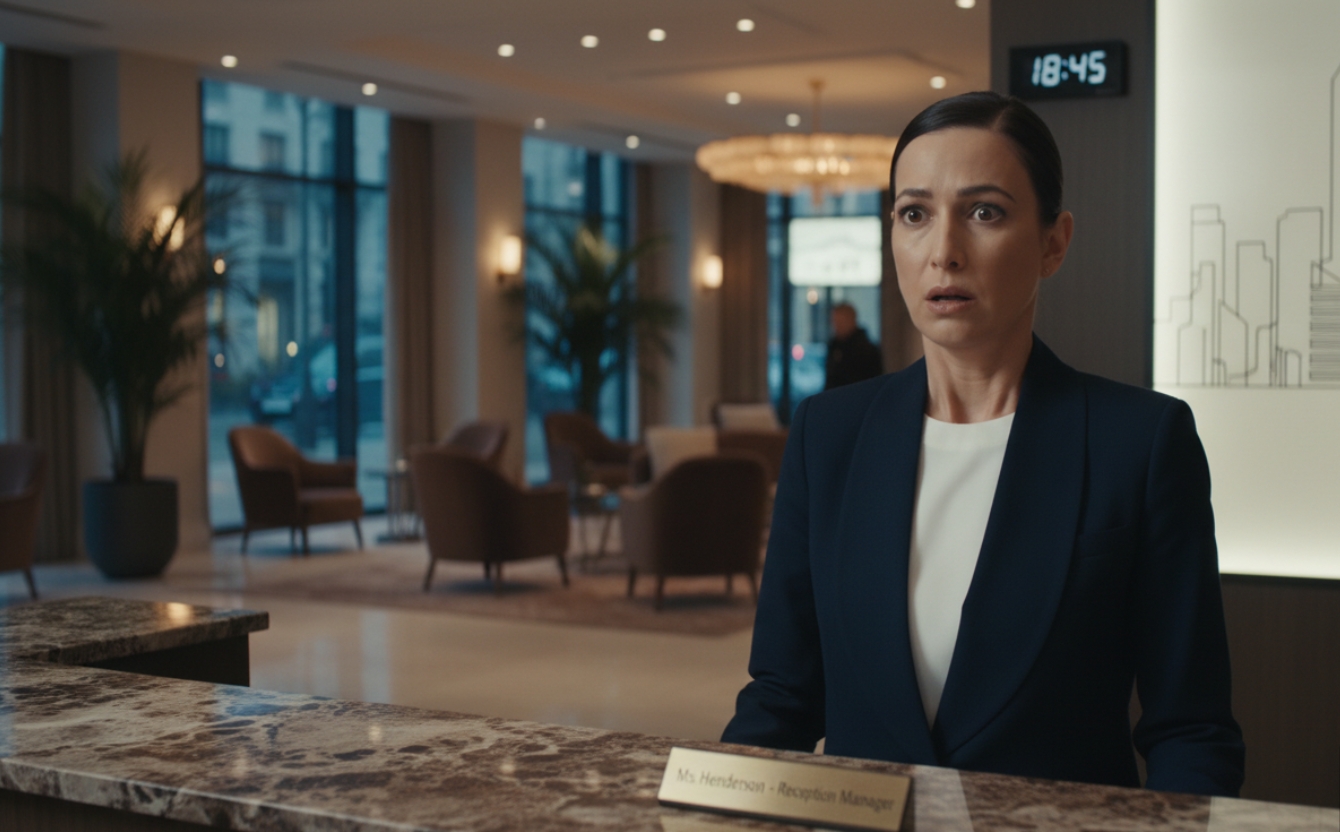
Margaret typed rapidly, her confidence surging. “There’s no James Whitmore in our system.”
“Try the penthouse suite.”
Her fingers froze. She looked again. The color drained from her face.
“There is a James Whitmore,” she whispered. “But that’s… that’s the owner’s suite. It’s never used. It’s permanently blocked.”
“Unblock it,” the man said.
Patterson leaned closer to Margaret’s screen. She watched his face go from annoyed to confused to horrified in three seconds.
“That’s impossible,” Patterson breathed. “The owner’s suite is reserved for—”
“For me,” James Whitmore said. “I own this hotel. And the other forty-seven in the chain.”
The lobby seemed to freeze. A businessman nearby dropped his coffee cup. It shattered on the marble, dark liquid spreading like spilled ink.
Margaret’s heart hammered. “You can’t be… The owner is James Whitmore III. The billionaire. He’s—”
“Seventy-three years old, yes. Founded Whitmore Luxury Group in 1982.” James smiled, but it didn’t reach his eyes. “I prefer traveling incognito. Learned more about my hotels that way.”
Patterson’s face went white. “Mr. Whitmore, sir, I apologize for any—”
“How long have you been regional manager, David?”
“Three years, sir.”
“And in those three years, how many surprise quality checks have you conducted?”
Patterson’s mouth opened. Closed. “I… we have regular audits, sir. Standard procedures.”
“That’s not what I asked.” James turned to Margaret. “How long have you worked here?”
She couldn’t speak. Her throat had closed.
“Fifteen years,” James said, glancing at a small tablet he’d pulled from his backpack. “Margaret Chen. Employee of the month six times. Excellent attendance record. Multiple commendations for guest service.”
Margaret felt a flicker of hope.
“Until today,” James continued. “Today you demonstrated something I explicitly forbid in my hotels: discrimination based on appearance.”
“Sir, I was protecting our guests—”
“You were making assumptions.” His voice hardened. “You saw someone who didn’t meet your standards of wealth or appearance, and you decided they were unworthy of basic human decency.”
“But our dress code—”
“Our dress code applies to the dining room and bar. Not the lobby. Not for check-in.” James looked at Patterson. “You know this. It’s in the employee handbook. Section three, page twelve.”
Patterson nodded miserably.
“I’ve been here twenty minutes,” James said. “I watched from the street as two teenagers in ripped jeans walked through that door. You smiled at them, Margaret. Welcomed them. Asked if they needed directions.”
Margaret’s stomach dropped. “They looked like college students—”
“They looked young and white and appropriately disheveled. I looked old and poor.” James shook his head. “Do you see the problem?”
The lobby had gone completely silent. A crowd had formed, guests and staff alike frozen in place.
“I built this company on a simple principle,” James said, his voice carrying. “Every person who walks through that door deserves respect. The businesswoman checking in for a conference. The family saving up for one special vacation. The blue-collar worker treating themselves to one nice night.”
He gestured to his clothes. “I dressed like this deliberately. I’ve done this at every property I own. Twice a year, unannounced. Most of your colleagues pass the test. They see a human being first.”
Margaret’s eyes burned. “I was just doing my job.”
“No. You were doing what you thought your job was. Protecting an image. Maintaining a certain type of clientele.” James pulled out his phone. “Let me show you something.”
He turned the screen toward her. Security footage, timestamp-marked from thirty minutes ago.
Margaret watched herself notice James at the door. Watched her face twist with disgust. Watched her immediately reach for the phone before he’d even approached the desk.
“That’s not protecting guests,” James said quietly. “That’s cruelty disguised as professionalism.”
Patterson stepped forward. “Mr. Whitmore, I take full responsibility for—”
“Do you?” James turned to him. “Because according to my records, you’ve fired three employees in the past month for being ‘off-brand.’ A housekeeper for having visible tattoos. A valet for speaking Spanish to a guest. A concierge for being ‘too friendly’ with budget travelers.”
Patterson’s face went from white to gray. “Those were… judgment calls.”
“They were discrimination. Dressed up in corporate language, but discrimination nonetheless.” James looked around the lobby. “Who else is management here?”
A nervous young man in a suit raised his hand. “Tyler Morrison, sir. Assistant manager.”
“Tyler, how long have you worked here?”
“Eight months.”
“Have you ever witnessed behavior like this? Staff treating guests poorly based on appearance?”
Tyler glanced at Patterson. Swallowed hard. “Yes, sir. It’s… it’s sort of an unspoken rule. Keep the lobby ‘premium.'”
“Premium.” James repeated the word like it tasted bad. “David, did you institute this policy?”
Patterson’s jaw worked. “I implemented efficiency standards. Guest satisfaction scores have increased eighteen percent—”
“By cherry-picking which guests receive service.” James put his phone away. “Margaret, you’re terminated. Effective immediately. No severance package beyond what’s legally required. Your personal belongings will be mailed to you.”
Margaret gasped. “Please, I have bills, I have—”
“You should have thought about that before treating a human being like garbage.” His voice was ice. “David, you’re also terminated. I’ll be speaking with HR and legal about your other terminations. If I find evidence of systematic discrimination, expect further consequences.”
Patterson’s face crumpled. “Sir, please. My reputation—”
“Your reputation?” James’s eyebrows rose. “What about the reputation of the people you fired? The housekeeper with tattoos who was supporting three kids? The valet whose mother only speaks Spanish? The concierge who believed in treating everyone warmly?”
“I’ll do better. I’ll change—”
“I don’t offer second chances for this.” James turned to Tyler. “You’re promoted to acting regional manager. Your first task is to review every termination David made in the past year. Anyone fired for discriminatory reasons gets a call offering their job back, with back pay.”
Tyler straightened. “Yes, sir. Absolutely.”
“Second task: implement mandatory bias training for all staff. Not just a video they click through. Real training. Role-playing exercises. Guest services specialists who can spot and correct discrimination.”
“I’ll start immediately.”
James looked back at Margaret and Patterson. “Security will escort you out. You have ten minutes to collect your things from your lockers. If you’re not gone by then, you’ll be charged with trespassing.”
Two security guards materialized from the hallway. Margaret felt one take her elbow gently but firmly.
“This isn’t fair,” she whispered. “Fifteen years—”
“Fair?” James’s expression finally showed real anger. “Tell me about fair. Tell me about being judged before you open your mouth. Tell me about being treated like a criminal for existing in a space.”
Margaret had no answer. The guard guided her toward the back hallway.
As she walked, she heard James speak again, his voice addressing the gathered crowd.
“I apologize to everyone who witnessed that. It doesn’t represent what Whitmore Luxury Group stands for. If anyone has experienced similar treatment at any of our properties, please contact our corporate line. We’ll investigate immediately.”
The crowd began to murmur. Some pulled out phones. Margaret knew by tomorrow this would be everywhere. Social media, news outlets, industry blogs.
Her career was over.
In the security office, she gathered her personal photos, her spare blazer, her collection of fancy pens. Fifteen years reduced to a cardboard box.
Patterson was already gone, his locker empty.
Margaret walked out through the service entrance into the afternoon sun. The street was busy with tourists and business people. Regular people. People she’d have judged, sorted, categorized.
Her phone buzzed. A text from her sister: “Saw what happened on Twitter. You okay?”
Twitter. Of course. She pulled up the app with shaking fingers.
The video was everywhere. Someone in the lobby had filmed the entire confrontation. The comments were brutal.
“Imagine being that snobby and it costing you your job” “Play stupid games, win stupid prizes” “15 years and she never learned basic human decency?” “That CEO is a legend. More bosses should do surprise checks like this”
Margaret closed the app. She felt hollow.
But underneath the hollowness, something else stirred. Something uncomfortable and unfamiliar.
Shame.
Real shame. Not embarrassment at being caught or fired. Shame at who she’d become without noticing.
When had she started seeing people as categories instead of individuals? When had “maintaining standards” become code for “keeping certain people out”?
She thought about the housekeeper with tattoos. The valet speaking Spanish. The concierge being friendly to everyone.
They’d all been fired for being human. For being themselves. For treating others with basic decency.
And she’d approved. She’d nodded along with Patterson’s efficiency standards. She’d enforced the unspoken rules.
Margaret sat on a bench across from the hotel. She watched James Whitmore emerge fifteen minutes later, now wearing a clean polo shirt and khakis he must have changed into. He looked like any other wealthy businessman.
He stopped on the steps, noticing her. For a moment, their eyes met.
She expected triumph in his gaze. Satisfaction. Instead, she saw something that might have been sadness.
He nodded once, then walked away, disappearing into the afternoon crowd.
Margaret sat there for a long time, holding her cardboard box, watching people pass.
She’d have to find a new job. Probably not in luxury hospitality—not after this went viral. Her savings would last three months if she was careful.
But that wasn’t what hurt most.
What hurt was realizing she’d spent fifteen years becoming someone she didn’t recognize. Someone cruel. Someone who valued appearance over humanity.
Her phone buzzed again. Another news alert. Another share of the video.
She turned it off and stood up. The box felt heavier than it should.
Tomorrow she’d start applying to jobs. Tomorrow she’d call her sister and admit she’d been wrong.
But today, she just walked. Away from the Grand Luminere. Away from fifteen years of carefully cultivated superiority.
Behind her, through the hotel’s glass doors, she could see Tyler already talking with staff. Could see people being retrained, systems being reformed.
The hotel would be better without her.
That was the hardest truth of all.
Margaret kept walking until the Grand Luminere disappeared from view. Only then did she let herself cry—not for her job, not for her reputation, but for all the people she’d dismissed and demeaned while convincing herself she was just doing her job right.
The job she’d loved had made her someone hateful.
And she’d been too proud to see it until it was too late.