

They told me my daughter married into old money and was living like royalty… But I found her scrubbing floors on her hands and knees while they watched.
I am Elena Vance. Twenty years running a commercial cleaning business in Chicago. Arthritis in my knuckles, permanent ache in my lower back, and a bank account I emptied to pay for Sophie’s wedding to a Caldwell—old Rhode Island money, the kind that doesn’t ask prices.
When Sophie moved East, our calls got shorter. “I’m fine, Mom. Victoria treats me like family. I have staff. I have everything we dreamed of.”
I wanted to believe her.
For her second anniversary, I didn’t call ahead. I bought a plane ticket, rented a car, and drove to the estate to surprise her.
The gates were open. The front door was unlocked.
I walked in carrying a bag of her favorite cookies, ready to shout “Surprise!”
Then I heard it. The wet scrape of a rag on wood.
I stepped into the foyer—all marble and dark wood and cold silence.
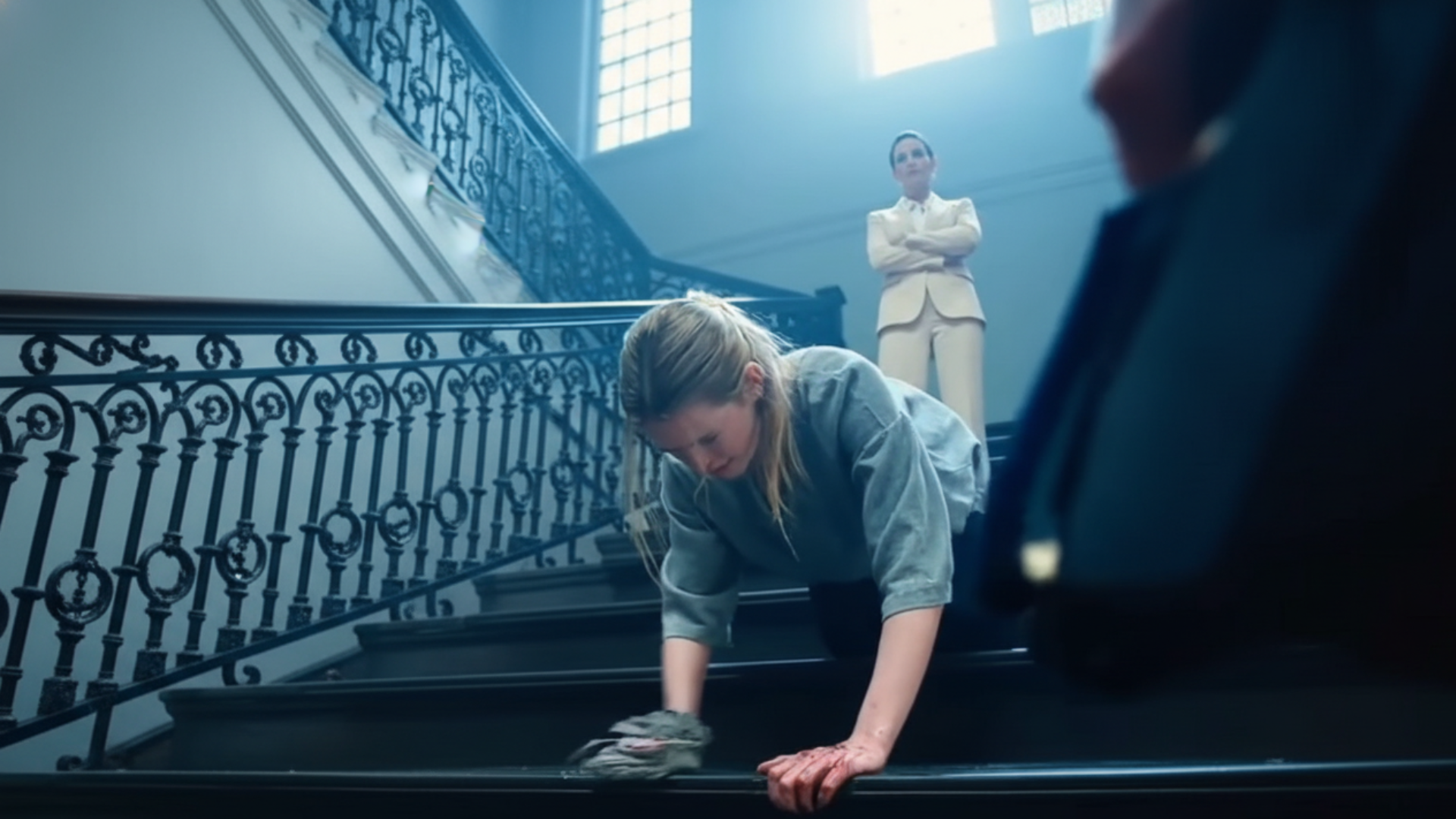
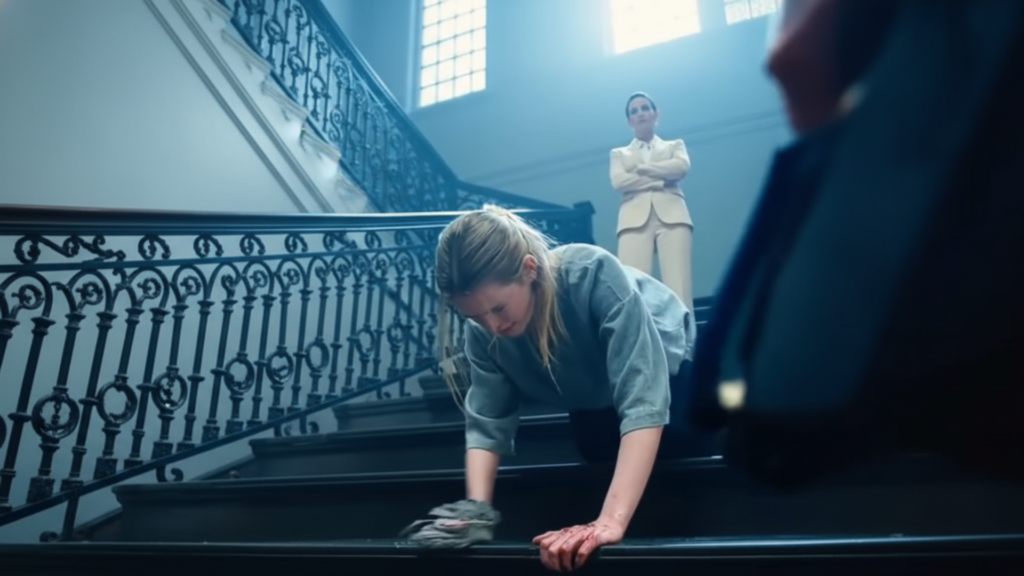
Sophie was on her hands and knees, scrubbing the bottom stair. Grey shapeless tunic. Hair falling in her face. Bucket of dirty water beside her.
At the top of the staircase stood Victoria Caldwell in a beige silk suit, arms crossed, looking down like she was inspecting livestock.
“You missed the corner, Sophie,” Victoria said. Her voice was bored. “Do it again. And stop sniffling—it’s pathetic. The housekeeper is off, and someone needs to make this presentable before the gala.”
Sophie dipped the rag again, shoulders shaking. “Yes, Victoria. I’m sorry.”
I dropped my bag. It hit the marble like a gunshot.
Sophie’s head snapped up. “Mom?”
Victoria turned, eyes narrowing. “Oh. The mother. I assume you’re here to show her how to do this properly? She’s useless at it.”
I walked forward slowly. Each step echoed.
“Get up, Sophie,” I said.
“Mom, please—” Sophie scrambled to her feet, wiping her raw, red hands on the tunic. “It’s not—I was just helping with—”
“She’s learning humility,” Victoria cut in, descending one step. “Something you clearly failed to instill.”
I looked at my daughter. Really looked. The weight she’d lost. The tremor in her hands. The terror in her eyes.
This wasn’t helping. This was her life.
“Humility,” I repeated. I smiled the smile I use when someone tries to stiff me on a bill. “Interesting word.”
I took the rag from Sophie’s hand and dropped it in the bucket. Splash.
“Pack a bag, Sophie. Small one. We’re leaving.”
“She most certainly is not,” Victoria said, voice sharp now. “Her husband—”
“Her husband is about to have a very bad week,” I said. I turned to face Victoria fully. “You think I’m just a cleaner. That’s your first mistake.”
Victoria’s mouth tightened. “Excuse me?”
“Cleaners see everything,” I said. “We empty trash cans. We find papers left on desks. And my company? We clean the offices at Mercer & Klein—the investment firm your family uses.”
I was bluffing. Completely. But I knew people like the Caldwells always had something to hide.
Victoria went very still.
“I’ve seen the wire transfer records,” I continued, voice steady. “The offshore accounts. The ‘consulting fees’ to shell companies. And if Sophie isn’t in my car in five minutes, I’m calling my contact at the IRS. Then the SEC. Then the Department of Justice.”
“You’re lying,” Victoria said. But her voice wavered.
“Try me,” I said. “Sophie. Go. Now.”
Sophie ran.
Victoria stood frozen on the stairs as we left. She didn’t move. Didn’t speak.
In the rental car, Sophie broke down. Told me everything. The verbal abuse. The forced labor “to earn her place.” The isolation from friends. The control.
“Where’s your husband in all this?” I asked.
“He—” Sophie’s voice cracked. “He says I’m being dramatic. That his mother is just ‘exacting.’ That I should be grateful.”
I drove us to a lawyer’s office. A good one.
“Did you see any documents while you were ‘cleaning’?” the lawyer asked Sophie.
Sophie hesitated. Then nodded. “Financial statements. In the study. I saw them when I was dusting. Account numbers. Places I didn’t recognize. Victoria told me to shred some of them, but I… I took photos first. On my phone. I don’t know why.”
The lawyer leaned forward. “Show me.”
Sophie pulled out her phone with shaking hands.
The lawyer’s expression changed as he scrolled. “This is… this is significant.”
“Significant how?” I asked.
“Tax fraud. Securities fraud. Possibly money laundering.” He looked up. “If you’re willing to cooperate with federal investigators, Mrs. Caldwell—Sophie—you could be protected. And they would be prosecuted.”
Sophie looked at me. “Mom, if I do this, they’ll destroy me. They have lawyers. Money. Connections.”
I took her hand. “Baby, they already tried to destroy you. You’re still here. You survived.”
Sophie filed for divorce the next day. She also called the FBI.
The investigation took four months.
I moved Sophie back to Chicago. Got her into therapy. Watched her hands heal. Watched her eat again. Watched her smile again.
The day the indictments came down, Sophie was in my kitchen making coffee.
Her phone rang. Unknown number.
She answered. Listened. Her eyes went wide.
“They’re freezing the assets,” she said quietly. “All of them. The estate. The accounts. Everything. Victoria and Richard are both being charged. Federal charges.”
She hung up. Stood there in silence.
“Sophie?” I said.
She turned to me. And then she laughed. Not a bitter laugh. A real one.
“I’m free,” she whispered. “Mom, I’m actually free.”
The Caldwell trial made regional news. Tax evasion. Wire fraud. Conspiracy. Richard Caldwell got six years. Victoria got four.
The estate was seized and auctioned to pay restitution and fines.
I heard through a former client that Victoria is living in a subsidized apartment now, working part-time at a dry cleaner.
I hope she’s good at folding.
Sophie got a settlement in the divorce. Not the fortune she could have had—most of it was seized—but enough. She’s enrolled in a graduate program now. Social work. She wants to help people in abusive situations.
Last week, she called me laughing. “Mom, you’ll never guess what happened.”
“What?”
“Victoria applied for a job at a cleaning company. The hiring manager called me as a reference for ‘character assessment’ since I was her former daughter-in-law.”
“What did you say?”
Sophie paused. Then, with the strongest voice I’ve heard from her in years: “I told them the truth. I said she has experience managing a very dirty house, but I wouldn’t trust her with anything valuable. Then I hung up.”
I smiled. “That’s my girl.”
Sophie doesn’t post perfect Instagram photos anymore. She posts pictures of textbooks and coffee cups and her tiny apartment that she picked out herself.
She posts pictures of herself smiling—really smiling—without permission from anyone.
And every Sunday, she comes over for dinner. She walks in, kicks off her shoes, and says, “Mom, I’m home.”
I don’t think she ever really was before.
But she is now.