They made her stand alone in the sand ring and face the biggest, angriest Marine on base just to watch her fail. What she said with his fists twisted in her collar silenced every man watching
By 0900 the desert heat had already started to bite, turning the parade ground at Camp Kincaid into a flat, shimmering mirror of dust and light. The air smelled of hot rubber, CLP, and sunburned canvas, the usual perfume of a Marine Corps training base baked under a merciless sky. From above, the formation of bodies on the sand might have looked ceremonial: four staggered ranks of Marines in faded cammies and tan boots forming a rough square around a patch of open ground. Up close, it felt less like a ceremony and more like an execution waiting for a reason to begin.
In the very center of that square stood Staff Sergeant Ava Morales.
She was neither tall nor especially imposing, her gear hanging on a frame built more for endurance than for intimidation. Her dark hair was braided tight and tucked up under her cover, not a single strand loose despite the restless wind that kept tugging at collars and flags. The only thing that really stood out about her at first glance was the patch on her left sleeve: a subdued caduceus backed by a dagger, the unofficial mark of a medic who worked where bullets, not clipboards, wrote the schedule. The guys in the circle had a less poetic name for people like her.
“PR asset.”
“Checklist diversity.”
“Pentagon project.”
The rumors had started the week she arrived. A female combat medic with two Bronze Stars and a stack of deployment ribbons transfers into a joint special operations integration course that most Marines spent their entire careers trying to get near. The easy explanation was that someone in a suit wanted talking points and photographs. The harder explanation was that maybe she actually belonged there. Most of the men at Camp Kincaid had chosen the easy version.
Gunnery Sergeant Cole Maddox definitely had.
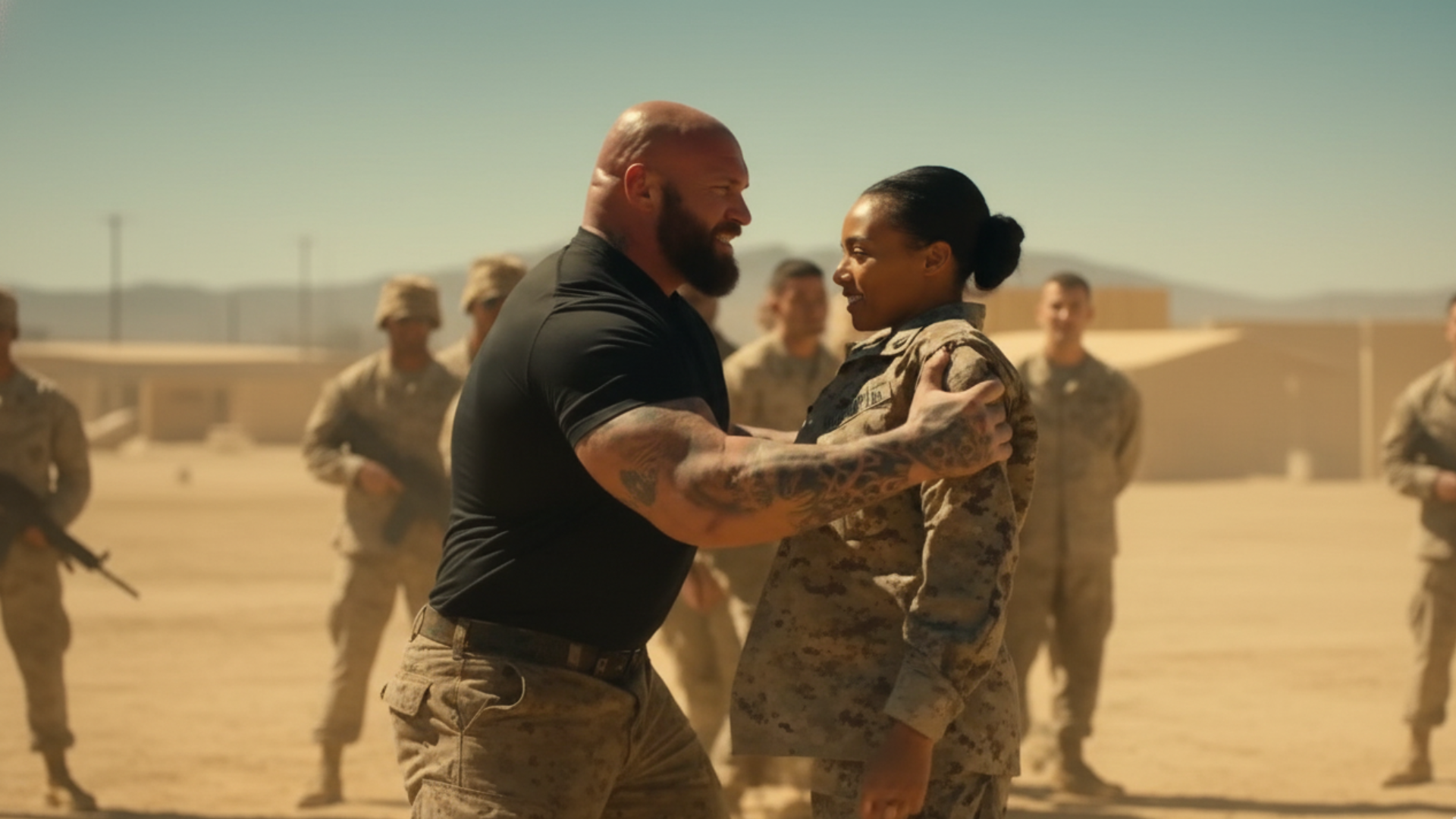
He stood a few paces in front of her, a slab of a man in a black moisture‑wicking shirt that clung to arms thick with ink and muscle. The sun glinted off the shaved curve of his skull as if even his head had been weaponized. There was a certain legend around him: former Recon, multiple combat tours, an unofficial record for the number of students who had voluntarily quit his combatives course. The younger Marines called him “the Wall” because once you ran into him, you usually stopped moving.
Right now, the Wall looked like he very much planned to live up to his name.
“Eyes on me, Marines!” he barked, voice easily swallowing the hum of the base. “We’re running a demonstration for the Joint Combat Trauma Integration Course. Scenario: hostile contact in close quarters. Medic gets separated from security element. Question is simple: does she become a liability… or can she stop being a soft target?”
A low ripple of amusement rolled through the circle. Ava heard it without looking at any of them; her gaze stayed fixed somewhere just above Maddox’s right shoulder, on the washed‑out blue of the sky.
“Staff Sergeant Morales,” he said, drawing her rank out like a challenge. “Step forward.”
She did, boots crunching in the sand. Her hands were empty, no weapon, no aid bag—just her, the heat, and the hulking figure in front of her.
“Gunny,” she said evenly. “What are the rules of engagement?”
Maddox grinned, and there was nothing friendly in it. “Rule one: you stay conscious. Rule two: you stay on your feet. That’s it.”
There was a brief flicker in her dark eyes, so quick most people would have missed it, like a camera aperture narrowing down just before the flash.
“With respect, Gunny,” she replied, “those aren’t rules. Those are hopes.”
A few Marines snorted, but the sound died quickly as Maddox closed the distance. He moved with the predatory confidence of someone who’d spent a lifetime bending bodies to his will. He planted a hand flat on her shoulder and gave her a firm shove, testing. Ava rocked back a step, absorbing the motion rather than resisting it head‑on, boots digging in.
“You nervous, Sergeant?” he asked, voice low enough that the front row heard every word. “You should be. This isn’t a trauma lane. There’s no mannequin, no rubber blood. Just you and me.”
“I’ve met worse company,” she said.
The shove came harder this time, snapping her backward enough that she had to throw a foot behind to keep from falling. A few men in the circle leaned in almost imperceptibly, like spectators at the edge of a car crash. She could feel every pair of eyes on her, weighing, measuring, waiting.
Ava lifted her hands to chest height, palms open, fingers relaxed—not a fighter’s stance so much as a peace offering that happened to line up with every joint and nerve she’d ever learned how to break.
“Gunny,” she said, her voice cutting through the dry air, “we’re supposed to be demonstrating how to keep medics alive. Not how to put them in traction.”
Maddox’s jaw flexed. He leaned in until his shadow swallowed the front of her uniform. “Out there, nobody’s going to care what you’re ‘supposed’ to be,” he growled. “They see that caduceus and they shoot you first. You want these men to trust you at their backs? Then show them you’re not just extra weight on the bird.”
She heard the word—weight—and filed it away. People rarely understood how much they revealed when they were trying to insult you.
Behind Maddox, near the edge of the square, Colonel Abrams watched with an unreadable face, arms folded. He had been the one to sign the orders bringing Ava to Camp Kincaid after reading a classified after‑action report that barely fit on three pages. The report mentioned, in sterile language, how one Staff Sergeant A. Morales had opened a collapsed airway with improvised tools while under indirect fire, then kept a wounded operator breathing for twenty‑three minutes with nothing but a bag valve mask and sheer refusal to let go. It did not mention how she had done it while covered in someone else’s blood, or how her hands had only started shaking after the helicopter lifted off.
The Marines circling her today knew none of that. They just saw a woman in a job they associated with gauze and paperwork, standing where they believed only door‑kickers belonged.
Maddox’s hand shot out again, this time not to shove but to seize. Thick fingers knotted into the front of her blouse, gathering the fabric into a fist that pressed hard against her collarbone. He yanked her forward so fast that for a split second her boots left the ground. The circle tightened, the air around them shrinking to the radius of his arm.
“Here’s lesson one,” he said, his voice a low snarl inches from her face. “The enemy doesn’t care how many lives you saved last deployment.”
Ava’s right hand rose and wrapped around his wrist, not prying, just making contact. Her left elbow tucked in protectively, body folding into the pressure instead of away from it.
“Here’s mine,” she answered, her tone still almost conversational. “Neither do I, when somebody puts their hands on me like that.”
Something changed then, subtle but undeniable. A few Marines shifted uncomfortably. The bravado that usually accompanied these demonstrations felt out of place for the first time. This wasn’t the usual scripted beat‑down where the instructor tossed a hapless volunteer around to laughter and applause. This felt like the kind of moment that made it into whispered stories in barracks years later.
“Gunny, you asked for full speed and no pulling punches,” Colonel Abrams called out at last. “You’ve proved your point. Let’s get to the technique.”
But Maddox either didn’t hear him or chose not to. Maybe he’d decided that the only way to keep his own legend intact was to make sure the ‘Pentagon project’ hit the dirt hard. Maybe it was something else—years of quiet resentment at changes he couldn’t control, all looking for a convenient target. Whatever the reason, he tightened his grip and drove forward, massive shoulder crashing into Ava’s chest as he tried to bulldoze her backward.
For a breathless instant she was somewhere else.
Not on the sand of Camp Kincaid, but in the stale, metallic gloom of a half‑collapsed factory on the outskirts of Raqqa, ankle‑deep in broken glass and dust. A man twice her weight had slammed into her there too, wild with pain and morphine, his hand scrabbling for the sidearm on her hip while she tried to keep his femoral artery from turning the floor into a red river. She remembered the smell—sweat, burned concrete, cordite—and the way her training had narrowed the world down to bones, leverage, breath. She had not chosen violence then. She had chosen survival.
The desert snapped back into focus. Maddox’s momentum was still carrying him forward, head low, shoulder into her chest, his center of gravity charging past his own base. Ava shifted her weight just enough, stepping off the line of attack instead of meeting it square. Her hips turned, her hand on his wrist rolled, and suddenly his strength was no longer driving into her, but past her.
She let the force he’d generated pull his arm across his own body, guiding rather than resisting, the way one redirects a flood into a different channel. Her other hand slipped under his elbow, rising sharply. There was a collective intake of breath as the massive Gunnery Sergeant found his own feet no longer where he’d left them.
For a man his size, the fall was almost elegant.
He hit the sand shoulder‑first with a heavy thud, arm captured and twisted into a joint lock that stopped millimeters before anything tore. Ava’s knee hovered just above his ribs, not quite pinning, but close enough that everyone could see how little effort it would take to turn control into cruelty. Maddox’s free hand scrabbled for purchase in the dirt, more out of reflex than need. She had him.
“Don’t move, Gunny,” she said softly. “I really would hate to explain to the colonel why I let our lead combatives instructor leave here with a dislocated shoulder.”
There was no triumph in her voice. If anything, she sounded tired.
Maddox tried to buck once, then realized the attempt only tightened the pressure on his elbow. His jaw clenched, a bead of sweat rolling from his temple into the sand. The circle had gone utterly still. Somewhere nearby, a flag snapped in the wind like a judge’s gavel.
“You think this is about embarrassing you?” Ava continued, eyes never leaving his. “It’s not. I’m not here to prove I’m stronger than you. I’m here because when someone tries to rip you apart in a hallway, I’m the one who has to put you back together before you bleed out. I can’t do that if I’m the first one who goes down.”
For a long moment, nobody moved.
Then, rough and grudging, Maddox tapped the sand twice with his free hand. The universal signal.
“Release,” Colonel Abrams ordered.
Ava eased off instantly, guiding his arm back into a neutral position and rising in one smooth motion. She took two steps back and came to attention, chest lifting and falling with controlled breaths. Maddox rolled to his knees, then to his feet, brushing sand from his shirt more for something to do with his hands than from any real concern with his appearance. His gaze swept the ring of Marines, searching for the laughter he usually heard after these demonstrations. He found only wide eyes and a few looks that might, in a different world, have been called admiration.
He turned back to her. For the first time since she’d arrived at Camp Kincaid, Gunnery Sergeant Cole Maddox looked at Staff Sergeant Ava Morales not as a prop, or a PR stunt, but as someone who might one day be the thin line between his pulse and a folded flag.
“Morales,” he said, voice rough. “Where’d you learn that throw?”
She shrugged slightly. “A hallway in Raqqa,” she answered. “The guy made worse life choices than you did.”
A ripple of uneasy laughter escaped the circle, then grew, loosening something knotted in the air. Even Maddox’s mouth twitched at the corner.
Colonel Abrams stepped forward into the ring, boots grinding into the sand where moments ago pride and momentum had collided.
“Lesson captured, Marines?” he called out. “No one out here is ‘extra weight.’ If you’re on this ground, in this course, you bring something the rest of us can’t afford to lose. Sometimes that means fire support. Sometimes it means the person who keeps your heart beating long enough to see the exfil bird.”
He let his gaze sweep the formation. “You saw what happened when one of you treated her like a target instead of a teammate. Don’t make that mistake outside the wire. Out there, nobody gets a second take.”
The formation broke a few minutes later, the spell of the moment dissolving into the usual bustle of training blocks and hydration checks. Still, the story had already started its inevitable migration. By chow time, it would mutate into a dozen versions: how the little medic had “judo‑thrown” the Wall, how she’d almost ripped his arm off, how she’d whispered something in his ear before letting him up that made him go quiet. In every retelling, the details would warp, but one truth would remain.
They would no longer say she was at Camp Kincaid because some colonel needed a photo in a briefing slide. They would say she was the medic who’d put the Wall on the ground and then offered him her hand to stand back up.
That night, long after the last boots had left the training field, Ava walked the perimeter alone, the desert finally cooling under a sky full of hard white stars. Her knuckles ached faintly from contact, and there was a ghost of bruised pressure along her collarbone where Maddox had grabbed her. She flexed her fingers, listening to the soft pops of tendons and joints, and thought about all the people whose bones she’d held, whose pulses she’d guarded like fragile secrets.
She didn’t need the circle’s approval to know her own worth.
But as the wind swept fresh tracks across the sand, erasing the marks of bodies that had fallen and risen there, she allowed herself one small, private acknowledgment: sometimes, for the whisper to be heard over the roar, it had to step into the center and let the world see exactly how much power it chose not to use.
Tomorrow, she knew, the drills would resume. There would be new scenarios, new obstacles, new ways to question whether she belonged. Maybe Maddox would come at her harder, this time with gloves and mouthguard, eager to prove that what happened in the ring was a fluke. Maybe the colonel would put a rifle back in her hands and remind everyone that medics shot straight too.
Either way, she would do what she had always done. She would show up. She would stand in the space everyone else stepped back from. And if someone decided to grab her collar and call her weight again, she would decide—calmly, deliberately—whether to let it pass or to remind them, gently but decisively, how fast a whisper could become a reckoning.