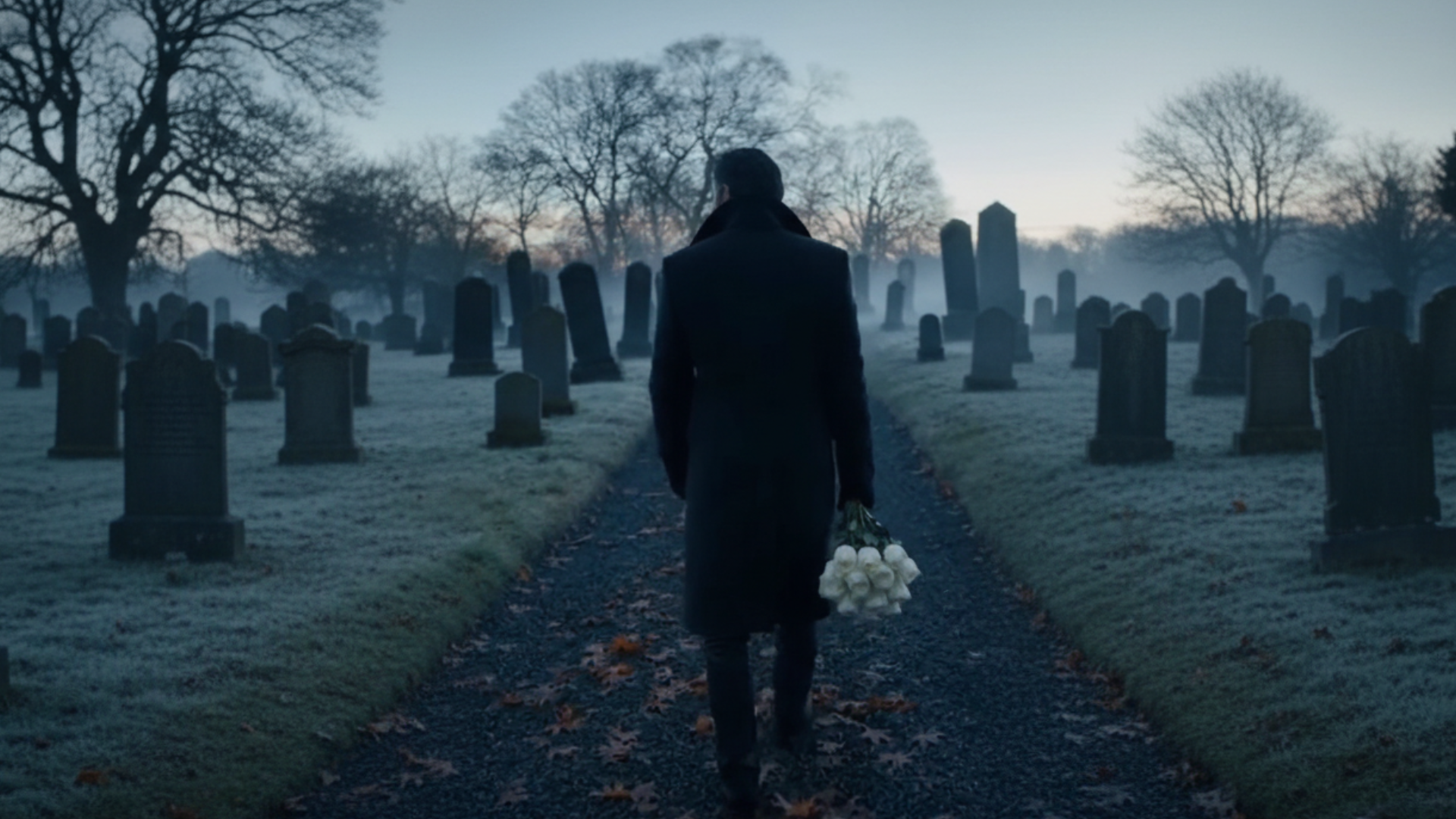
He thought he was visiting his wife’s grave alone… until a strange boy began calling her “aunt.”
The first time Daniel Kerrigan noticed the rust on the cemetery gate, he realized how long he’d been coming here without really seeing anything at all.
Every Sunday for two years, he drove his obsidian electric sedan up the winding hill to Willow Ridge Cemetery, parked by the crooked maple, and walked the same stone path to the grave with the black marble headstone that carried her name: Elena Kerrigan, Beloved Wife, Fierce Heart.
The world knew Daniel as the man who had turned a glitchy logistics app into a global empire—the kind of success journalists liked to call “overnight” even though it had eaten fifteen years of his life. Share prices rose when he smiled on television. Articles called him visionary, ruthless, indispensable.
But in front of that headstone, under the quiet sky of late October, he was just a widower who didn’t know how to talk to the dead.
This Sunday, the air had the thin, metallic cold that comes right before the first snow. Brown leaves stuck to the heels of his Italian shoes as he climbed the hill, tightening his coat around his throat. In his left hand he carried a florist’s arrangement of perfect ivory roses, bound tight with a silk ribbon. They looked like they belonged in a magazine spread about tasteful grief.
He rounded the last bend and stopped so abruptly the roses tilted in his grip.
Someone was already there.
A small boy sat cross‑legged in front of Elena’s grave, his back to Daniel, his thin jacket too light for the wind. A cheap plastic backpack lay beside him, half unzipped, a book with bent corners peeking out. His sneakers were scuffed to gray, and his hair stuck out in cowlicks that looked like no one had bothered to smooth them down that morning.
Daniel’s first instinct was annoyance, sharp and reflexive. This was his ritual. His hour. He didn’t come here to share the space with strangers.
Then he heard the boy’s voice.
“I know you said not to get into fights,” the child whispered, plucking at the stiff grass, “but he shoved me first, Aunt Lena. And he called you a name. So I punched him. I’m not sorry.”
Daniel froze. Aunt Lena.
No one called her that. At least no one in his world.
The boy fell silent, shoulders curling in against the wind. After a moment, he added, even softer, “They’re gonna move me again. Ms. Harrow said the county won’t pay enough if I keep ‘causin’ trouble.’ But I got a B on my reading test. You’d like that, right?”
Something in Daniel’s chest twisted.
He shifted his weight, and a twig snapped under his shoe. The boy flinched and whipped around. His eyes were enormous in his thin face—gray with a ring of pale green around the iris, the kind of unusual color people commented on and remembered.
“I wasn’t doing anything wrong!” the boy blurted. “I wasn’t… I wasn’t hurting it.” He glanced at the headstone as if afraid it could accuse him.
Daniel lifted his free hand, palms open. “Hey. It’s okay.” His voice sounded rough, like he hadn’t used it all day. “You’re not in trouble.”
The boy scrambled to his feet, brushing off his knees. In his small fist, he clutched a handful of wildflowers—if they could be called that this late in the year: mostly weeds and a few stubborn pops of yellow that refused to die. They were arranged in a clumsy ring at the base of the headstone.
Daniel’s expensive roses suddenly looked stupid beside them, stiff and artificial in their perfection.
“I’m Daniel,” he said. The word Mr. caught in his throat, so he left it out. “This is… this was my wife.” He nodded toward the grave.
The boy’s eyes widened even further. “You’re him,” he breathed. “You’re the one from the picture.”
Something cold slid down Daniel’s spine. “What picture?”
The boy fumbled with the zipper of his backpack, hands shaking faintly from the cold. After a moment he pulled out a wrinkled photograph, the glossy edges cracked from too much handling.
It was a candid shot Daniel vaguely remembered from their fifth anniversary—Elena laughing sideways at him, her dark hair caught by the wind, his arm around her shoulders. He hadn’t seen that picture in years.
“She kept it in her notebook,” the boy said. “Said it was her favorite ‘cause you weren’t posing. She showed it to us at the center.”
“The center?” Daniel asked.
“The after‑school one. On Calder Street.” The boy pulled his jacket tighter. “She used to help us there. With reading and stuff. And she brought snacks when the vending machine was broke again.”
Elena had mentioned volunteering “here and there,” but in the last months before the cancer took her, every conversation had circled back to her treatments, to his travel schedule, to the board. There had been so many things he told himself they’d get to once the next crisis passed.
“What’s your name?” Daniel asked.
“Liam.”
“How did you know…” He swallowed. The name still caught in his throat. “How did you know Elena?”
Liam’s gaze dropped to the ring of weeds and stubborn flowers. “She said I was her favorite troublemaker,” he said, a small smile ghosting across his lips for the first time. “She helped me with the long words. Everyone else just got mad when I messed them up. She never did.”
The wind rose, sharp and insistent. Liam shivered hard enough that his teeth clicked. Instinct finally overrode Daniel’s disorientation.
“Where are your parents, Liam?” he asked gently.
Liam’s shoulders rose to his ears. “My mom… left. I don’t remember when. They say I was little.” A pause. “My dad’s… not around.”
“You live with… Ms. Harrow?” Daniel repeated the name he’d heard earlier.
Liam nodded. “Next building over from the center. She’s nice when the social worker visits.” He hesitated. “Not so much when she doesn’t.”
Daniel’s jaw tightened. “Is she here with you now?”
Liam gave a quick, guilty shake of his head. “She was sleeping. I walked. It’s not that far if you cut across the tracks.”
Daniel glanced toward the road. There were no other cars, no other visitors. Just his silent sedan and the boy’s too‑thin jacket.
“You walked all the way out here alone?”
“She said gas costs more than I do,” Liam mumbled. “But I had to tell Aunt Lena about the B.” He straightened a little, pride shining through the fear. “She promised she’d be proud if I got one.”
The words landed like a stone in Daniel’s throat.
For a moment he saw Elena as he used to see her without thinking: the woman who knew the names of the barista’s kids, who tipped waiters too much, who volunteered for “little things” he never asked the details about because his notifications were always buzzing.
He’d been so busy conquering the world he hadn’t noticed the parts of it she was quietly patching back together.
“Liam,” he said, his voice low, “you must be freezing. Let me drive you home. I’ll take you to Ms. Harrow’s place.”
The boy’s eyes darted to the gate, then back to Daniel. Suspicion warred with exhaustion. “You’re not a creep, right?”
Despite everything, a short, surprised laugh escaped Daniel. “No,” he said. “I’m not a creep. You can sit in the back and keep the door unlocked if it makes you feel better. I’ll just… I’ll just drive.”
After a long moment, Liam gave a tiny nod. “Okay.”
They walked down the hill together, side by side. Daniel left the perfect roses propped against the cold stone, dwarfed by the messy halo of Liam’s weeds.
The drive from the cemetery to Calder Street was only fifteen minutes, but the landscape shifted brutally fast—from quiet, tree‑lined roads to cracked sidewalks and leaning row houses, storefronts with half their letters burned out.
Liam pressed his nose to the window, watching it all slide by as if this route was familiar.
“She used to drive me sometimes,” he said. “When it got dark too fast. She had that little blue car that made the funny noise when it turned.”
Daniel pictured the beat‑up hatchback Elena had stubbornly refused to trade in even after his company went public. “It has history,” she’d said whenever he pointed out the new models. He’d rolled his eyes and sent her a car service instead.
“What did she… talk about?” he asked carefully.
“Books,” Liam said immediately. “And how words are like doors. That if I could read, I could go places without moving. She said that was important when you’re stuck.” He rubbed at a spot on the glass with his sleeve. “Sometimes she’d talk about you too.”
Daniel’s fingers tightened on the wheel. “About me?”
“Yeah. She said you were busy saving the boring grown‑up world so she had to save the fun parts.” Liam grinned faintly. “She always sounded… I dunno. Proud, I guess.”
They turned onto Calder Street, where the community center crouched like an old brick animal on the corner, its paint peeling, its windows covered in flyers. Two blocks down, Liam pointed to a sagging duplex with a chain‑link fence half fallen over.
“That one.”
Daniel parked at the curb. The house’s front steps were cluttered with empty soda cans and a dead potted plant. The curtains in the front window twitched, then stilled.
“You sure you’ll be okay?” Daniel asked.
Liam’s throat bobbed. “I’m used to it,” he said, which was not an answer. He reached for the door handle, then hesitated. “Can I… can I ask you something?”
“Sure.”
“Why don’t you visit her in the daytime?” Liam blurted. “It’s always dark when you go. Doesn’t that make it scarier?”
Daniel blinked. “How do you know when I—”
Liam shrugged one shoulder. “Sometimes I’m there too. On the hill. Not all the way up, just… close enough I can see your car lights. Ms. Harrow doesn’t pay attention when I’m gone as long as I’m back before she needs the checkbook.”
A lump formed in Daniel’s throat. “I didn’t… realize anyone was watching.”
“She used to say you were better in real life than in pictures,” Liam said. “I wanted to see if that was true.” He studied Daniel’s face with a seriousness that felt far too old for nine. “I think she was right.”
Before Daniel could respond, the front door swung open. A woman in her fifties leaned on the frame, a cigarette dangling from her fingers. Her eyes narrowed as she spotted Liam.
“There you are,” she snapped. “You run off again without telling me, I swear I’ll call that social worker and have you shipped somewhere worse. You think I got time to chase after you?”
Liam flinched at the volume even from inside the car.
Daniel stepped out, closing his door with measured calm. “I’m the one who brought him back,” he said. “He walked to Willow Ridge alone. That’s a long way for a child.”
The woman’s gaze flicked over his tailored coat, the car, the whole package. Her tone changed a fraction, wary but calculating. “And you are?”
“Daniel Kerrigan.” He gestured toward Liam. “My wife used to work with him at the community center.”
Recognition flickered. “Oh. Her.” Ms. Harrow exhaled smoke through her nose. “Do‑gooder with the notebooks. Shame about… y’know.” She snapped ash in the general direction of the street. “Well, thanks for the ride. County pays me to keep him, not entertain him. Get inside, Liam.”
Liam’s hand tightened on the strap of his backpack. He glanced once at Daniel, something like apology in his eyes, then trudged up the steps and disappeared inside. The door slammed. The house swallowed him whole.
Daniel stood on the sidewalk for a long time, hands useless at his sides, until the cold bit through his coat.
He didn’t go back to the office that night. Instead, he drove home on autopilot, the house suddenly too big when he stepped inside—too many clean surfaces, too many expensive touches Elena had never quite broken in.
Her study door was still closed, as if she were just out running an errand and might come back any minute to find him standing there. He opened it for the first time in months.
Dust motes spun in the amber light from the hallway. The room smelled faintly of her vanilla lotion and old paper. Her desk was a controlled chaos of notebooks, sticky notes, and a cracked ceramic mug full of pens that had probably run out of ink.
He sat down and pulled the top notebook toward him. Inside, her looping handwriting marched across the pages—lesson plans, vocabulary lists, names of kids with stars next to them. Under one name, circled three times, was Liam H.
Beside it she’d written: Reads like he’s fighting the words. Very bright. Doesn’t know it. Keep him fed. Keep him seen.
Daniel turned the pages faster, heart pounding. Tucked near the back was an envelope, unsealed, his name on the front in her hand.
He stared at it for a full minute before he could bring himself to touch the paper.
Inside was a letter dated three weeks before she died.
Danny, it began, just like all her notes had when they were twenty‑two and broke and stupid and thought love could outrun anything.
She wrote about the center, about the kids whose names he was seeing now, about funding cuts and broken heaters and the way some of them flinched when anyone raised a hand too fast. She wrote about Liam specifically—about his stubbornness, his temper, his brilliance hiding under all that armor.
You’re always saying you want to build something that matters, she’d written. I think I’ve found someone who could be your most important project, if you’re brave enough. I know you’re scared of kids (yes, you are, don’t roll your eyes), but he needs someone who can show up even when it’s messy. If anything happens to me before we talk about this properly, promise me you’ll at least meet him.
At the very bottom, in smaller letters that looked like she’d written them when she was already tired, she’d added:
He reminds me of you before you decided success was safer than feeling anything.
The letter blurred. Daniel realized belatedly that his eyes were wet.
He sat there for a long time, the house silent around him except for the hum of the refrigerator and the faint ticking of a clock. The empire he’d built felt suddenly distant, like a skyline seen from too far away to care about.
On his desk, his phone lit up over and over with notifications: emails, missed calls, a reminder about tomorrow’s investor briefing. He let them all go dark.
In front of him, his dead wife’s handwriting waited, asking him for something she’d never had time to say out loud.
The next week, he went back to Calder Street in daylight.
He didn’t go to the duplex first. He went to the community center.
Inside, fluorescent lights buzzed over scuffed floors and mismatched chairs. A woman in a cardigan with weary eyes looked up from behind a folding table stacked with forms.
“Can I help you?” she asked.
“I’m looking for whoever runs the tutoring program,” Daniel said. “My wife used to volunteer here. Elena Kerrigan.”
The woman’s expression softened. “Oh. Elena.” She stood, offering her hand. “I’m Marisol. I coordinate the after‑school stuff. We’ve… missed her.”
They sat in a cramped office that smelled faintly of coffee and dry‑erase markers. Marisol told him about the kids, about how Elena had shown up even on the days when chemo had left her so tired she leaned on the table between sessions. She told him about the notebooks, the late‑night emails with ideas, the arguments Elena had picked with the county over funding.
When he mentioned Liam, something wary flickered in Marisol’s eyes.
“He’s a tough one,” she said. “Bright, like she wrote, but he’s had more placements than birthdays. Every time he starts to settle, someone decides he’s too much work.” She hesitated. “Elena talked about him a lot. Said if her life had gone a little differently, she would’ve…” She trailed off, studying his face.
“Would have what?” Daniel asked.
“Fostered him,” Marisol finished quietly. “Maybe even adopted him. She was trying to figure out how to talk to you about it. She thought you’d think it was too big, too messy. I told her she might be surprised.”
Daniel didn’t know what to do with the ache those words left behind.
Marisol reached into a drawer and pulled out a thin file. “The social worker left this for you, in case you ever came by. Elena asked her to. She said you might need… a little push.”
On top of the file was another envelope with his name, the handwriting shakier this time.
If you’re reading this, the letter inside began, either I finally found the courage to tell you everything, or I ran out of time and had to cheat. You always did say I loved a dramatic gesture.
She wrote about fear—hers and his. About how they’d put off conversations about children until “later,” as if time owed them anything. About how meeting Liam had made her realize that waiting was its own kind of choice.
I don’t know what you’ll do, she ended. I just know this: if that boy ever stands in front of you, looking at you like you’re the only safe place in the room, please don’t walk away. Not because of me. Because of you.
The next stop was the county office.
Paperwork, interviews, background checks—it all blurred into a maze of forms and nervous glances. The social worker, a brisk woman named Carpenter, seemed skeptical at first, like she was waiting for him to realize this was harder than signing a check.
But Daniel kept showing up. To appointments. To home inspections. To the community center, where he stumbled through reading exercises with kids who glared at him until they realized he really was going to come back next week.
He saw Liam only in snatches at first—across the crowded room, at the edge of a group game, hovering near the snack table like he wasn’t sure if he was invited.
One afternoon, as Daniel stood by the door putting on his coat, a small voice said, “You came back.”
He turned. Liam stood there, backpack slung over one shoulder, eyes narrowed as if trying to catch him in a lie.
“I said I would,” Daniel replied.
“Grown‑ups say lots of things.” Liam scuffed his shoe against the floor. “Most of it’s fake.”
Daniel crouched a little, enough to be closer to Liam’s eye level. “You’re right,” he said. “Sometimes it is. I’ve been one of those grown‑ups. I’m trying to be less fake.”
Liam studied him in silence for a long moment, then nodded once as if filing that away. “Aunt Lena’d like that,” he said.
The confrontation with Ms. Harrow came two months later, after a neighbor called in a noise complaint that turned into something else when officers saw the inside of the house.
Daniel arrived with social worker Carpenter, his stomach in knots. The living room smelled of stale smoke and something sour. Liam sat on the couch, arms folded tight, a bruise blooming along his jaw.
“You people are overreacting,” Ms. Harrow protested, waving a hand. “Kids fall. He’s clumsy. And who’s gonna take him, huh? You?” she sneered at Daniel. “Mister Fancy Car, gonna play house for a week and dump him when it gets hard?”
Liam flinched at her words, his face hardening into something brittle.
Daniel’s first impulse was to snap back, to meet aggression with the sharp, cutting tone that had won him a dozen boardroom battles. But Elena’s letter, her careful handwriting, hovered at the edge of his mind.
Instead, he knelt in front of the couch, ignoring the way his expensive trousers creased against the sticky carpet.
“Liam,” he said, keeping his voice calm. “Look at me.”
After a moment, Liam did.
“You remember what she told you about doors?” Daniel asked. “How reading was a way to get out even when you were stuck?”
A flicker of recognition passed through Liam’s eyes.
“This is another door,” Daniel said. “It’s scary because you don’t know what’s on the other side. I can’t promise it’ll be perfect. I can’t promise I won’t mess up. But I can promise I’m not going anywhere just because it’s hard.”
Liam swallowed. “Grown‑ups always say—”
“I know,” Daniel cut in gently. “I used to be one of those grown‑ups. I’m trying very hard not to be anymore.”
Silence stretched.
Finally, Liam whispered, “If I come with you… do I still get to visit her?”
The question gutted him.
“Every time you want,” Daniel said. “We’ll go together.”
Behind him, he heard social worker Carpenter exhale, some of her skepticism softening. Papers would still have to be filed, hearings scheduled, boxes checked. Nothing would change overnight.
But in that cramped, foul‑smelling living room, something shifted anyway.
Liam reached out and gripped Daniel’s sleeve. It was a small, almost accidental gesture. Daniel covered the boy’s knuckles with his own hand as if they were both the ones who needed steadying.
The adoption took nearly a year.
There were setbacks. An uncle no one had heard from in years suddenly materialized, then vanished again when it became clear there was no money attached. Liam had tantrums that rattled the windows, nightmares that left him shaking, days when he refused to go to school or snapped at kids who looked at him sideways.
There were moments when Daniel sat on the kitchen floor at three in the morning, exhausted, wondering what he’d been thinking. He missed meetings. He stepped back from deals. People whispered that he’d gone soft.
But there were also other moments—Liam falling asleep on the couch halfway through a movie and unconsciously leaning against his shoulder; the first time Liam burst into his home office waving a report card with an A circled in red; the quiet afternoons at the community center where Daniel caught himself laughing more than checking his phone.
One gray afternoon in late autumn, the call finally came.
The judge had signed. It was done.
That evening, Daniel drove up the winding hill to Willow Ridge with a boy in the passenger seat instead of a bouquet.
Liam climbed the familiar path with easy steps now, his new, too‑big hoodie pulled up against the wind. In his hands he carried a small chaos of wildflowers and weeds he’d insisted on picking himself along the roadside.
“I know she likes these better,” he said when Daniel had suggested something from a florist. “They’re like… real. Not fake nice.”
The gates of the cemetery groaned as they swung shut behind them. The sky was the deep purple of almost‑night, the air sharp enough to sting.
When they reached Elena’s grave, Liam dropped to a knee and began carefully arranging his messy bouquet at the base of the stone.
“Hey, Aunt Lena,” he said softly. “Told you I’d come back.” He glanced over his shoulder at Daniel, then added, “You were right about him, y’know.”
Daniel swallowed past the tightness in his throat. He crouched beside Liam, running his fingers over the carved letters of her name.
“Hi, El,” he murmured. “You win. Again.”
Liam leaned against his side, just enough that Daniel could feel the weight.
For the first time in a very long time, the cemetery didn’t feel like a place he came to bring something that had been taken from him. It felt like the place where something had been given back. Something messy and loud and alive.
The wind moved through the trees, rattling the branches like distant applause.
Daniel looked at the wildflowers, at the scuffed sneakers beside his polished shoes, at the boy who had once sat here alone and whispered to a woman who’d seen him when no one else did.
“Come on,” he said after a while, standing and offering his hand. “We’ve got a lot of doors to open, you and me.”
Liam took his hand without hesitation. “As long as we keep this one,” he said, glancing back at the headstone.
“We will,” Daniel promised.
Together, they walked down the hill, the last light of day stretching their shadows long and strange behind them—two figures where once there had only been one.