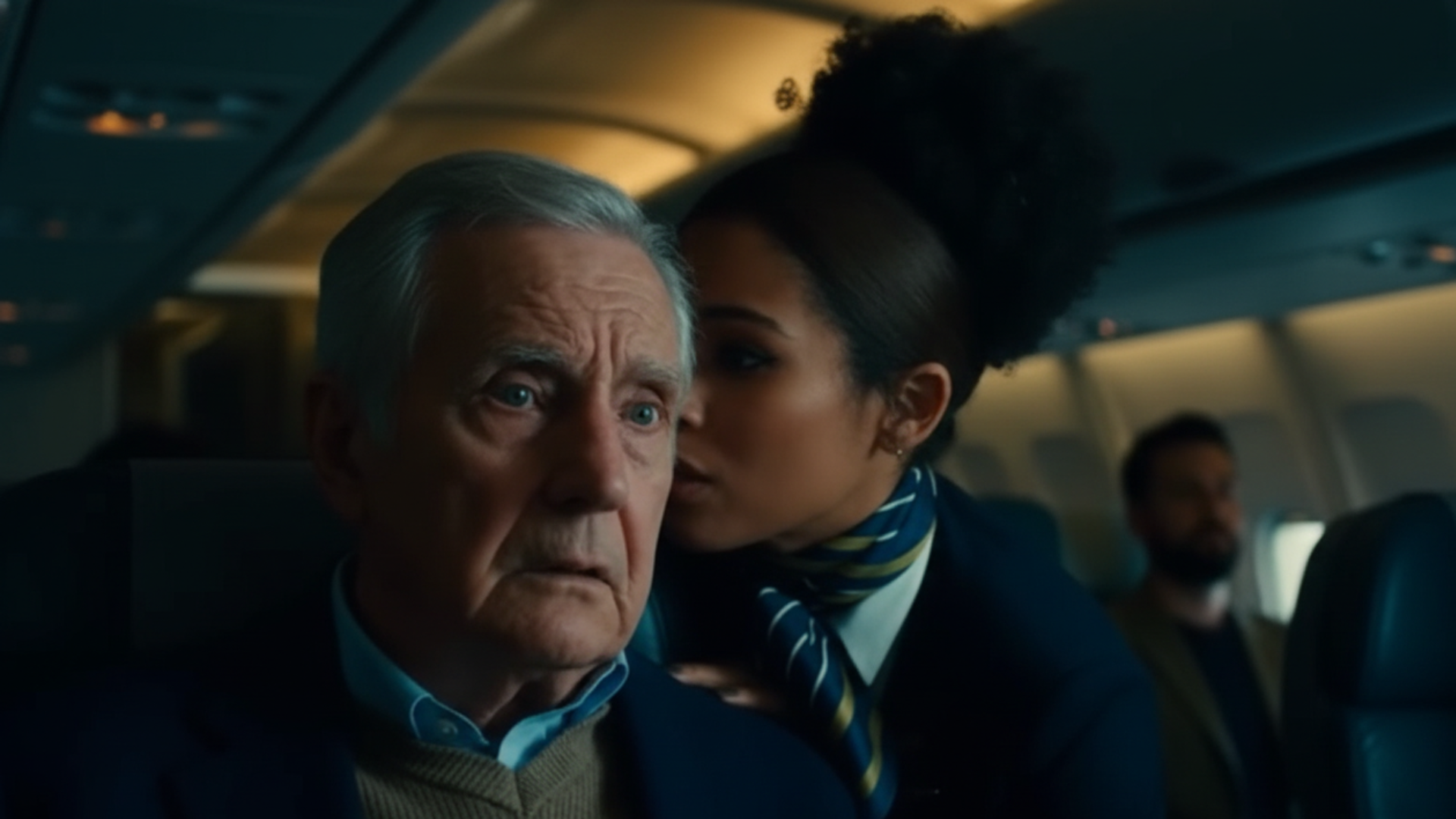
‘The flight attendant whispered five words that forced me to fake a heart attack and flee the plane… When I looked back at my son’s face, I realized she hadn’t just delayed our trip—she had saved my life.
“Sir, please pretend you’re sick and step off this plane right now,” the flight attendant whispered, her voice trembling so slightly that only I could hear it over the low hum of the engines. Her fingers were digging into my wrist, not aggressively, but with a desperate, anchoring grip. I looked up, ready to crack a joke or ask what on earth she was talking about, but the words died in my throat. I saw genuine terror in her eyes. It wasn’t the professional concern of a stewardess dealing with a difficult passenger; it was the raw, primal fear of someone witnessing a catastrophe in slow motion.
“Trust me,” she breathed, her eyes darting toward row 14, where my son, David, and his wife, Elena, were busy stowing their carry-ons. “Just hold your chest. Now.”
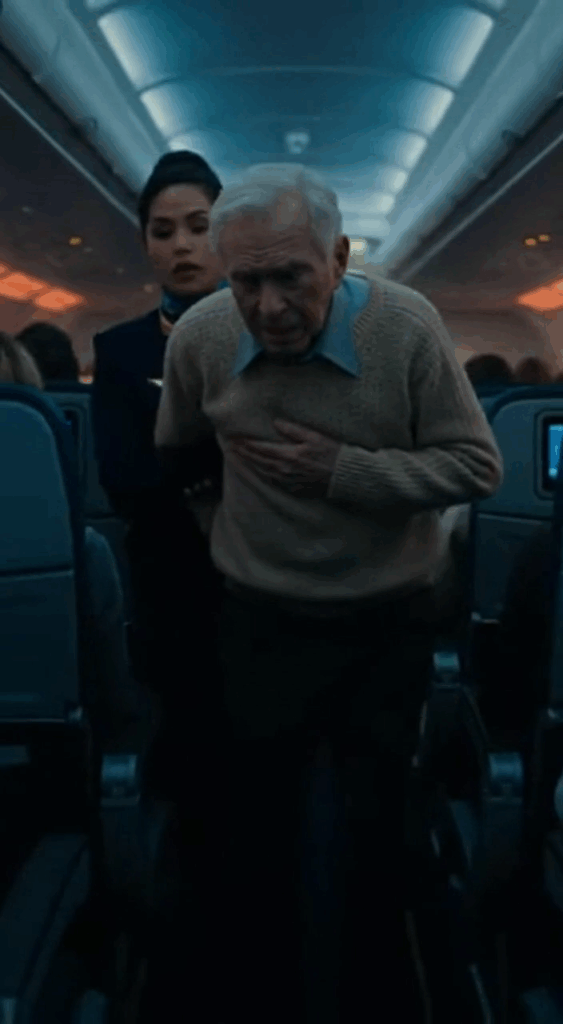
I didn’t understand. My mind, usually sharp from forty years of auditing complex accounts, felt sluggish, lagging behind the reality of the moment. But instinct—that quiet, ancient alarm system we all possess—kicked in. I groaned, a guttural sound that surprised even me, and slumped forward, clutching my sternum.
“Sir? Sir!” The attendant’s voice pitched up, theatrical and loud now. “We have a medical emergency! I need the aisle clear!”
The chaos that followed was a blur of movement. But in that swirl of noise, time seemed to fracture. As the paramedics were being radioed and I was being supported down the aisle, I risked a single glance back at row 14.
I expected to see David jumping up, his face twisted in panic, rushing to his father’s side. I expected Elena to be screaming for help.
Instead, I saw them frozen. David was gripping the seat back in front of him, his knuckles white, but his expression wasn’t fear for me. It was annoyance. Pure, unadulterated irritation, like I had just spilled red wine on a new carpet. And Elena? She wasn’t looking at me at all. She was looking at David, her eyes narrowed, her lips moving in a sharp, silent curse. They didn’t move to follow me. They stayed seated.
As the cool air of the jet bridge hit my face, the flight attendant—whose nametag read ‘Sarah’—guided me not to a waiting ambulance, but into a private crew lounge just off the gate. She locked the door and leaned against it, shaking.
“You can stop pretending now,” she said, her voice hollow. “They aren’t coming off. The doors are closing.”
I straightened up, the adrenaline fading into a cold knot in my stomach. “Young lady, you better explain why you just pulled me off my family vacation. My son is going to be worried sick.”
Sarah looked at me with a pity so deep it felt like a physical blow. “Sir, while I was doing the pre-flight checks, I was in the row behind your family. They didn’t see me. The woman… your daughter-in-law? She was showing your son a document on her phone.”
“So?” I demanded, though my hands had started to tremble.
“It wasn’t a travel itinerary,” Sarah whispered. “It was a toxicology report on interaction times. And then she said, ‘If he drinks the scotch before we hit cruising altitude, it looks like natural heart failure. If he waits until the hotel, we have to use the stairs.’ And your son… he just nodded and asked if the insurance payout would clear before the funeral costs.”
The room spun. I sat down heavily on a plastic chair, the silence of the lounge deafening compared to the roar in my ears.
To understand how I ended up here, a seventy-year-old man shivering in an airport lounge, you have to go back eight months. Back to the quiet.
After my wife, Martha, passed away five years ago, my life in the Arizona desert had settled into a gentle, if lonely, rhythm. I had my garden, my books, and the steady, comforting tick of the grandfather clock in the hall. I was content. Wealthy, in a modest way, having saved every penny from a lifetime of careful living, but simple.
Then came the phone call. David. My only son.
He had lost his job in the tech layoffs. They were losing their apartment. Could they stay for a few weeks? Just until they got back on their feet.
I said yes, of course. What father wouldn’t?
The first month was wonderful. The house felt alive again. David and I watched football; Elena cooked elaborate meals that filled the kitchen with smells I hadn’t realized I missed. But slowly, the atmosphere shifted. It wasn’t abrupt—it was like the temperature dropping degree by degree until you suddenly realize you’re freezing.
Elena began to “organize” things. First, it was the pantry. Then the linen closet. Then my office. I came home one afternoon to find her at my desk, my filing cabinet open.
“Just dusting, Arthur!” she had chirped, her smile too bright, too wide. “You have so much paperwork. It must be a nightmare to keep track of.”
I noticed later that my estate planning folder had been moved to the top of the pile. I brushed it off. Paranoia, I told myself. She’s just trying to be helpful.
But then the isolation started. “Oh, Arthur, don’t worry about going to the grocery store, I’ll go.” “Arthur, your friends called, but I told them you were napping, you looked so tired.” “Dad, you shouldn’t drive at night anymore, your eyes are getting bad.”
Bit by bit, they dismantled my independence. David, once my shadow, became a ghost. He avoided my gaze, slipping out of rooms when I entered. He looked haggard, worn down. I tried to ask him what was wrong, but Elena was always there, hovering, answering for him.
“He’s just stressed about the job hunt, Arthur. Don’t pester him.”
The job hunt that never seemed to yield interviews. The days spent whispering in their bedroom. The way conversation stopped the moment I walked in.
Then came the “Family Trip.”
Elena announced it at breakfast three days ago. “Vegas!” she declared, pouring my coffee. “We all need a break. A bonding trip. I found an amazing deal at the Bellagio. My treat.”
I frowned. “Elena, you have no income. How can you afford the Bellagio?”
“I have some savings left!” she insisted, her eyes hard. “Let us do this for you, Dad. You’ve done so much for us.”
David stared at his toast. “Yeah, Dad. It’ll be… good.”
I agreed because I wanted to believe them. I wanted to believe that my son still loved me, that this tension was just the stress of their situation. But as we packed, I felt a nausea I couldn’t shake.
On the drive to the airport, the car was silent. Elena kept checking her watch. David was sweating, despite the AC blasting. When we checked our bags, Elena insisted on keeping my medication in her carry-on. “So you don’t lose it,” she said.
And then, the plane.
Sitting in that lounge with Sarah, the pieces fell into place with the devastating weight of a collapsing building. The sudden interest in my finances. The isolation from my friends. The “trip” to a city known for excess and accidents.
“You saw the scotch?” I asked Sarah, my voice raspy.
She nodded. “She bought a mini bottle at the duty-free shop. She had a small vial in her hand when she was showing him the phone. She put something in it.”
I called the police from the lounge. They arrived within minutes, airport security in tow. We waited.
The plane took off without me.
Two hours later, it landed in Las Vegas. Police were waiting at the gate. They detained David and Elena immediately.
They found the vial in Elena’s purse. It was a concentrated digitalis extract—enough to stop a heart, especially one already medicated for blood pressure. They found the search history on David’s laptop: untraceable poisons, accidental death payouts, how to contest a will.
But the hardest part wasn’t the police report. It wasn’t the news that they had taken out three separate life insurance policies on me in the last six months, forging my signature.
The hardest part was the recording from the interrogation room.
The detective played it for me a week later. Elena was screaming, blaming David, claiming it was his idea. But David… David was quiet. When the detective finally asked him why—why he would kill the man who raised him, the man who welcomed him back when he had nothing—David simply shrugged.
“He’s had his life,” my son said, his voice flat, unrecognizable. “He’s sitting on a house worth a million dollars and doing nothing with it. We have debts. We have needs. He was just… in the way.”
I sit in my house now. It’s quiet again. The grandfather clock ticks in the hall. But the comfort is gone. I fired the maids, the gardeners, everyone. I changed the locks. I rewrote the will.
Every Sunday, I drive to the airport. I sit in the coffee shop outside the security checkpoint. I wait for Sarah to finish her shift. We don’t talk much. I just buy her a coffee, and she smiles—a real smile, not like Elena’s.
I’m alive. My heart is still beating. But sometimes, in the silence of this empty house, remembering the look on my son’s face when he thought I was dying… I wonder if a part of me didn’t die on that plane after all.
Be careful who you let into your sanctuary. Even if they share your blood. Especially if they share your blood.