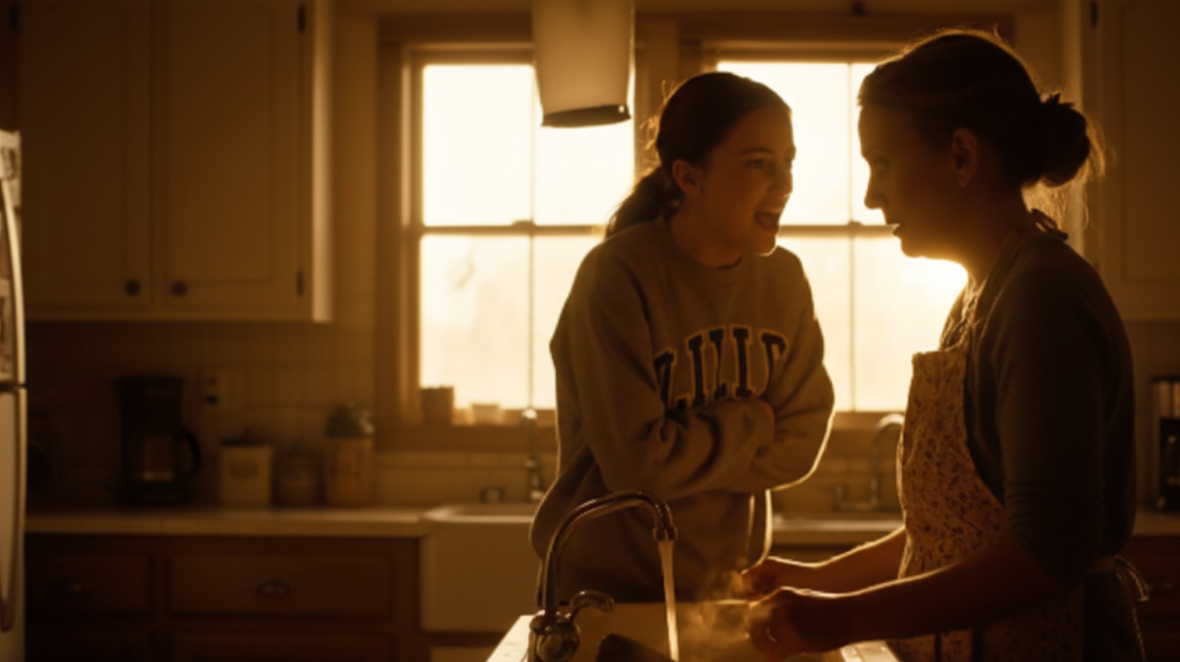
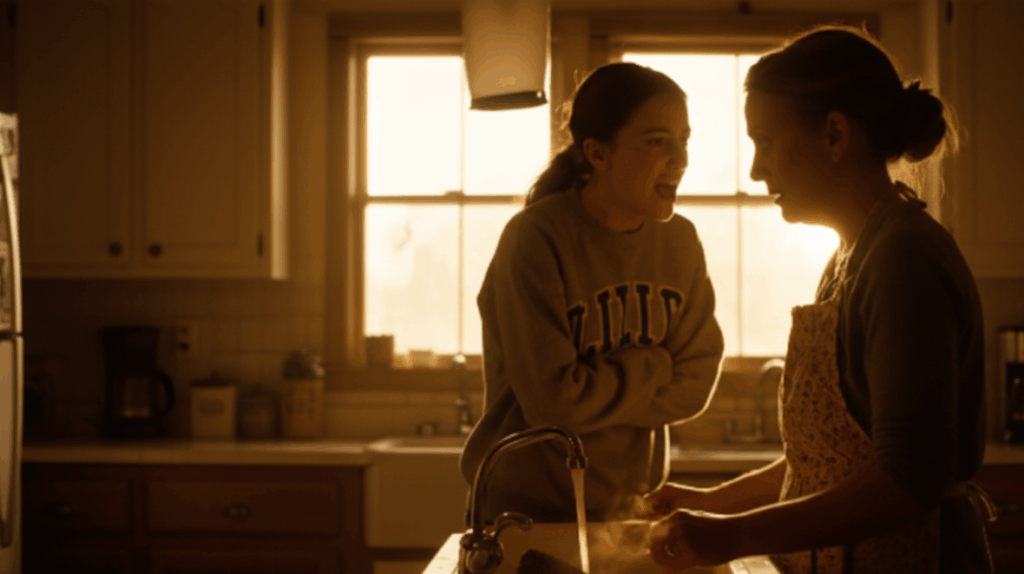
The late-afternoon sun slanted through the small kitchen window, painting long golden lines across the faded linoleum floor. Emily Harper, a 22-year-old American college student, slammed her backpack onto the table, her jaw clenched, her eyes sharp with frustration.
Her mother, Linda, a woman in her mid-50s with tired hands and gentle blue eyes, stood at the stove stirring a pot of soup. The same soup they had almost every day. The same kind Emily was sick of.
“I’m tired of living like this,” Emily blurted. Her voice cracked the quiet room. “We’re always broke. Always struggling. Why can’t you ever do better?”
Linda froze. Just for a second. Then she forced a small smile — the kind that hid more pain than comfort.
Emily didn’t notice. Or maybe she refused to.
She grabbed her coat and stormed out, slamming the door behind her.
But that night, something happened in the old house — something that would begin to unravel the first thread of a truth Emily had never imagined.
The house settled into silence after Emily left. Linda stood motionless at the stove, her wooden spoon suspended over the pot, steam rising like ghosts around her weathered face. A single tear traced the familiar path down her cheek — a path worn smooth by years of silent crying.
She turned off the burner and walked slowly to her bedroom, each step heavier than the last. In the corner of her closet, beneath folded winter blankets that smelled of mothballs and memories, lay a small wooden box. She hadn’t opened it in months. Sometimes, the past hurt too much to revisit.
But tonight, she needed to remember why she kept going.
Inside the box were photographs, old hospital bracelets, and a leather-bound diary — its pages yellowed, its spine cracked from being held too tightly during the darkest hours.
Linda opened to a random page, dated March 14th, 1998:
“Emily turned three today. I bought her a cupcake from the bakery — just one, because that’s all I could afford. She smiled so big, my heart nearly broke from the beauty of it. She doesn’t know that I haven’t eaten today. She doesn’t know that I told her daddy I was fine, even though I wasn’t. He left us last week. Said he couldn’t handle being poor, couldn’t handle the responsibility. But when I see her smile, I know I can handle anything.”
Linda closed the diary and placed it back in the box. She couldn’t read more tonight.
Not yet.
Three days passed in cold silence. Emily came and went like a ghost, avoiding her mother’s eyes, eating dinner in her room. The tension in the house was thick enough to choke on.
On Saturday afternoon, Emily came home to an empty house. A note on the kitchen table read: “Went to work extra shift. Soup in the fridge. Love, Mom.”
Emily crumpled the note and tossed it in the trash. “Of course,” she muttered. “Always working. Never here.”
She wandered through the quiet house, restless and angry without quite knowing why. Her feet carried her to her mother’s bedroom — a place she rarely entered. It felt like trespassing, but curiosity pulled her forward.
The closet door stood slightly ajar.
Inside, something caught her eye — a corner of the wooden box peeking out from beneath the blankets. Emily knelt down and pulled it into the light. The box was old, carved with delicate flowers, and locked with a simple brass clasp that opened easily.
Inside, she found the diary.
Her hands trembled as she opened it.
The first entry was dated July 2nd, 1995:
“I’m pregnant. Twenty-two years old, working two jobs, and terrified. But I’m also happy. This baby is mine. This baby is hope.”
Emily’s breath caught. She turned the page.
“September 15th, 1995: Michael left today. He said he never wanted to be a father. He said I trapped him. But I didn’t. I just loved him. Now I love our baby more than I ever loved him. I’ll be enough for both of us.”
Emily’s hands shook harder. She kept reading, page after page, year after year.
“December 1998: Emily got sick today. Pneumonia. The hospital bill will take me two years to pay off, but I don’t care. She’s breathing again. That’s all that matters.”
“April 2001: I took a night job at the factory so Emily can have new shoes for school. The other kids were making fun of her old ones. She doesn’t know I saw her crying. I’ll work every night if it means she never cries like that again.”
“October 2005: Emily made the honor roll. I wanted to take her out to celebrate, but we couldn’t afford it. So I baked a cake from scratch — the flour was almost expired, but she didn’t notice. She hugged me so tight. I wish I could give her the world.”
Emily’s vision blurred with tears. She couldn’t stop reading.
“June 2010: The scholarship application for Emily’s dream college requires a fee I don’t have. I sold my mother’s wedding ring today — the only thing I had left of her. But Emily will go to that school. She will have the life I never had.”
“March 2015: Emily got accepted to college. Full scholarship. She’s moving away soon. I’m so proud I can barely breathe. And so scared. What will I be without her to fight for?”
“November 2017: Emily called today, angry because I couldn’t send her money for a new laptop. She said I was selfish. She doesn’t know I’ve been eating once a day so I can send her what little I have. She doesn’t know I work sixteen-hour shifts so she doesn’t have to. Maybe it’s better that way. Maybe she needs to be angry at me so she can be strong.”
The diary fell from Emily’s hands. She sat on her mother’s bedroom floor, surrounded by photographs of a life she’d never truly seen. Pictures of Linda, young and smiling, holding baby Emily. Pictures of birthday cakes made from nothing. Pictures of a woman who sacrificed everything and asked for nothing in return.
Emily had been so blind.
So cruel.
So ungrateful.
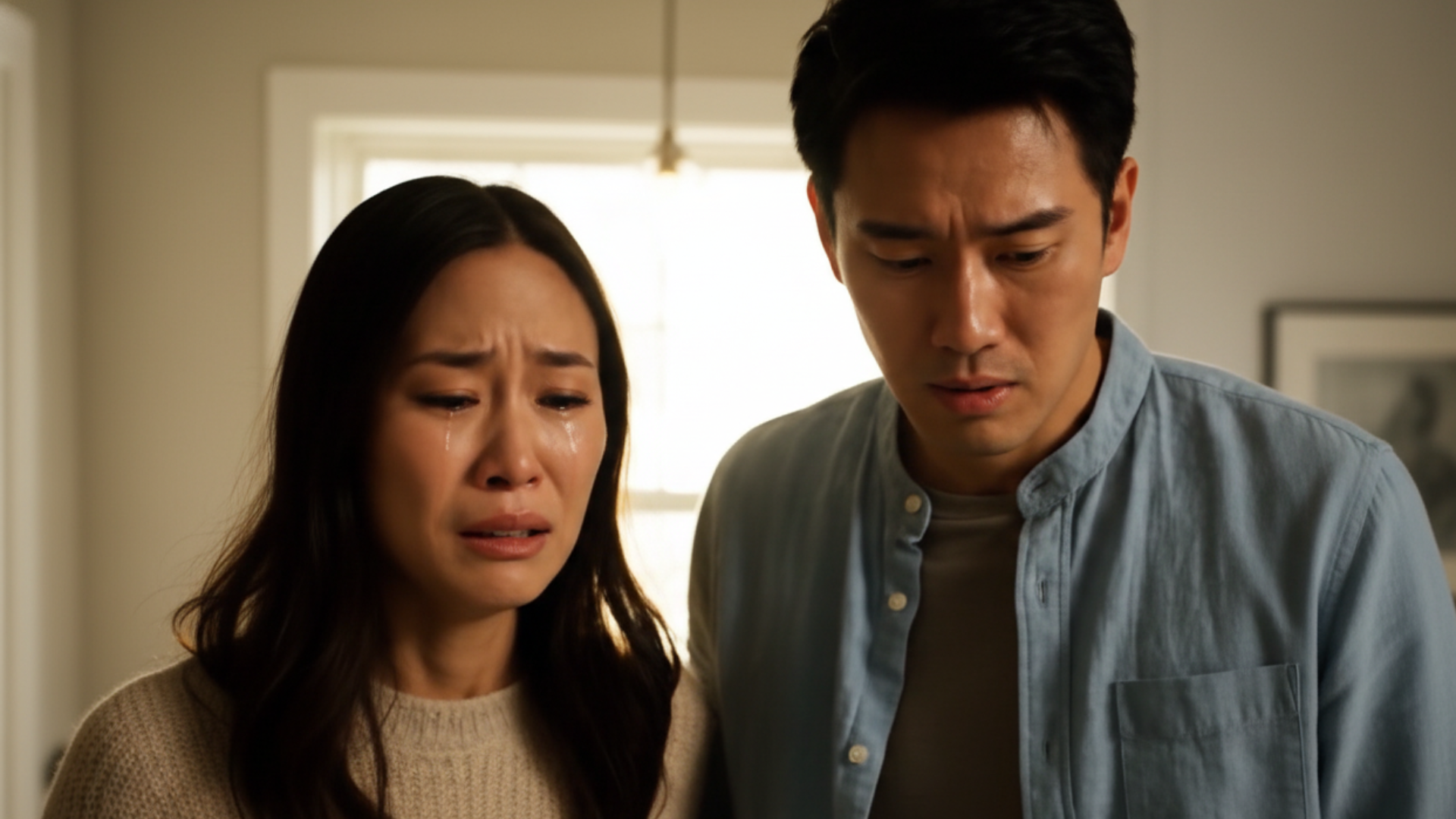
She pressed her hands to her face and sobbed — deep, wrenching sobs that came from a place of unbearable shame and sudden, devastating understanding.
The front door opened just after sunset. Linda came home, her shoulders slumped, her uniform stained with grease from the diner where she worked. She stopped in the doorway to her bedroom, finding Emily sitting on the floor, the diary open in her lap.
“Emily—”
“Why didn’t you tell me?” Emily’s voice was raw, broken. She looked up at her mother with red, swollen eyes. “Why didn’t you ever tell me what you gave up? What you sacrificed?”
Linda’s face went pale. She stepped into the room slowly, as if approaching something fragile. “You weren’t supposed to find that.”
“But I did.” Emily stood, clutching the diary to her chest. “I read it, Mom. All of it. The hospital bills. Dad leaving. Selling Grandma’s ring. Working night shifts so I could have new shoes. Going hungry so I could eat.”
Linda’s eyes filled with tears, but she didn’t speak.
“I’ve been so horrible to you,” Emily whispered, her voice breaking. “I blamed you for everything. For being poor. For not doing better. But you were doing everything. You gave me everything you had, and I—” She choked on the words. “I threw it in your face.”
“Emily, no—”
“Yes!” Emily’s cry echoed through the small room. “I’ve been selfish and blind and cruel, and you never said a word. You just kept loving me. Even when I didn’t deserve it.”
Linda crossed the room and pulled her daughter into her arms. Emily collapsed against her, sobbing into her mother’s shoulder the way she hadn’t done since she was a child.
“I’m so sorry, Mom. I’m so, so sorry.”
Linda stroked her daughter’s hair, her own tears falling freely now. “You have nothing to be sorry for, sweetheart. I wanted you to have a better life. That was always my choice. My gift to you.”
“But I should have seen it,” Emily said, pulling back to look at her mother’s face. “I should have known. I should have been grateful.”
Linda cupped Emily’s face in her worn, gentle hands. “You were just young. Just trying to find your way. I was never angry at you. Not once.”
“How?” Emily asked, genuinely bewildered. “How could you not be angry when I said those things to you?”
Linda smiled — a real smile this time, soft and sad and full of more love than Emily had ever recognized. “Because I’m your mother. And a mother’s love doesn’t keep score. It doesn’t demand recognition. It just is.”
They stood there in the fading light, holding each other, years of unspoken pain and love finally finding voice in the silence between them.
The weeks that followed were different. Emily saw her mother with new eyes. She noticed the way Linda winced when she stood too quickly, the result of years of working on her feet. She saw the careful way her mother counted out money for groceries, choosing the cheapest options so there would be enough.
Emily got a part-time job. Not because her mother asked, but because she wanted to help. She insisted on paying for groceries every other week. She cooked dinner sometimes, learning her mother’s recipes, understanding now that the simple soup wasn’t a sign of failure — it was a sign of creativity, of making something nourishing from almost nothing.
One evening, as they sat together at the small kitchen table eating that same soup, Emily reached across and took her mother’s hand.
“Thank you,” she said simply.
Linda looked up, surprised. “For what?”
“For everything. For every sacrifice you never told me about. For every night you went without so I could have more. For loving me even when I was too stupid to see it.”
Linda squeezed her daughter’s hand, tears shining in her eyes. “Loving you was never a sacrifice, Emily. It was the greatest gift of my life.”
Emily smiled, and for the first time in years, it was a smile without resentment, without blame. Just gratitude.
Just love.
Months later, on a crisp spring morning, Emily sat at her own desk in her college apartment. She opened her laptop and began to write. Not an essay for class. Not a paper on economics or literature.
A letter.
“Dear Mom,
I found your diary six months ago. I know you know that. We’ve talked about it. But there are things I never said, things I need you to understand.
When I was growing up, I thought we were poor because you didn’t work hard enough. I thought you were weak because we struggled. I thought you failed me because we didn’t have what other families had.
I was wrong about everything.
You didn’t fail me. You saved me. Every single day.
You taught me that strength isn’t about having everything — it’s about giving everything you have. You taught me that love isn’t measured in dollars or gifts, but in quiet sacrifices made in the dark when no one is watching.
I’m sorry I didn’t see it sooner. I’m sorry I hurt you with my words and my anger. But I see it now, Mom. I see you. And you are the most beautiful, strongest, most incredible person I’ve ever known.
I will spend the rest of my life trying to be half the woman you are.
I love you more than words can say.
Emily”
She printed the letter, folded it carefully, and placed it in an envelope. That weekend, she drove home — not because she had to, but because she wanted to. Because home wasn’t a place defined by what it lacked.
It was defined by the woman who made it whole.
When Linda opened the letter that evening, sitting in her favorite worn chair, she cried tears of joy. Not because she needed the recognition. Not because she’d been waiting for thanks.
But because her daughter — her beautiful, strong, precious daughter — finally understood that the greatest wealth in life isn’t what you have.
It’s who you love, and who loves you in return.
And in that small house with the faded linolinum floors and the simple soup, there was more love than all the riches in the world could ever buy.