

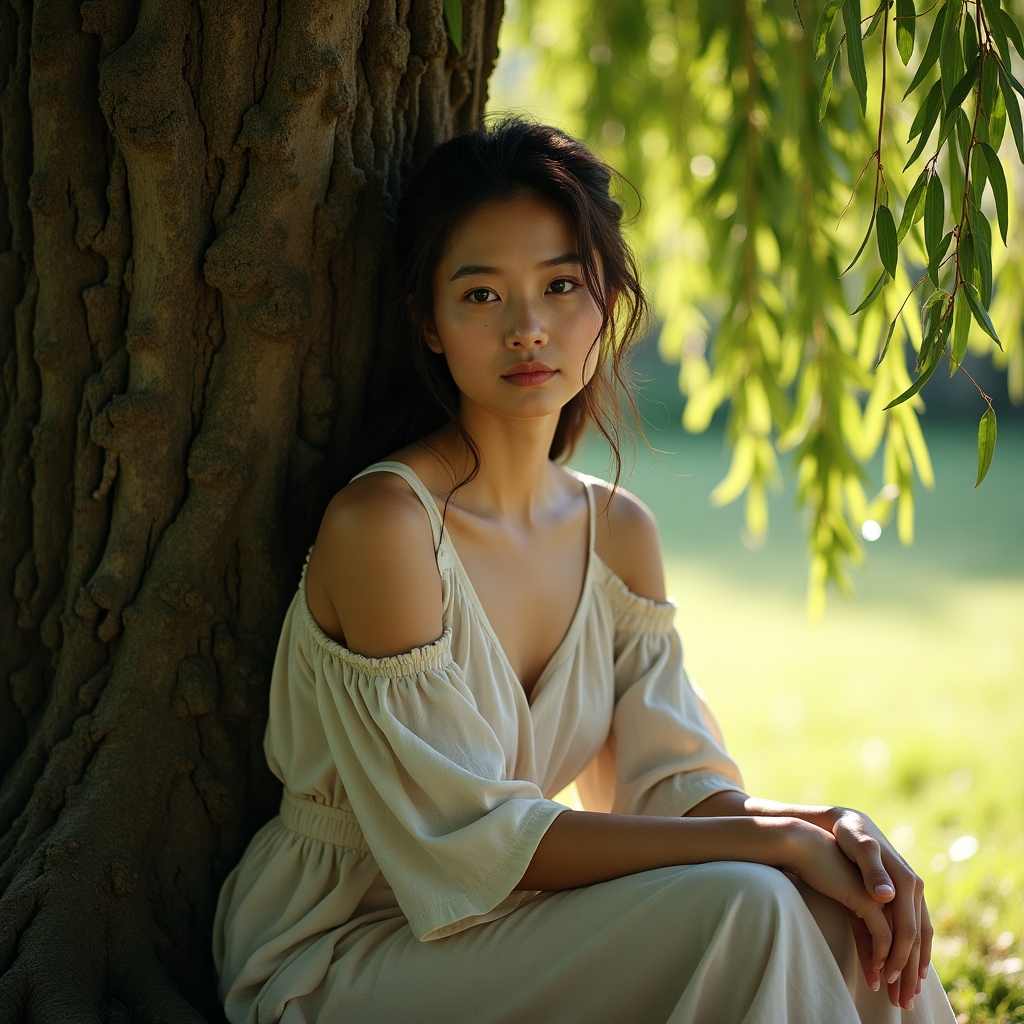
Under the shade of an ancient willow tree, Aria sat on the worn wooden bench, its paint peeling under the weight of countless seasons. This place, tucked away in the corner of her grandmother’s garden, offered her refuge from the cacophony of voices that came not just from her lively family but from the echoes of her ancestors, whose presence was felt in every stone and plant within the garden.
Her family, originally hailing from a small village in Northern Italy, had long held a reputation for their unwavering adherence to tradition. Every Sunday, the Spoleto household became a veritable amphitheater of old-world customs, each member playing their part without question. Aria had grown up in this world, where expectations were as fixed as the stars, their light guiding each generation along the same well-trodden path.
Yet as Aria approached her twenty-fourth birthday, she found herself caught between the security of tradition and the thrilling, if uncertain, allure of her own path. Her passion lay in art, a pursuit her family viewed as a charming hobby rather than a viable future. Mentioning dreams of an artist’s life in Florence or Paris was akin to speaking a foreign tongue. Instead, her family envisioned a respectable career for her in architecture—a field close enough to art to appease her own interests while promising stability and prestige.
Each dinner conversation felt like a delicate dance. Aria would nod along to her parents’ discussions about her future, their voices a blend of excitement and assumed certainty. Her father, with his gentle smile, would speak of her potential to blend tradition with modern innovation in architectural design, while her mother emphasized the pride it would bring to see Aria maintaining the family’s respected status.
But it was her grandmother, Nonna Sofia, who understood the whispers of yearning in Aria’s heart. The two of them shared silent conversations beneath the willow’s branches, where Nonna would weave stories of her youth and the unfulfilled dreams she had tucked away. “We are all bound by our choices and the love we bear for our families,” she would say, her eyes twinkling with a mix of wistfulness and wisdom.
It was during one of these quiet afternoons that Aria grappled with her internal conflict. She sat next to Nonna Sofia, who was knitting a scarf in the warm hues of autumn. Aria’s mind was a whirlpool, spinning the threads of her desires against the anchoring weight of her family’s expectations.
“Nonna,” Aria began softly, “do you ever regret the choices you made?”
Nonna paused her knitting, her gaze fixed on the horizon as if searching for answers among the clouds. “Regrets,” she mused, “are like shadows—ever present, but they fade when you turn towards the light.”
Aria turned her head slightly, seeing her grandmother’s profile etched in the golden afternoon light. “But how do you find that light? How do you know when it’s time to choose your own path?”
A soft laugh escaped Nonna’s lips, a sound like the rustle of leaves. “Ah, mia cara, the light comes when your heart speaks louder than the world around you.” She gently laid her hand atop Aria’s. “Listen to it closely, and when the time comes, you will know.”
It was this conversation that lingered in Aria’s mind as she found herself, weeks later, standing alone in her room, staring at a blank canvas. Her sketchbook lay open on the desk, filled with visions of places she longed to visit, of colors she wished to bring to life. A half-finished application for an art residency in Paris sat beneath it, a symbol of her hidden desires waiting to be acknowledged.
That evening, as she sat at the dinner table, the tension in her chest tightened with each passing course. Her father spoke of an upcoming family gathering, where Aria would be formally introduced to a friend’s son, a rising architect himself. “He’s quite talented,” her father noted with a proud nod.
Aria smiled politely, yet her mind was elsewhere, trailing back to the willow and her grandmother’s words. The conversation ebbed and flowed around her, the traditional ritual of family dinner both comforting and confining.
It was then, unexpectedly, that a sense of calm clarity washed over her—a feeling unlike any she had known. Her heart, which had murmured through the years, now sang with clarity. She looked up, meeting Nonna Sofia’s eyes across the table. Her grandmother gave a small, almost imperceptible nod, as if encouraging Aria to trust the song within her.
“I have something to say,” Aria announced, her voice steadier than she felt. The room quieted, her family’s attention turning towards her like sunflowers seeking the light.
Breathing deeply, she spoke of her dreams, of the art residency in Paris, and the path she longed to carve for herself. Her words were met with a mix of shocked silence and murmured dismay. Her father’s brow furrowed, while her mother’s lips pressed into a thin line.
But before doubt could take root, her grandmother’s voice cut through the silence. “We must all find our own way, just as leaves must eventually fall to grant space for new growth.” Her eyes met Aria’s, filled with pride and understanding.
The tension in the room slowly transformed into acceptance, a process as gradual and natural as the changing of seasons. Aria’s parents exchanged glances, a silent communication unfolding in the space between them.
Finally, her father spoke, his tone gentle but firm. “We want you to be happy, Aria. Whatever path you choose, know that you have our love and support.”
In that moment, the bonds of tradition softened, allowing space for Aria’s truth. The room felt lighter, as if a window had been opened, permitting fresh air to breathe life into the old.
As the conversation resumed, Aria felt the edges of her world expand, her heart buoyant with the newfound freedom to pursue her dreams. Underneath the table, she reached out and squeezed Nonna Sofia’s hand, grateful for the sunlight her wisdom had shown.
The ancient willow swayed gently outside, a silent witness to the unfolding of Aria’s journey—a journey rooted in love, watered by courage, and reaching ever towards the light.