
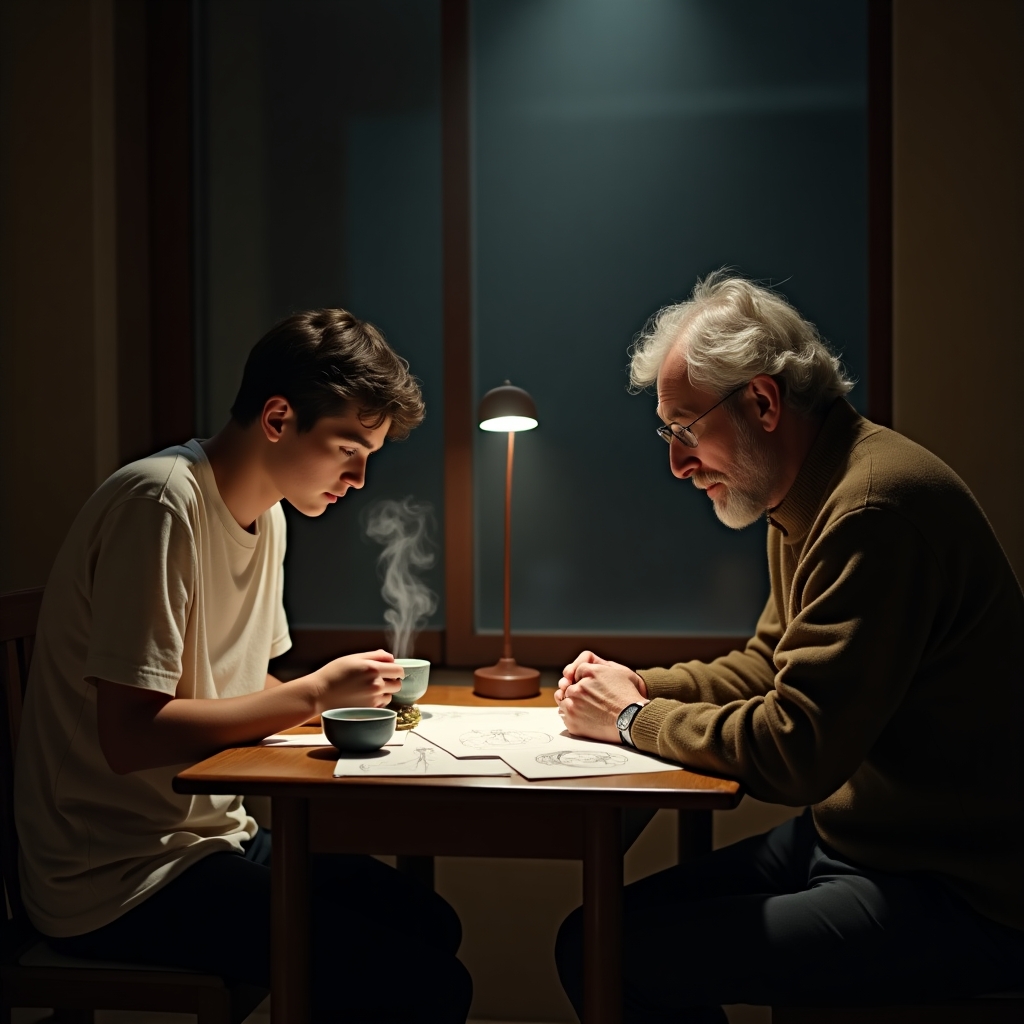
Nathan sat at the small wooden desk in his room, a cup of herbal tea steaming beside him, untouched. The room was a comforting blend of old and new—the walls adorned with posters of his favorite bands, the bookshelves packed with Western literature, all encompassed by the scent of frankincense from the incense his mother burned every morning. He was a young man on the cusp of two worlds—the modernity of his own desires and the traditional values tightly interwoven into his family’s fabric.
His fingers hovered over the keyboard, attempting to find the words to express himself in an email to a potential employer. The internship was a dream opportunity in graphic design, his passion since he first picked up a pencil. However, the company was located across the country, far from his family and their expectations. The room was silent, save for the rhythmic ticking of the clock, yet Nathan’s mind buzzed with the echoes of family expectations, a constant hum that blended with his every thought.
His parents had sacrificed much to provide Nathan with opportunities they never had, emigrating from their small village to offer him a life filled with possibilities. They cherished their cultural heritage and had instilled in Nathan the importance of maintaining their traditions. They envisioned him as a doctor or an engineer, roles of prestige in their culture. Graphic design, on the other hand, seemed frivolous and uncertain to them. Nathan understood their perspective but felt a growing sense of suffocation each time he imagined himself in their envisioned future.
Days turned into weeks as Nathan wrestled with his internal conflict, his outward demeanor composed, yet his spirit surged with a quiet storm. He spent afternoons in the local library, seeking solace in the works of artists who had walked similar paths. Each story resonated deeply, yet none brought the clarity he sought. He wanted to honor his parents’ sacrifices, but not at the cost of his own dreams.
One evening, his father, a reserved yet deeply thoughtful man, entered Nathan’s room. He glanced at the array of sketches spread across Nathan’s desk, each one a testament to his son’s talent. Nathan braced himself for the quiet, probing questions that would follow. Instead, his father simply sat down, looking at the sketches with a contemplative silence. “Your grandfather would have been proud,” he said finally, breaking the silence. “He was an artist, you know.”
Nathan was taken aback. This was a part of their history never shared before. “Why didn’t you ever tell me?” he asked quietly, his voice tinged with confusion and curiosity.
His father sighed softly, a blend of nostalgia and regret in his eyes. “Times were different. It was not something that brought stability back then.” There was a pause, a moment where past and present hung delicately in the balance. “But these times are different. Perhaps, you can find a way to honor him by following your path.”
This quiet revelation was Nathan’s emotional turning point. It was a gentle nudge towards understanding that the values he held dear, the ones his parents held dear, didn’t have to be opposing forces but could instead intertwine, crafting a new narrative that respected both past and future.
The realization came gently, like dawn breaking over a field. Nathan felt a warmth spreading through his chest, a release of tension he didn’t know he was holding. He understood now that he could carry forward his family’s legacy, not by following a prescribed path, but by creating one of his own. It was a moment of clarity quietly blooming within him, where silence spoke louder than words.
The next morning, Nathan sat at his father’s side with a sketchbook in hand. They didn’t need to speak much. Their shared silence was enough—a pact, an unspoken understanding that Nathan would walk his path, and in doing so, he would not only honor his grandfather but also himself.