




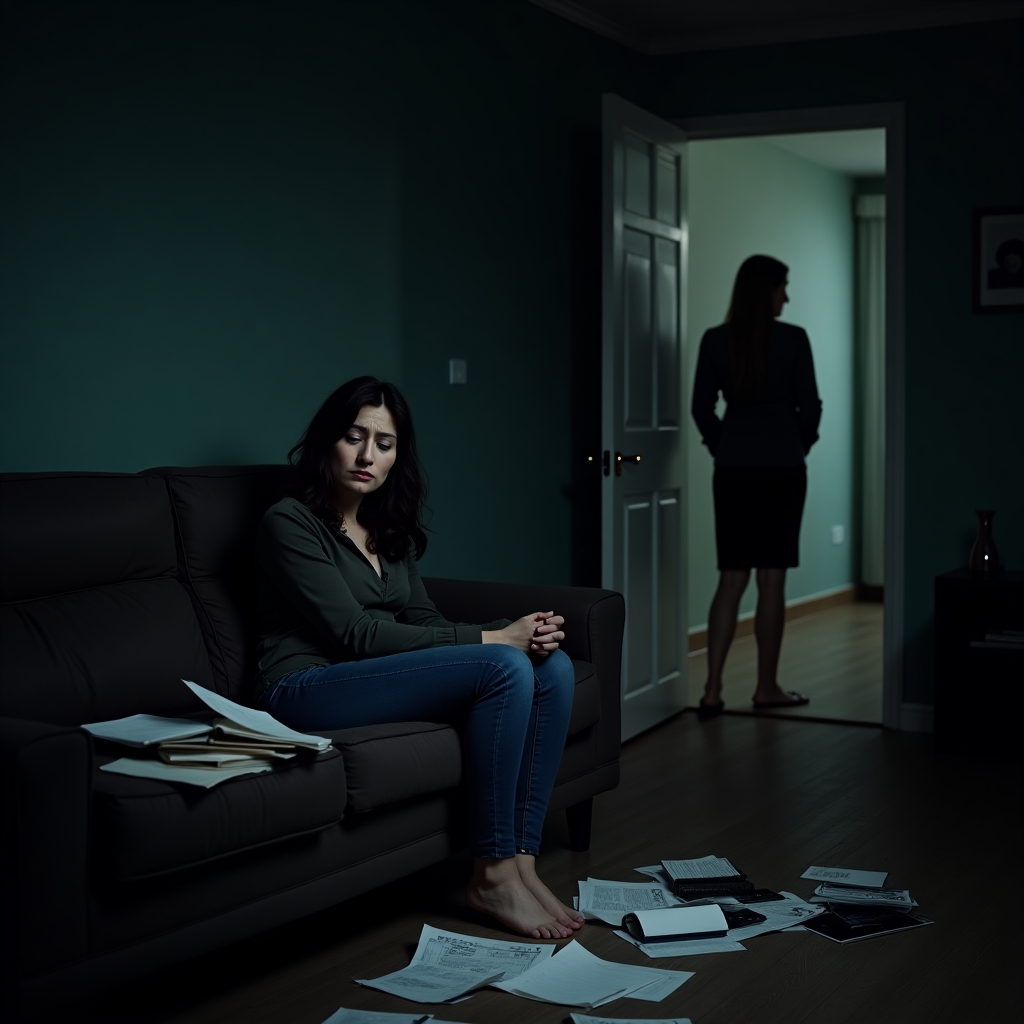
Amelia had always thought herself attuned to the subtle shifts in the emotional landscape around her. A whisper of anxiety in a friend’s voice, a fleeting glance that betrayed a hidden sadness—these were like melodies she could hear in the static of everyday life. Yet, when it came to Jacob, her partner of seven years, she found herself perplexed, standing on the precipice of understanding yet unable to leap forward.
It was a Tuesday evening when the first crack in her certainty appeared. They sat on the sofa, Jacob’s eyes fixed on the soft glow of his phone screen, the blue light casting strange shadows on his face. His laughter, usually a sound that wrapped around her like a comforting blanket, emerged too quickly, as if forced. She dismissed it then, a small sliver of unease that she tucked away neatly, filing it under ‘irrelevant’.
But as the weeks passed, Amelia noticed more of these oddities. The spaces between Jacob’s words seemed to elongate, stretching into silence that felt heavy, pregnant with unsaid things. His stories about work began to mismatch in the retelling, minor details falling apart like threads in a tapestry coming undone.
More than once, she awoke in the night to find herself alone in bed, the place beside her cold. The first time she found him in the living room, he claimed he couldn’t sleep, but the way he looked at her, as if appraising how much she believed, left her unsettled.
Amelia’s once serene mind became a restless sea, her thoughts caught in a whirlpool of suspicion and doubt. She started keeping a journal, noting down these peculiarities, each entry a puzzle piece in a picture she could not yet see.
There were moments when she doubted herself, questioning if she had become the unreliable narrator of her own story. Was she conjuring phantoms out of smoke, or was there truly something lurking in the spaces of their lives together? The uncertainty gnawed at her, a quiet torment.
One evening, as they sat across from each other at dinner, she mentioned a movie she wanted to see. Jacob nodded absentmindedly, his fork poised mid-air. It struck her then, the profoundness of his absence—here, yet not truly present. His eyes, usually warm and engaging, seemed to slide off her, as if she were made of glass.
“Is everything okay?” she asked, her voice a thin thread in the air.
“Yeah,” he replied, too quickly. “Just tired.”
The lies, she realized, were in the gaps—the pauses that lingered too long, the questions answered just a beat too late. She noticed how the music he played when they drove together became unfamiliar, his playlist changing almost overnight to songs he had never liked before.
A month later, her suspicions reached a fever pitch. Jacob’s phone, once left casually on counters and tables, was now always by his side, the screen angled away. Late one night, when he was showering, she picked it up, her heart a drum in her chest.
The messages she found were not what she expected. Conversations with someone named Theo, filled with layers of unspoken tension and a sense of longing. They spoke of meetings, of shared moments and decisions that should have been theirs alone.
When she confronted him, Jacob’s face went through a series of transformations—shock, denial, and finally, a resigned kind of acceptance. He confessed not to an affair of the body but of the soul. Theo was someone from his past, a part of himself he thought he had left behind.
“I didn’t know how to tell you,” he said quietly. “I didn’t want to lie, but I didn’t know how to tell you that I’m not the person you think I am.”
Amelia sat in silence as his words unfurled the truth that stood between them like a shadow. She realized that the betrayal was not in his connection with Theo, but in his withdrawal from her, in letting her believe a version of him that no longer existed.
The truth did not shatter them as she expected; instead, it hung between them, a fragile bridge. She understood now that trust was not just about honesty, but about vulnerability and the willingness to share one’s entire self with another.
With time, they began to rebuild, not on the ashes of what was but on the foundation of a new understanding. Amelia realized that acceptance was an ongoing choice, a journey rather than a destination.
Their story was not tied up neatly, the edges still frayed, but in its incompleteness lay a strange beauty—a testament to the resilience of both the heart and the bond they shared.