



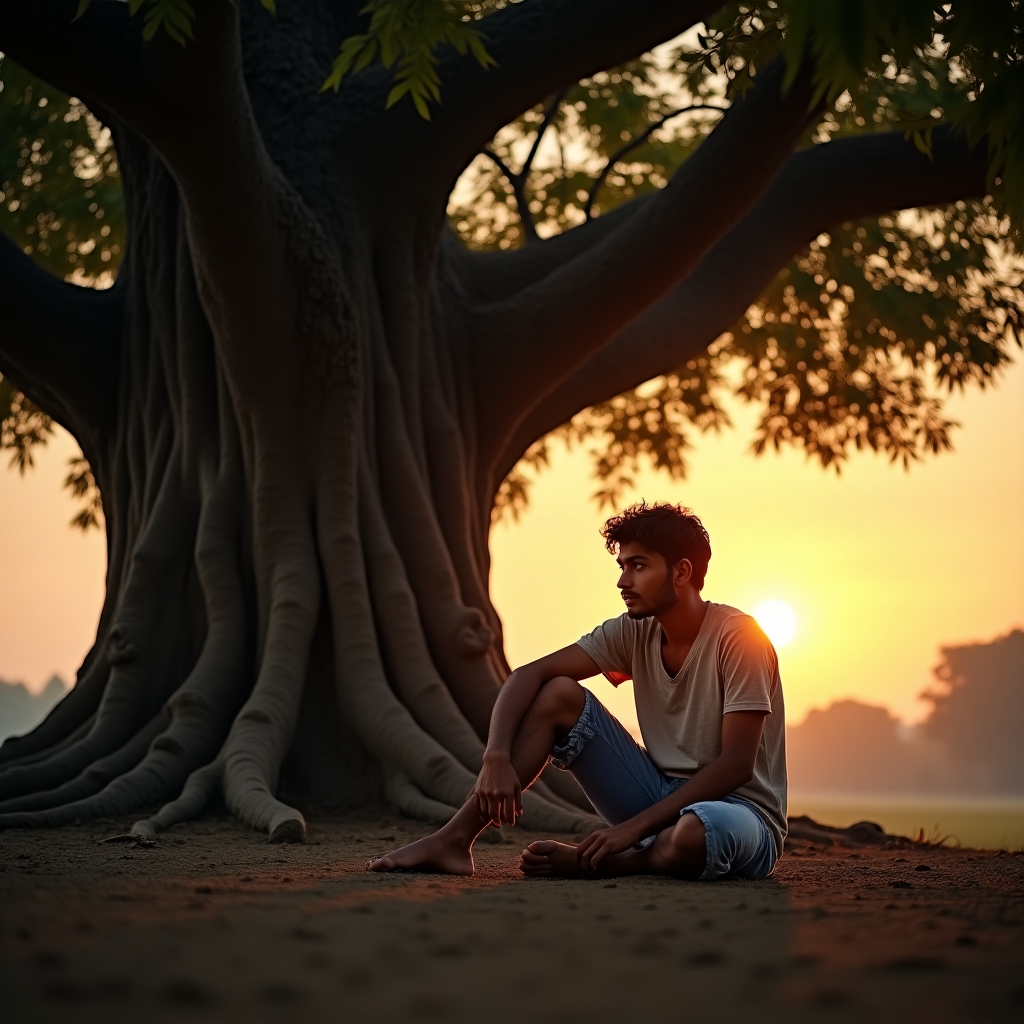
The sun filtered through the thick canopy of the banyan tree, its ancient roots grounded in the same soil where Arjun’s ancestors had once walked. He sat beneath its shade, his back pressed against the cool, rough bark, and listened to the quiet symphony of rustling leaves and chirping birds. The village had always seemed timeless in its simplicity, yet beneath its serene surface, Arjun felt the weight of expectations pressing on him like a heavy stone.
Growing up in this small Indian village meant that Arjun was constantly surrounded by the echoes of tradition. His grandfather, a respected elder, often spoke of duty and honor—principles that were intertwined with every story and every lesson. Arjun admired him deeply, yet he found himself grappling with the path that had been set before him.
His family had expected him to take over the management of their ancestral land—a role his father had fulfilled with dignity. Yet Arjun’s heart yearned for something different, a life beyond the village that had cradled him since birth. He had secretly nurtured dreams of becoming a writer, of capturing the beauty and complexity of his world through words. But such ambitions were deemed frivolous, mere distractions from the responsibilities that awaited him.
The duality of his desires and the family’s expectations weighed heavily on him, manifesting in sleepless nights and days filled with quiet contemplation. He often wandered to the banyan tree, seeking solace and clarity. The whispers of the wind through its leaves seemed to carry the voices of his ancestors, reminding him of the legacy he was meant to uphold.
As months passed, the psychological tension within him grew more pronounced. He attended family gatherings, festivals, and rituals with a polite smile, feeling increasingly detached despite being surrounded by the warmth of his kin. Each evening, he retreated to the quiet of his room, filling pages with stories he feared would never see the light of day.
Amidst this inner turmoil, his closest confidant was Priya, a childhood friend who had always understood the complexities that lay beneath his calm exterior. She listened without judgment as he spoke of his dreams and fears. Her presence was a balm, but even she could not provide the answers he sought.
One late afternoon, as the sky blazed with hues of orange and purple, Arjun found himself again beneath the banyan tree. He watched the shadows lengthen, contemplating the generations who had sought refuge in its shade. He thought of his grandfather, whose stern love was both a comfort and a burden. The legacy, once a source of pride, now felt like chains.
In that still moment, clarity washed over him like a gentle tide. He realized that honoring his family’s legacy did not mean sacrificing his own identity. His stories, though different in form, could be a bridge between tradition and his personal truth. Writing could become a means of preserving his culture, even as he pursued his own path.
With newfound resolve, Arjun rose and walked back to the village. He felt lighter, the weight of expectations loosening as he embraced the possibility of balancing duty and desire. He approached his grandfather the following day, heart pounding but voice steady. He spoke of his dreams, of the stories he longed to share with the world.
To his surprise, his grandfather listened intently. A silence stretched between them, filled with unspoken understanding. Finally, his grandfather nodded, a small smile playing at the corners of his lips. In that moment, Arjun saw a hint of pride and acceptance.
From then on, Arjun’s days were filled with words and stories, interwoven with the teachings of his ancestors. He wrote about his village, the people, and the banyan tree that had been both a witness to and participant in his journey. And as his tales traveled beyond the boundaries of the village, he realized that he had not chosen between personal values and familial expectations. Instead, he had brought them together in a dance as intricate and eternal as life itself.