




In the hushed streets of Willowbend, where the echo of the past lingered like the gentle rustle of leaves, lived a young woman named Maia. Her life swirled within the confines of a tightly-knit community, deeply rooted in traditions that had been passed down through generations. Each custom, each whisper of expectation, was like a thread woven into the intricate tapestry of her existence.
Maia was the daughter of the Tsang family, known for their dedication to cultural preservation. Her parents, Wei and Lin, were revered figures who had dedicated their lives to upholding the values and rituals that defined their heritage. From a young age, Maia had watched them lead the community with grace and authority, their actions always in harmony with the expectations of their ancestors.
Yet, in the quiet corners of her mind, Maia harbored dreams that fluttered like caged birds, yearning for a sky unbound by the weight of tradition. She found solace in painting, an art form that allowed her to express emotions too abstract for words. Her canvases were vibrant with colors and textures, each stroke a testament to her innermost desires.
Her aspirations, however, were often overshadowed by the whispered voices of obligation. The Tsang family expected Maia to follow in their footsteps, to become a torchbearer of their cultural legacy. Her parents envisioned her future as one that mirrored their lives, rooted deeply in the soil of their homeland. The weight of their expectations was both a comfort and a burden, like the gently falling snow that blankets the landscape, beautiful yet suffocating.
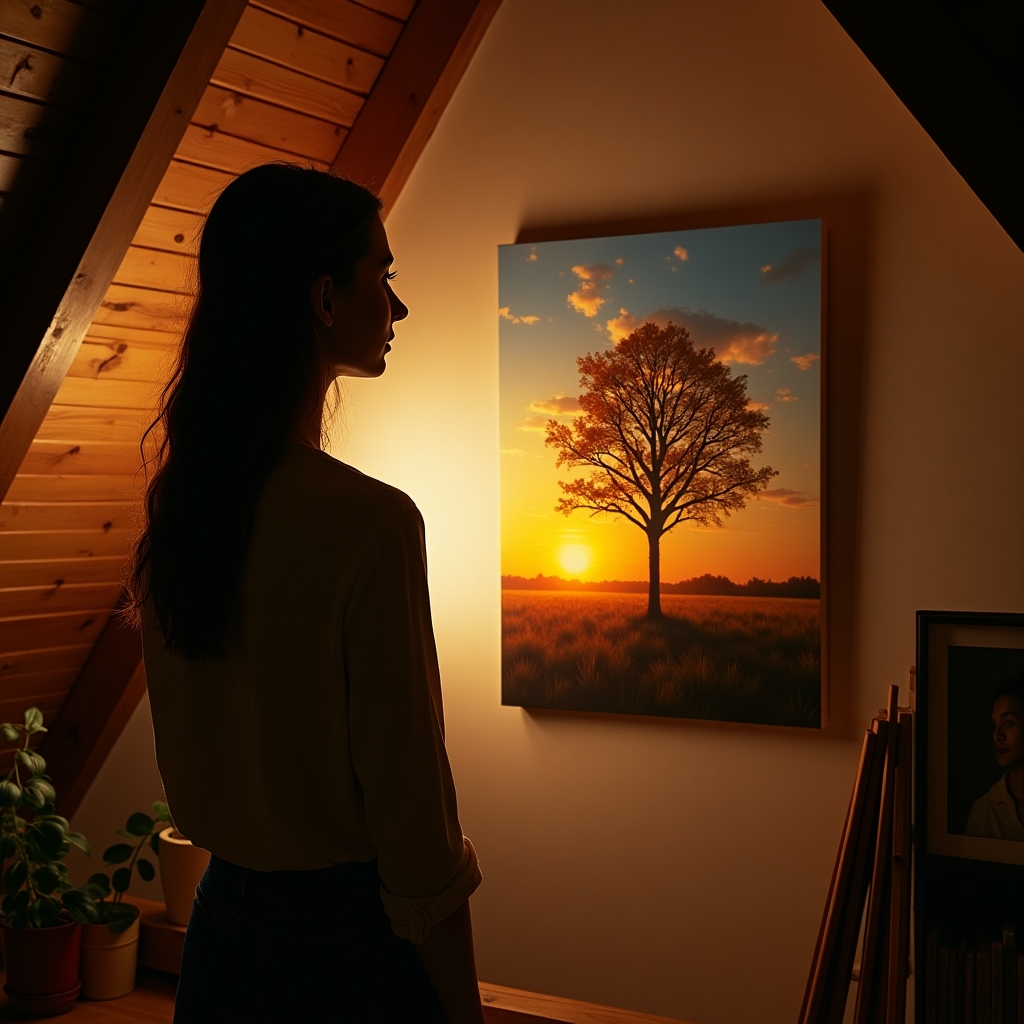
It was in the twilight hours of a summer evening that the disharmony within Maia’s heart reached a crescendo. She sat in her attic studio, surrounded by canvases that seemed to pulsate with life, each one a reflection of the conflict within her. As the golden light of the setting sun filtered through the skylight, bathing the room in ethereal hues, Maia felt the stirrings of a revelation.
The world outside was quiet, the village wrapped in a tranquil hush that mirrored her internal silence. Yet, within her, emotions churned like the turbulent sea—a blend of love and guilt, of loyalty and rebellion. In her mind’s eye, she saw the faces of her ancestors, proud and solemn, their gazes stern yet filled with the compassionate understanding that can only come from shared experience.
It was then, amidst the silent echoes, that Maia felt a shift. A gentle uncoiling, like the first breath of dawn breaking the night’s grip. Her gaze fell upon a painting she had completed months before, a depiction of a tree standing alone in a vast meadow, its branches reaching skyward, unencumbered by the surrounding forest. In that tree, Maia saw herself—rooted yet yearning.
The realization hit her with a quiet clarity: she could honor her family’s traditions while also forging her path. Her love for her heritage did not need to confine her; it could instead be the foundation upon which she built a life true to herself.
The next morning, Maia found herself standing before her parents. The room was filled with the mingled scents of jasmine tea and anticipation, their eyes meeting hers with an intensity that spoke of generations past.
“Baba, Mama,” Maia began, her voice steady yet imbued with the tenderness of her revelation. “I have something to share.”
Wei and Lin listened in silence as Maia spoke of her dreams, her words unraveling the tapestry of tradition to weave in her own colors. She spoke of honoring their legacy through her art, of sharing their stories in a medium that transcended language and time.
Her parents’ initial silence was a tapestry of its own—a weave of surprise, contemplation, and the gentle fraying of old expectations. Yet, within that silence, Maia saw a burgeoning understanding.
As the conversation unfolded, the air between them shifted, nuanced yet profound. Her parents’ acceptance was not immediate, but it was there, growing like a seed planted in fertile soil. The room filled with an unspoken promise of change, of a future where the echoes of the past could harmonize with the dreams of tomorrow.
Maia’s heart swelled with a quiet strength—an emotional courage she had found when she embraced her truth, not as a defiance, but as a tribute to the love and culture that had shaped her. As she stood amidst her family, she realized that true loyalty lay not in blind adherence, but in the courage to be oneself while holding dear the values instilled by those who came before.
In that moment, generational healing began—not with a dramatic clash, but with the gentle acceptance of change and the unyielding bond of love that articulated through understanding.