



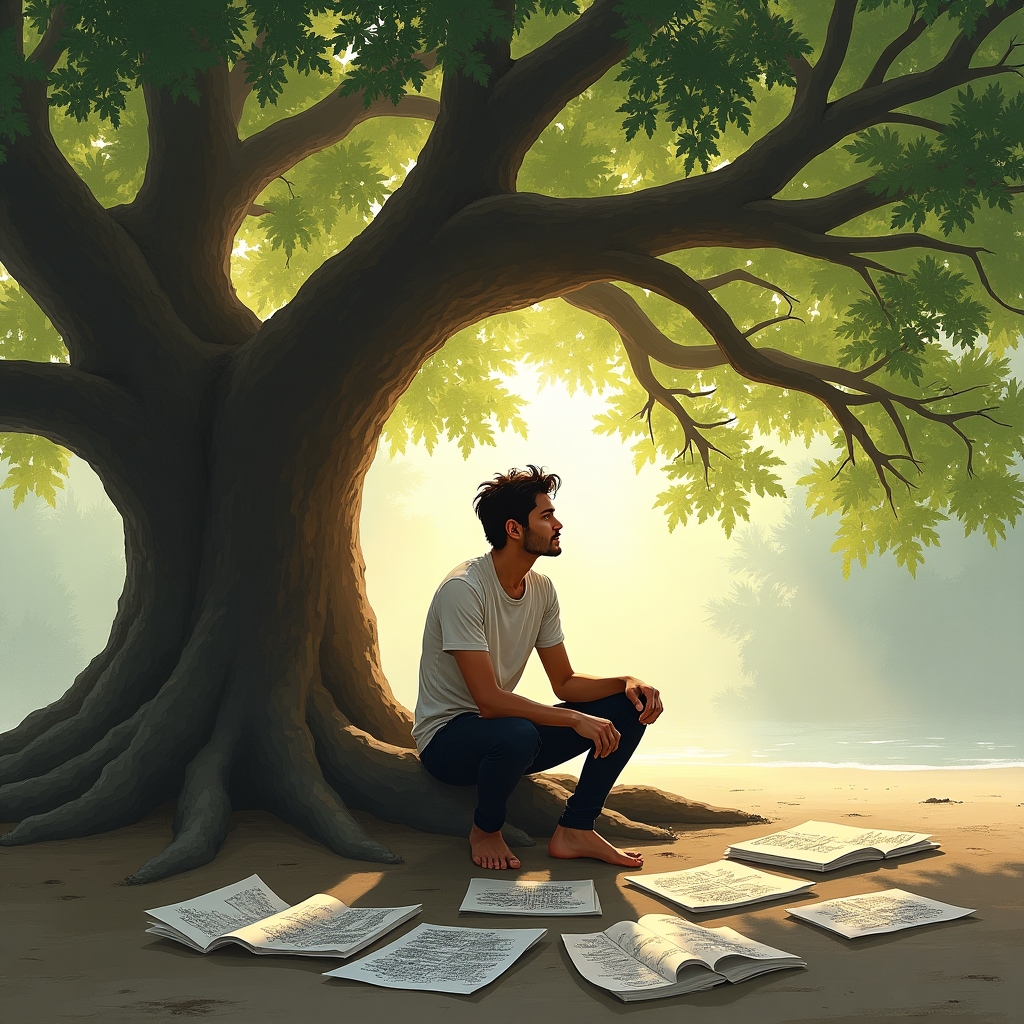
Aarav sat on the creaky swing, his feet barely grazing the green carpet of lawn beneath him, the air fragrant with the scent of blooming jasmine. The giant banyan tree in his grandmother’s garden loomed over like an ancient guardian. Its branches, sprawling and gnarled, seemed to whisper the secrets of generations past. It was here that Aarav felt the weight of his familial legacy most acutely.
Growing up in an Indian household in the heart of Delhi, Aarav had been taught the importance of tradition and the family’s honor. His parents, both academics at a prestigious university, held high expectations for him. They had charted a path that seemed non-negotiable—medical school, a reputable career, and a life that mirrored the stability and success they had cultivated. Yet, Aarav’s heart yearned for something different.
In moments of solitude, Aarav would retreat to his room, where he sketched the world as he saw it—vivid, colorful, and endlessly expressive. The need to create art was a fire within him, one that both illuminated and scorched. He dreamt of being an artist, of painting stories that connected humanity in ways words often failed. But how could he voice this desire without fracturing the expectations carefully laid upon him?
His mother, Meera, often spoke of their ancestors with reverence, weaving tales of their sacrifices and achievements at the dinner table. “We stand on the shoulders of those who came before us,” she would say, her voice a mixture of pride and responsibility. Aarav understood her devotion and respected it deeply, but felt increasingly suffocated by it.
One evening, as the monsoon rains drummed a relentless rhythm on the roof, Aarav joined his parents in the living room. They sat together, the room dimly lit by the soft glow of a single lamp, casting shadows that danced across their faces. The discussion turned, as it often did, to his future. His father, Rajesh, spoke with unwavering certainty about the benefits of a medical career, while Aarav nodded absently, lost in his own thoughts.
“Aarav, are you listening?” Rajesh’s voice cut through the haze.
“Yes, Papa,” Aarav replied, his voice even, betraying none of the turmoil inside.
“Good,” Rajesh said. “We only want what’s best for you.”
Aarav nodded again, yet inside, his heart ached. Torn between his love for his parents and the longing to pursue his art, he found himself trapped in an invisible cage of expectations. He sought solace in the banyan tree, where he often sat, hoping the whispers of the past might offer him some guidance.
Days turned into weeks, and Aarav’s internal struggle deepened. He became increasingly introspective, observing his parents’ interactions, their dreams and the sacrifices they made. He admired their dedication but felt a growing need to assert his own path.
One afternoon, while sitting beneath the banyan tree, Aarav experienced a moment of clarity. The sun filtered through the leaves, creating a dappled tapestry of light and shadow. As he sketched the scene before him, Aarav suddenly understood the quiet strength within him—the strength to honor his parents while also honoring himself.
In that moment, he realized that carrying forward a legacy didn’t mean living the same life as those who came before. It meant taking the essence of their sacrifices and courage, and transforming it into something new—something uniquely his own.
Armed with this newfound clarity, Aarav approached his parents one evening. The air was thick with the remnants of the day’s heat as he sat across from them.
“Mama, Papa,” Aarav began, his voice steady but soft, “I need to talk to you about something important.”
He spoke about his passion for art, the way it made him feel alive, and how he wished to pursue it seriously. The room was silent as his parents absorbed his words, their expressions shifting from surprise to contemplation.
“Aarav,” Meera finally said, her voice tender yet firm, “we only want what’s best for you, but we also want you to be happy.”
Rajesh nodded, adding, “Your happiness matters to us, Aarav. If this is truly your path, we will support you.”
In that quiet exchange, Aarav felt the invisible chains of expectation begin to loosen. His parents, bound by their love for him, made room for his dreams, even if those dreams diverged from their own.
As Aarav lay in bed that night, he thought of the banyan tree, its roots deep and its branches wide, embracing the sky. He realized that in asserting his truth, he was not alone but supported by the very legacy that had once felt burdensome. His journey was not a rejection of his past but a continuation of its spirit in a new, vibrant form.
And so, Aarav embarked on his path, knowing that while the whispers of the banyan tree would always be there to guide him, he had found his own voice within their echoes.